Editorial: We should commit to keeping data centers away from our water
Published 1:30 am Saturday, June 6, 2026
OUR TAKE
When Herald writer Taylor Scott Richmond reported on a development company’s request to Snohomish County Public Utility District for a peak demand load of 9.5 megawatts, residents quickly voiced their concerns that the proposed project may be a data center.
An approximately 1.2 million-square-foot project, currently known as Project Cascade, is proposed for the Cascade Industrial Center. Despite assurances from Arlington Mayor Don Vanney that the project is not a data center, skepticism remains among many.
The public’s concern prompted Amazon to announce in a press release its plan to build on the site and that Project Cascade would “support customer delivery in the Central and North Puget Sound area.”
Residents’ concerns were understandable due to the large anticipated need for power. A request for 9.5 megawatts points toward a very power-hungry facility. It would conceivably be enough electricity to power a large manufacturing plant, a large cold storage warehouse, a charging hub for an entire fleet of EV vehicles, a university campus or a regional theme park. It’s no wonder that fears of a possible data center grew quickly.
A negative attitude toward the building of data centers — which are used to power artificial intelligence as well as networking, processing and storing data for a wide range of applications — is not unique to Snohomish County. Resistance to data centers has grown in recent years due to the realization of what they demand in power and water while occupying large parcels of land and creating more noise pollution than jobs. The jobs factor is compounded when you consider that the artificial intelligence made possible by these data centers has the potential to eliminate many more jobs than it creates.
Project Cascade is estimated to use around 44,000 gallons a day, which supports Vanney’s assurances that it would not be a data center. Large data centers can consume up to 5 million gallons of water each day.
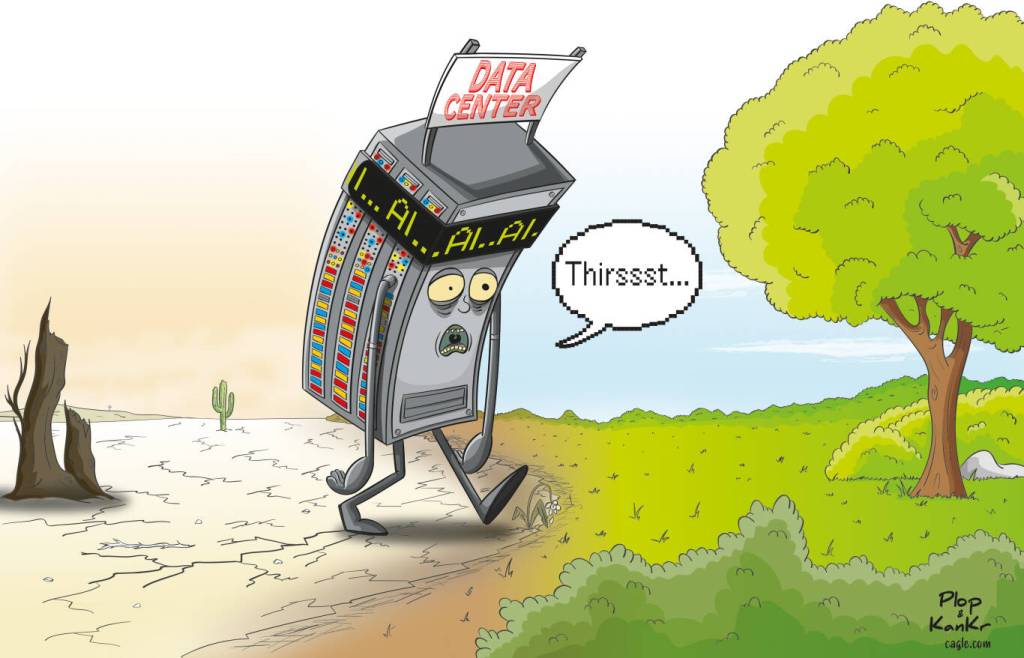
That scale of water usage would rightly concern everyone living in Washington state, which has been in a drought for the last four years with historically low snowpack. According to the Washington State Climate Office, as of April 1, statewide snowpack was at 53% of the median — lower than 95% of all years we have records for.
At a Snohomish County PUD Board meeting on May 5, Arlington resident Julie Winchell expressed her concern about the amount of water data centers use.
“Approving contracts to supply enormous amounts of water to any business seems risky at the least and, at the worst, really foolhardy in today’s environment, given climate change with water becoming scarcer,” she said. “This is not the time to inflict any more stress on the area’s lakes, rivers and aquifers.”
Project Cascade may not be a data center, but residents’ bristling at even the idea that someone would be allowed to build a data center anywhere in Snohomish County is the appropriate reaction. As water resources become increasingly scarce and the power demands only grow, a data center would take much and give back very little.
Like Camano Island resident Mary O’Farrell said at that same meeting, data centers are “not the economic vitality our communities want or need … Hyperscale data centers will destabilize scarce water, power, land and other well-known impacts while employing few people after construction.”
I agree with Mary and Julie. People are going to need their water and power much more than they will need AI.
Some of our Puget Sound neighbors must agree as well.
Seattle and Skagit County have both proposed moratoriums on new data centers to stop the rush to build these resource vacuums seen across the nation in recent months due to the AI boom.
On June 1, the Skagit County Board of Commissioners announced its adoption of a temporary moratorium on new data centers in the rural areas outside of incorporated cities and towns in the county.
“The Skagit Valley is subject to large floods, volcanic lahar, and other major natural risk, and summertime water limitations mean that Skagit farmers already have a hard time getting the water they need,” Skagit County Commissioner Peter Browning said in the press release. “As we contemplate the possibility of data centers in our community, we have a duty to recognize and respond to the limitations that nature imposes.”
Snohomish County and all of the incorporated cities and towns within its boundaries should take note and adopt their own moratoriums or, even better, outright bans.
The Herald Editorial Board represents the voice of The Daily Herald. It operates independently from the newsroom, ensuring a strict separation between opinion and news reporting. Board members shape positions on community matters, politics, and civic policy. We welcome diverse perspectives from our readers. Submit a letter to the editor at letters@heraldnet.com (limit 250 words) or read our full submission guidelines at heraldnet.com.