Gleaners find that reaping the leftovers saves a lot of money
Published 9:00 pm Saturday, November 24, 2001
By Theresa Goffredo
Herald Writer
MARYSVILLE — It was a quick trip from Jean Ramdolson’s trailer across the parking lot to the community room at Pilchuck Apartments to pick up some rolls and a few pastries.
At 75 and ambulating on two artificial hips, Ramdolson tries to be 30 on her feet.
"I can’t pack a lot of stuff home anymore when I go to the store," the petite Ramdolson said.
| Gleaning statistics
|
So every Monday, Ramdolson and other seniors who live at the Pilchuck Apartments on Grove Street take advantage of the free bread, rolls and other goodies dropped off by volunteers of the Evergreen Gleaning Association.
Not only do these deliveries cut down on trips to the store, the gifts of food ensure that seniors won’t go hungry.
"A lot are so close in their income that sometimes it’s either food or medicine, and this really helps," said Betty Stejer, manager for Meadow Park Apartments, another drop on the gleaners’ circuit.
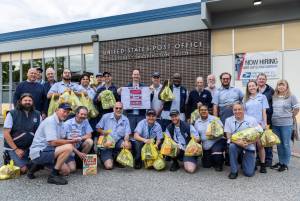
And giving to seniors is just one of the ways the Marysville team of gleaners, and the Gleaning Association in general, share their bounty with the community and, in doing so, cut down on waste.
The idea of gleaning had its origins 6,000 years ago as an honorable way of neighbor helping neighbor when groups would gather in farmers’ fields after harvest and collect what was left behind by the reapers.
Today, gleaners still clean the fields. But as those fields have been paved over for shopping centers and subdivisions, the gleaners have had to branch out for food to commercial sites, such as grocery stores and wholesalers.
| What is a gleaner?
The tradition of gleaning began 6,000 years ago when groups gathered in farmers’ fields after harvest to collect what was left behind by the reapers. Modern-day gleaners in Snohomish County collect: |
Gleaners now take leftover produce and fruit from Safeway, QFC, Fred Meyer and Haggen, and get pies and other items from Costco. They also glean hatchery salmon from American Indian tribes, and receive donated books and clothing. The Marysville team recently received a big green dumpster from Snohomish County Waste Management to be used as a compost bin.
All the donations and gleanings go first to the Evergreen Gleaning Association members, who number about 1,000 from Skagit County to Pierce County. The Marysville team serves 96 families and more than 300 children.
Gleaners pay an annual membership fee of $35 — unless they can’t afford it — to cover insurance, a newsletter, postage and administrative costs. Also, members must volunteer five hours a week, delivering, picking up or sorting food.
If there’s too much food and other items for the gleaners to use, they offer their abundance to local seniors and service organizations such as the Salvation Army, and even give books to the Navy.
If food isn’t fresh enough for humans to eat, the gleaners use it to feed pigs and cows.
"We’re like an ant hill — we all benefit from the job everybody does," president Susan Goldsmith said.
Evergreen Gleaning Association serves a special niche, the working poor, said Goldsmith, who has been a gleaner for eight years and got involved because she wanted to stay home and raise her three boys instead of working.
"It was really important to me when they were babies to give them the values I wanted them to have," Goldsmith said.
The association recently surveyed members and found that about 80 percent were single-income households with annual earnings of between $20,000 and $30,000.
"We’re filling a niche in society that nobody out there is doing," said Goldsmith, whose grocery bill went from $250 a week to $300 a month after she joined the group..
In Marysville, Alice Thomas is the manager for the Snohomish North team of the Evergreen Gleaning Association. Recently, that team received a $2,000 grant from the city’s human services fund to help pay the rent on a new site for the Marysville team, getting them out of a residential neighborhood and into a commercial area.
Since joining the association, Thomas said her family’s food bill has dropped from $600 a month to $100 a month.
She said the savings allow her to "pay another bill." But she also likes the opportunity of giving back. So does her mother, Evelyn Weiser, who helps Thomas with weekly food drop-offs to seniors.
"When I first started, I was going home every day crying because I knew I was helping," Weiser said.
You can call Herald Writer Theresa Goffredo at 425-339-3097
or send e-mail to goffredo@heraldnet.com.