Starwatch: There’s super hype about Monday night’s full moon
Published 1:30 am Sunday, November 13, 2016
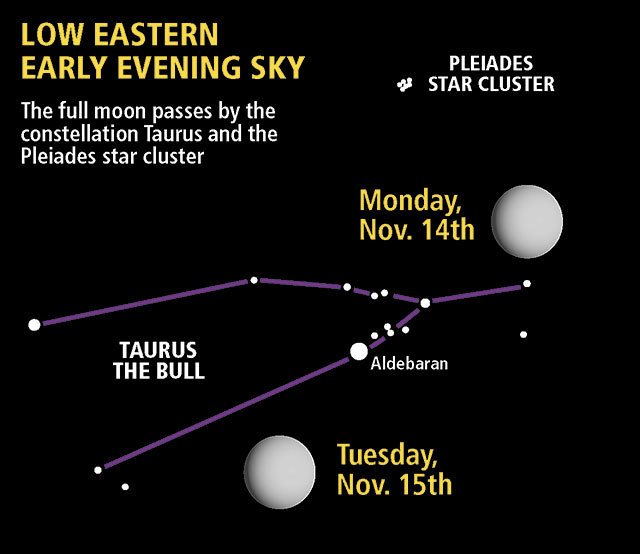
No doubt you’ve heard there will be “super moon” Monday. It’s a term that I didn’t know until a few years ago.
It’s not an astronomical term, but rather an astrological one dreamed up by Richard Nolle, a famous astrologer. (Astronomy is a real science and astrology isn’t. That’s as much as I’ll badmouth astrology, at least for now.)
Nolle arbitrarily declared that any full moon that’s within 224,641 miles of the Earth is a super moon. Electronic media fell in love with the term. This year we’re having three super moons, but the one Monday is super duper — not only is it the closest and largest in 2016, but it’s also the closest and largest full moon since 1948.
Every 27.3 days the moon makes one complete orbit around the Earth. The moon has no light of its own, but merely reflects the sun’s light. The changing angle between the moon, Earth, and the sun is what causes the moon to go through its cycle of phase changes.
Full moons occur when the Earth lies roughly in a line between the sun and moon, and the moon is fully bathed in the sun’s light. What gives rise to the super moon is that the moon’s orbit around the Earth’s orbit is not a perfect circle, but a little oval-ish. That means the moon’s distance from Earth varies more than 25,000 miles in the course of its circuit. Every month the moon’s farthest distance from the Earth, dubbed apogee, is over 250,000 miles. The closest distance, perigee, is a little over 221,524 miles.
The full moon this week only is 221,541 miles from Earth, just 17 miles farther than perigee.
When the moon is rising at 5:16 p.m. Monday it’ll look a lot bigger than the average full moon, but that’s just an illusion. The moon and sun always seem much larger when they rise and set. This optical illusion is caused by our eyes and brains comparing celestial bodies with land objects.
The closest full moon since 1948 will have a definite physical effect on Earth, however. Tides will be a little higher than they usually are during an average full moon because of the increased gravitational pull of the closer moon. It’s said that the full moon can make people a little crazy, and maybe because it’s closer and has a slightly stronger pull it may have a greater effect. More likely it’s the power of that suggestion that may make folks a little more crazy.
Any full moon does a great job of scouring the night sky with natural light, so serious stargazing is pretty much shot down.
You can certainly look at the full moon through your telescope, but I have to warn you that it can be so bright it could sting your eyes a bit. You may still see a bright disk in your eye for several seconds afterward, similar to what happens if someone uses flash when they take a photo of you.
The easiest way to avoid that is to wear sunglasses when you look at the moon through your telescope. I’m not kidding — it works. Even with that, full moons aren’t all that great to view through a telescope.
You can see the contrast between dark lunar plains, larger craters, and the whiter highlands, but without any shadows you can’t see a whole lot of details.
I think the best thing to do with our super-duper moon this month is to take a walk under it and soak in its light.