Everett grad students propose vacancy tax for large retailers
Published 1:30 am Thursday, May 14, 2026
EVERETT — A group of master’s students proposed a vacancy tax to prevent shuttered big box stores from sitting empty for years, the students said in a community meeting Friday.
The five students — Anneke Beach-Garcia, Bethany Carlson, Kat Chin, Spencer Jones and Claire Turner — are graduate students from Eastern Washington University, studying social work out of the Washington State University Everett campus. Their proposal for the Everett City Council, which has not yet formally considered the tax, would create significant costs for companies that leave large storefronts vacant for more than 18 months.
In a small Friday meeting attended by roughly a half-dozen community members, including city council members Paula Rhyne and Luis Burbano, the students discussed their proposal and sought guidance about how to refine it in a way that would achieve their stated goal: activating unused retail space.
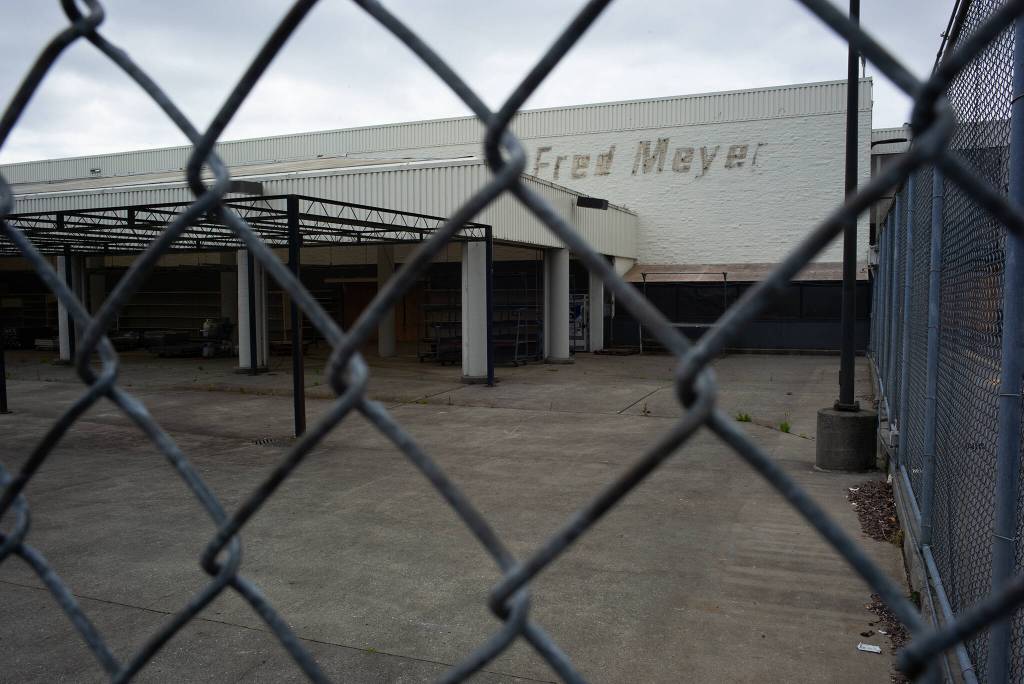
The proposal is largely in response to Kroger’s October 2025 closure of a Fred Meyer store in the Casino Road neighborhood in south Everett. The grocer cited “a steady rise in theft and a challenging regulatory environment” as reasons for the closure, though Everett police stated that reports of shoplifting at the store declined significantly in recent years.
The closure impacted a diverse, lower-income neighborhood that has lower rates of car ownership, leaving it without a crucial grocery option that had been in the community since the mid 1970’s. It drew a formal rebuke from the Everett City Council, which called the closure “an act of corporate neglect.”
The site of the former Fred Meyer remains vacant.
The group hopes to amend a city law currently on the books that, if it were enforced, would fine companies or landlords that leave storefronts vacant for years at a time.
But that law, as it stands, isn’t enforced, according to the city, due to the staff time needed to track vacant properties across Everett. And the fines that law would levy against property owners or businesses — a maximum of $1,000 per year — are paltry sums for the grocery giant or the nationwide real estate company that owns the site of the former Fred Meyer.
Without a vacancy tax to incentivize finding a new tenant to fill the site, companies may find it easier — and cheaper — to sit on their lease rather than finding a new business to occupy the empty space, the students argued.
“We wouldn’t be looking at it if it didn’t exist. We’re not trying to reinvent the wheel,” Beach-Garcia said of the city’s existing vacancy tax. “But how can we modify that so it is a benefit to the community and can make a positive impact? Not just to pay the admin fees, but actually serve the community in which those vacancies exist to rotate and make change.”
The city’s current vacancy tax is “defunct,” said Dan Eernissee, the city of Everett’s economic development director, in an interview Wednesday. When the code was adopted in 2009, the city hired an employee to develop a registry and track ownership, but once they left the role, that position wasn’t backfilled, city staffer Jennifer Gregerson said at an October 2025 committee meeting.
“I think at the time we were maybe overly ambitious and underestimated how much staff time it would take to actually enforce that,” City Attorney David Hall said at the committee meeting. “And I think that’s why it fell by the wayside.”
Under the students’ initial proposal, the vacancy tax would apply to stores larger than 10,000 square feet, and charges would begin if a property remained vacant for over 18 months. The amount of the tax would be calculated based on the square footage of the property, roughly $10.4 for every square foot.
The tax levied on the Fred Meyer location, if the initial proposal went into effect today, would amount to about $1.9 million per year, money that would go toward community improvement projects.
That sum is far from paltry. But the students argued that in the corporate world, money talks, and if there isn’t a financial incentive for the company to make a change, they would retain the status quo.
“How do we get their attention to hold them accountable?” Turner said. “I think that’s what we’re trying to address. It seems like, if they’re only interested in the dollars, do we do that with money?”
The 173,000-square-foot grocery store in question was built in 1975, according to Snohomish County property records. The property is owned by a Florida-based real estate company, Benderson Development, which purchased the land in 2021 for about $23 million. The company did not respond to an email with questions about the future use of the land.
A real estate firm is currently looking to sublease the property to another tenant, according to a listing posted by Bellevue-based Leibshon & Company. Fred Meyer’s existing lease lasts until 2046, according to a document published by the real estate company. A representative from Leibshon & Company did not respond to an email seeking comment.
When it comes to filling vacant retail spaces, the city of Everett plays a supportive role in the property owners’ efforts, Eernissee said.
“This Fred Meyer closure property, that’s probably 100 plus million dollars of investment that would flow into Everett for that to get filled,” he said. “My job is to tell stories that attract that investment.”
While vacant retail spaces have negative economic impacts, such as the loss of sales tax and jobs, the empty spaces can also create room for growth, Eernissee said Wednesday.
“If you don’t have any vacant property, new services and new entrepreneurs and new kinds of things don’t have any room to penetrate a market,” he said.
In the absence of the big-box retailers, local grocery stores fill in the gaps left behind, Eernissee said. One grocery store, Los Gavilanes, located on Casino Road north of the shuttered Fred Meyer, began expanding its services to offer products previously carried by the supermarket chain.
“Those smaller grocery stores fill a really, really important niche,” he said. “And are really much more community-connected.”
In committee meetings last year, some council members had previously floated the possibility of implementing taxes or fees on the owners or tenants of empty businesses, as a way to mitigate the length of time commercial properties stay vacant. They also suggested other ideas like implementing a land value tax, which levies taxes on land rather than the improvements on it, in order to incentivize putting land to productive use. None of those ideas have yet come forward in the form of legislation.
During the Friday meeting, council member Luis Burbano argued that Everett should do more work to revitalize the neighborhood — an intersection of wide streets that is in need of significant traffic safety improvements, according to the city’s Vision Zero plan — before creating new taxes for businesses.
“We can design our cities to be failure-proof, right?” Burbano said. “We cannot rely on one grocery store. We can design bicycle lanes, we can design smaller shopping centers that can cover for the grocery store if the grocery store leaves. It’s something to think about, how can we be more proactive and do something before something bad happens?”
Burbano said, however, that if the proposal makes it to the city council, he would support it because it would push the city government and large businesses to address the problems of vacant spaces.
Paula Rhyne, the city council vice president, said the students’ proposal was worth considering, and that “it could be refined or maybe divvied up in certain ways, but I do think that the (existing) fine is out of date,” she said.
“When a 15-year lease is less expensive than offloading the property, or $1,000 penalties, they’re not going to move, and the property owner isn’t going to budge unless it’s too expensive for them to stay,” Rhyne said.
The students said they hoped to develop their proposal further through more conversations with community members and city lawmakers.
“We would like to see some sort of change to the code so that it benefits the community,” Chin said. “We’re not trying to look at it in a punitive manner, but if you’re just going to sit on a property, let’s find a way that the money can be funneled back to support the community and help with the revitalization that we are all wanting.”
Will Geschke: 425-339-3443; william.geschke@heraldnet.com; X: @willgeschke.
Jenna Millikan: 425-339-3035; jenna.millikan@heraldnet.com; X: @JennaMillikan