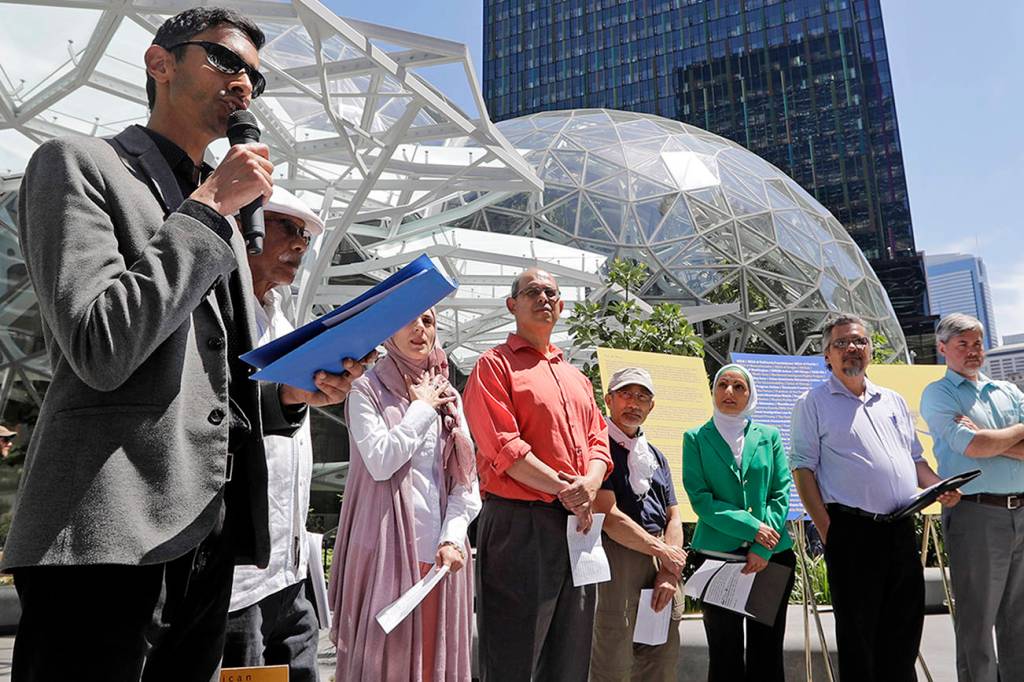
Shankar Narayan, legislative director of the ACLU of Washington (left), speaks at a news conference outside Amazon headquarters on June 18 in Seattle. Representatives of community-based organizations urged Amazon to stop selling its face surveillance system, Rekognition, to the government. They later delivered the petitions to Amazon. (AP Photo/Elaine Thompson)

Shankar Narayan, legislative director of the ACLU of Washington (left), speaks at a news conference outside Amazon headquarters on June 18 in Seattle. Representatives of community-based organizations urged Amazon to stop selling its face surveillance system, Rekognition, to the government. They later delivered the petitions to Amazon. (AP Photo/Elaine Thompson)

Orlando police quit using Amazon’s facial recognition tech

Civil rights groups say the tool will disproportionately target vulnerable minority communities.

  • Hamza Shaban The Washington Post
  • Tuesday, June 26, 2018 12:08pm
  • Business

By Hamza Shaban / The Washington Post

A Florida police department said that it would not immediately renew a pilot program with Amazon.com for controversial facial recognition technology, a decision that civil rights advocates claimed as a victory.

Orlando had deployed software, known as Rekognition, in five cameras at police headquarters and three cameras downtown during a six-month trial period.

“The City of Orlando is always looking for new solutions to further our ability to keep our residents and visitors safe,” the city of Orlando and the Orlando Police Department said in a joint statement Monday. “Partnering with innovative companies to test new technology – while also ensuring we uphold privacy laws and in no way violate the rights of others – is critical to us as we work to further keep our community safe.”

The existence of the pilot program was first revealed last month, when the American Civil Liberties Union published documents detailing Amazon’s sale of powerful facial recognition tools to several law enforcement agencies, including the Orlando police and Washington County, Oregon. The ACLU’s investigation sparked a public backlash, with a coalition of civil rights groups arguing that such tools will be used to disproportionately target vulnerable minority communities.

On Monday, the ACLU Foundation of Florida and a host of civil society groups called on City of Orlando Chief of Police John Mina to renounce the use of facial recognition technology as a law enforcement tool. In response, Orlando said that the pilot program had already expired last week. Orlando officials did say, however, that no decision has been made whether to continue the pilot in the future.

Amazon did not respond to requests for comment. (Amazon chief executive Jeff Bezos owns The Washington Post.)

Matt Cagle, a technology and civil liberties attorney at the ACLU of California who co-authored the investigative report on Amazon, said that people in Orlando and around the country don’t want face surveillance technology used in their communities. “While the city of Orlando is taking the right step by not renewing its contract for Amazon’s face surveillance technology, Orlando must listen to its community members and publicly commit to not using the dangerous technology – now or in the future,” he said.

Highlighting the reservations people have with the normalization of biometric surveillance in American life, Brian Brackeen, the chief executive of the facial recognition technology company Kairos, said Monday that he would not sell his tools to law enforcement agencies, and neither should anyone else. Brackeen, who is black, said in an essay on Techcrunch that facial recogntition technology contains biases against people of color and can be used to dehumanize entire populations.

“In a social climate wracked with protests and angst around disproportionate prison populations and police misconduct, engaging software that is clearly not ready for civil use in law enforcement activities does not serve citizens, and will only lead to further unrest,” he wrote. “Whether or not you believe government surveillance is okay, using commercial facial recognition in law enforcement is irresponsible and dangerous.”

Orlando’s announcement arrives as employees at Google, Microsoft, and Amazon have protested against their companies’ tech partnerships with government agencies. Last week, workers at Amazon began circulating an internal email calling on Bezos to cut the company’s business ties with (ICE), and to end the sale of facial recognition tech to law enforcement agencies. “Our company should not be in the surveillance business; we should not be in the policing business; we should not be in the business of supporting those who monitor and oppress marginalized populations,” the email stated.

Similar efforts have already prompted policy changes at Google. After a slew of resignations and outcry over an artificial intelligence contract with the Pentagon, officials at the company said the deal would not be renewed and that Google will bar the development of AI that can be used in weapons. Microsoft’s chief executive was also pressured to answer internal criticism over the company’s contract with ICE. After employees there called for the end of $20 million contract, chief executive Satya Nadella tried to reassure workers at Microsoft that the company’s business with ICE was unrelated to the Trump administration policy of separating migrant children from their families at the U.S.-Mexico border.


Talk to us

> Give us your news tips.

> Send us a letter to the editor.

> More Herald contact information.

More in Business

Lynnwood Police Officers AJ Burke and Maryam McDonald with the Community Health and Safety Section Outreach team and City of Lynnwood’s Business Development Program Manager Simreet Dhaliwal Gill walk to different businesses in Alderwood Plaza on Wednesday, June 25, 2025 in Lynnwood, Washington. (Olivia Vanni / The Herald)
Lynnwood advocate helps small businesses grow

As Business Development Program Manager for the city of Lynnwood, Dhaliwal Gill is an ally of local business owners.

Kelsey Olson, the owner of the Rustic Cork Wine Bar, is introduced by Port of Everett Executive Director Lisa Lefebar on Dec. 2, 2025 in Everett, Washington. (Olivia Vanni / The Herald)
Rustic Cork Wine Bar opens its doors at the Port of Everett

It’s the first of five new restaurants opening on the waterfront, which is becoming a hotspot for diners.

Wide Shoes owner Dominic Ahn outside of his store along 205th Street on Nov. 20, 2025 in Edmonds, Washington. (Olivia Vanni / The Herald)
Edmonds shoe store specializes in wide feet

Only 10% of the population have wide feet. Dominic Ahn is here to help them.

Penny Clark, owner of Travel Time of Everett Inc., at her home office on Nov. 21, 2025 in Arlington, Washington. (Olivia Vanni / The Herald)
Arlington-based travel agency has been in business for 36 years

In the age of instant Internet travel booking, Penny Clark runs a thriving business from her home office in suburban Arlington.

Lily Lamoureux stacks Weebly Funko toys in preparation for Funko Friday at Funko Field in Everett on July 12, 2019.  Kevin Clark / The Herald)
Everett-based Funko: ‘Serious doubt’ it can continue without new owner or funding

The company made the statements during required filings to the SEC. Even so, its new CEO outlined his plan for a turnaround.

Sound Sports Performance & Training owner Frederick Brooks inside his current location on Oct. 30, 2025 in Lynnwood, Washington. (Olivia Vanni / The Herald)
Lynnwood gym moves to the ground floor of Triton Court

Expansion doubles the space of Sound Sports and Training as owner Frederick Brooks looks to train more trainers.

A runner jogs past construction in the Port of Everett’s Millwright District on Tuesday, July 15, 2025 in Everett, Washington. (Olivia Vanni / The Herald)
Port of Everett finalizes ‘conservative’ 2026 budget

Officials point to fallout from tariffs as a factor in budget decisions.

The Verdant Health Commission holds a meeting on Oct. 22, 2025 in Lynnwood, Washington. (Olivia Vanni / The Herald)
Verdant Health Commission to increase funding

Community Health organizations and food banks are funded by Swedish hospital rent.

The entrance to EvergreenHealth Monroe on Monday, April 1, 2019 in Monroe, Wash. (Andy Bronson / The Herald)
EvergreenHealth Monroe buys medical office building

The purchase is the first part of a hospital expansion.

The new T&T Supermarket set to open in November on Oct. 20, 2025 in Lynnwood, Washington. (Olivia Vanni / The Herald)
TT Supermarket sets Nov. 13 opening date in Lynnwood

The new store will be only the second in the U.S. for the Canadian-based supermarket and Asian grocery.

Judi Ramsey, owner of Artisans, inside her business on Sept. 22, 2025 in Everett, Washington. (Olivia Vanni / The Herald)
Artisans PNW allows public to buy works of 100 artists

Combo coffee, art gallery, bookshop aims to build business in Everett.

The Port of Everett’s new Director of Seaport Operations Tim Ryker on Oct. 14, 2025 in Everett, Washington. (Olivia Vanni / The Herald)
Port of Everett names new chief of seaport operations

Tim Ryker replaced longtime Chief Operating Officer Carl Wollebek, who retired.

Support local journalism

If you value local news, make a gift now to support the trusted journalism you get in The Daily Herald. Donations processed in this system are not tax deductible.