Starbucks, home of the $4 latte, is moving into poor areas
Published 1:30 am Thursday, January 16, 2020


By Dee-Ann Durbin / Associated Press
DETROIT — Starbucks has a point to prove: There’s more to the company than selling $4 lattes to rich people.
The Seattle-based coffee giant that has cultivated a reputation for being socially responsible said Thursday it is expanding its effort to put more coffee shops — and create more jobs — in poor neighborhoods.
Starbucks plans to open or remodel 85 stores by 2025 in rural and urban communities across the U.S. Each store will hire local staff, including construction crews and artists, and will have community event spaces. The company will also work with local United Way chapters to develop programs at each shop, such as youth job training classes and mentoring.
The effort will bring to 100 the number of “community stores” Starbucks has opened since it announced the program in 2015.
“All of these programs are with the intent of being purposeful and profitable,” said John Kelly, Starbucks executive vice president of public affairs and social impact.
Starbucks opened its first community store in Ferguson, Missouri, in 2016, two years after the riots that broke out over the shooting of an unarmed black man by police. It has added 13 more locations since then, including stores in Baltimore, Chicago, Dallas, New Orleans and Jonesboro, Georgia. Another one will open this spring in Prince George’s County, Maryland. Starbucks estimates the shops have created more than 300 jobs.
The project could help the company overcome lingering mistrust in some communities after the furor that erupted in 2018 when two black men waiting to meet someone in a Philadelphia Starbucks were arrested for not ordering anything. Starbucks mandated racial bias training at its 8,000 company-owned stores in response to that incident.
Kelly said the stores reflect Starbucks’ core belief in responsible capitalism. The coffee shops are profitable, he said, and have the same menu as regular Starbucks stores.
Prices vary, but not by much. A grande coconut milk latte in Ferguson costs $4.95, according to Starbucks’ app. Six miles away, a Starbucks in University City charges $5.25 for the same drink. In Jonesboro, a grande coffee is $2.25. It’s $2.45 at a Starbucks in downtown Atlanta.
“This is not charity. These are successful stores,” Kelly said, acknowledging neighbors’ skepticism. “We’re defying a lot of the stereotypes and we’re proud to do so.”
The Starbucks in Jonesboro lies on a busy road with strip malls and numerous chain restaurants. Business was brisk on Thursday afternoon, with a dozen or so customers inside and a steady stream of cars at the drive-thru.
A man who was walking by the store and gave his name as Leroy Z said he is glad Starbucks is giving locals another choice for coffee beyond the fast-food restaurants in town. But he was skeptical about how much Starbucks cares about the community and how much the store will bolster the local economy.
“They wouldn’t be here if they didn’t think they could make money,” he said. “They’re here because this is a main drag to Atlanta.”
Brett Theodos, a senior fellow at the Urban Institute who studies economic development, said he has visited Starbucks’ community stores in Chicago and Baltimore, and they seemed to be providing a service — and, more important, jobs — that those neighborhoods wouldn’t otherwise have.
“I can’t think either of a retailer, especially one that has more of a discretionary, higher-end purchase, being willing to push into neighborhoods and markets that have less purchasing power,” Theodos said. “Starbucks usually appears when a neighborhood has the purchasing power to support it.”
He also applauded Starbucks’ plan to add community rooms in the stores, since low-income neighborhoods often don’t have many places to gather.
But he thinks the impact will be limited. One Starbucks store won’t cause a neighborhood to gentrify, he said.
The program is unusual for a big chain. Starbucks has one advantage: Unlike McDonald’s, which relies on franchisees, Starbucks owns its standalone U.S. stores and can open them wherever it wants to.
Panera Bread opened a few pay-what-you-can cafes starting in 2010, but all have closed. They weren’t profitable.
Starbucks said most of the 85 shops will be new, while some will be existing stores that have been remodeled. The company will consider various factors, including youth unemployment rates and low household income, in deciding where to build them, and will give priority to economically distressed areas.
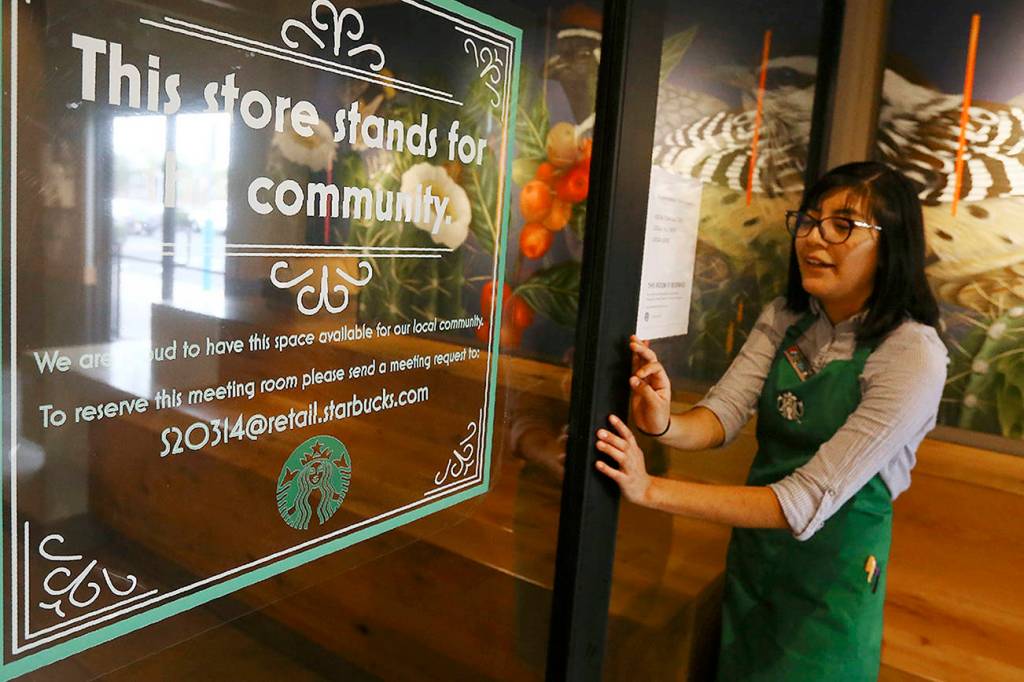
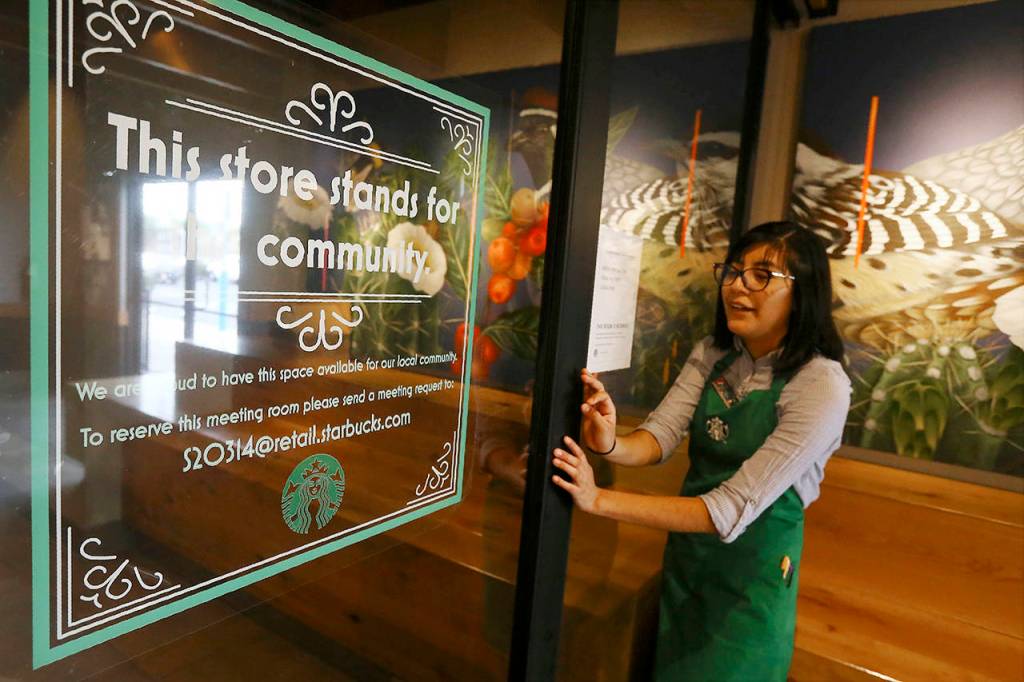
In New Orleans on Thursday, around 20 people were eating, drinking and working on computers at the Starbucks community store, which sits near a vacant clothing shop. A sign behind the counter read, “This store stands for this community” and “Local contractors / Local partners / Local love.”
Starbucks already offers tuition-free online college courses to employees and gives grants to those who come up with ideas for helping their communities. In 1998, it worked with former NBA star Magic Johnson to open stores in urban neighborhoods, but some struggled and closed. Starbucks said it learned from the experience.
Thomas Shinick, a business professor at Adelphi University in Garden City, New York, said he would rather see manufacturing companies or trade schools setting up shop in distressed areas so young people could learn skills beyond the service industry.
“We don’t need more coffee servers,” he said.
Associated Press writers Janet McConnaughey in New Orleans and Sudhin Thanawala in Jonesboro contributed.