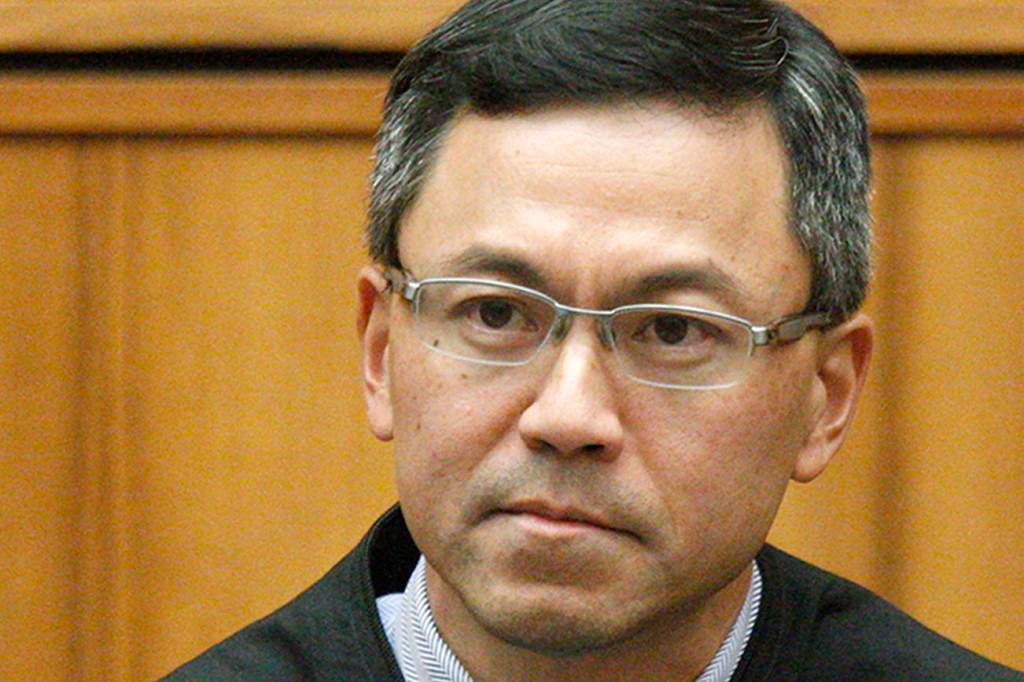
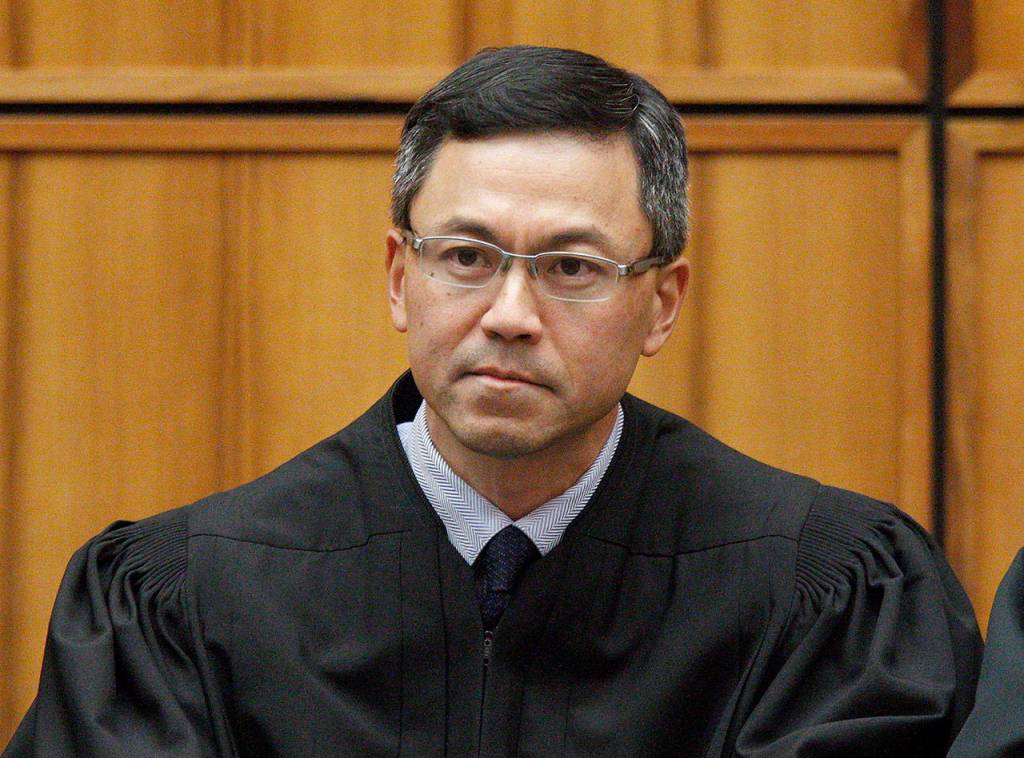
U.S. District Judge Derrick Watson in Honolulu. (George Lee/The Star-Advertiser via AP)

U.S. District Judge Derrick Watson in Honolulu. (George Lee/The Star-Advertiser via AP)

U.S. judge in Hawaii hands Trump a new defeat on travel ban

By Jennifer Sinco Kelleher / Associated Press

HONOLULU — In another setback for President Donald Trump, a federal judge in Hawaii has further weakened his already diluted travel ban by vastly expanding the list of family relationships with U.S. citizens that visa applicants can use to get into the U.S.

The ruling is the latest piece of pushback in the fierce fight set off by the ban Trump first attempted in January. It will culminate with arguments in front of the U.S. Supreme Court in October.

The current rules aren’t so much an outright ban as a tightening of already-tough visa policies affecting citizens from six Muslim-majority countries: Syria, Sudan, Somalia, Libya, Iran and Yemen. People from those countries who already have visas will be allowed into the country. Only narrow categories of people, including those with relatives named in Thursday’s ruling, will be considered for new visas.

U.S. District Judge Derrick Watson on Thursday ordered the government not to enforce the ban on grandparents, grandchildren, brothers-in-law, sisters-in-law, aunts, uncles, nieces, nephews and cousins of people in the United States.

“Common sense, for instance, dictates that close family members be defined to include grandparents,” Watson said in his ruling. “Indeed grandparents are the epitome of close family members.”

Watson also ruled that the government may not exclude refugees who have formal assurance and promise of placement services from a resettlement agency in the U.S.

The U.S. Supreme Court, which last month allowed a scaled-back version of the ban to go into effect before it hears the case in October, exempted visa applicants from the ban if they can prove a “bona fide” relationship with a U.S. citizen or entity.

The Trump administration defined “bona fide” relationship as those who had a parent, spouse, fiance, son, daughter, son-in-law, daughter-in-law or sibling already in the U.S.

The case came back to Watson when the 9th U.S. Circuit Court of Appeals ruled that he had the authority to interpret the Supreme Court’s order and block any violation of it.

Watson’s Thursday ruling broadened the definition of what counts as a “bona fide” relationship to include grandparents and the rest of the wider list of relatives.

Hawaii Attorney General Douglas S. Chin, who represents the state as the plaintiff in the case said the court made clear “that the U.S. government may not ignore the scope of the partial travel ban as it sees fit.”

“Family members have been separated and real people have suffered enough,” Chin said in a statement.

The Supreme Court ruled that workers who accepted jobs from American companies, students who enrolled at a U.S. university or lecturers invited to address a U.S. audience would also be exempt.

A relationship created for purposes of avoiding the travel ban would not be acceptable, the justices said.

Trump proposed a blanket ban on Muslims during his campaign, but limited it to a handful of countries when he issued his initial travel ban in January, promoting it as a necessary tool for national security and fighting terrorism.

It set off massive protests at airports around the country and immediately sparked a sprawling, ongoing legal fight.

Courts blocked that first ban as well as a second the Trump administration had retooled, until the Supreme Court partially reinstated it at the end of June.

It’s unclear how significantly the new rules have affected or will affect travel. In most of the countries singled out, few people have the means for leisure travel. Those that do already face intensive screenings before being issued visas.

Associated Press writer Andrew Dalton contributed to this story from Los Angeles.
Talk to us

> Give us your news tips.

> Send us a letter to the editor.

> More Herald contact information.

More in Local News

Darryl Dyck file photo
Mohammed Asif, an Indian national, conspired with others to bill Medicare for COVID-19 and other respiratory tests that hadn’t been ordered or performed, according to a U.S. Department of Justice press release.
Man sentenced to 2 years in prison for $1 million health care fraud scheme

Mohammed Asif, 35, owned an Everett-based testing laboratory and billed Medicare for COVID-19 tests that patients never received.

Snohomish County Fire District No. 4 and Snohomish Regional Fire and Rescue responded to a two-vehicle head-on collision on U.S. 2 on Feb. 21, 2024, in Snohomish. (Snohomish County Fire District #4)
Family of Monroe woman killed in U.S. 2 crash sues WSDOT for $50 million

The wrongful death lawsuit filed in Snohomish County Superior Court on Nov. 24 alleges the agency’s negligence led to Tu Lam’s death.

Judy Tuohy, the executive director of the Schack Art Center, in 2024. (Olivia Vanni / The Herald)
Director of Everett’s Schack Art Center announces retirement

Judy Tuohy, also a city council member, will step down from the executive director role next year after 32 years in the position.

Human trafficking probe nets arrest of Calif. man, rescue of 17-year-old girl

The investigation by multiple agencies culminated with the arrest of a California man in Snohomish County.

A Flock Safety camera on the corner of 64th Avenue West and 196th Street Southwest on Oct. 28, 2025 in Lynnwood, Washington. (Olivia Vanni / The Herald)
Everett seeks SnoCo judgment that Flock footage is not public record

The filing comes after a Skagit County judge ruled Flock footage is subject to records requests. That ruling is under appeal.

Information panels on display as a part of the national exhibit being showcased at Edmonds College on Nov. 19, 2025 in Lynnwood, Washington. (Olivia Vanni / The Herald)
Edmonds College hosts new climate change and community resilience exhibit

Through Jan. 21, visit the school library in Lynnwood to learn about how climate change is affecting weather patterns and landscapes and how communities are adapting.

Lynnwood City Council members gather for a meeting on Monday, March 17, 2025 in Lynnwood, Washington. (Olivia Vanni / The Herald)
Lynnwood raises property, utility taxes amid budget shortfall

The council approved a 24% property tax increase, lower than the 53% it was allowed to enact without voter approval.

Lynnwood
Lynnwood hygiene center requires community support to remain open

The Jean Kim Foundation needs to raise $500,000 by the end of the year. The center provides showers to people experiencing homelessness.

Logo for news use featuring Snohomish County, Washington. 220118
Vending machines offer hope in Snohomish County in time for the holidays.

Mariners’ radio announcer Rick Rizzs will help launch a Light The World Giving Machine Tuesday in Lynnwood. A second will be available in Arlington on Dec. 13.

UW student from Mukilteo receives Rhodes Scholarship

Shubham Bansal, who grew up in Mukilteo, is the first UW student to receive the prestigous scholarship since 2012.

Roger Sharp looks over memorabilia from the USS Belknap in his home in Marysville on Nov. 14, 2025. (Will Geschke / The Herald)
‘A gigantic inferno’: 50 years later, Marysville vet recalls warship collision

The USS Belknap ran into the USS John F. Kennedy on Nov. 22, 1975. The ensuing events were unforgettable.

Kelsey Olson, the owner of the Rustic Cork Wine Bar, is introduced by Port of Everett Executive Director Lisa Lefebar on Dec. 2, 2025 in Everett, Washington. (Olivia Vanni / The Herald)
Rustic Cork Wine Bar opens its doors at the Port of Everett

It’s the first of five new restaurants opening on the waterfront, which is becoming a hotspot for diners.

Support local journalism

If you value local news, make a gift now to support the trusted journalism you get in The Daily Herald. Donations processed in this system are not tax deductible.