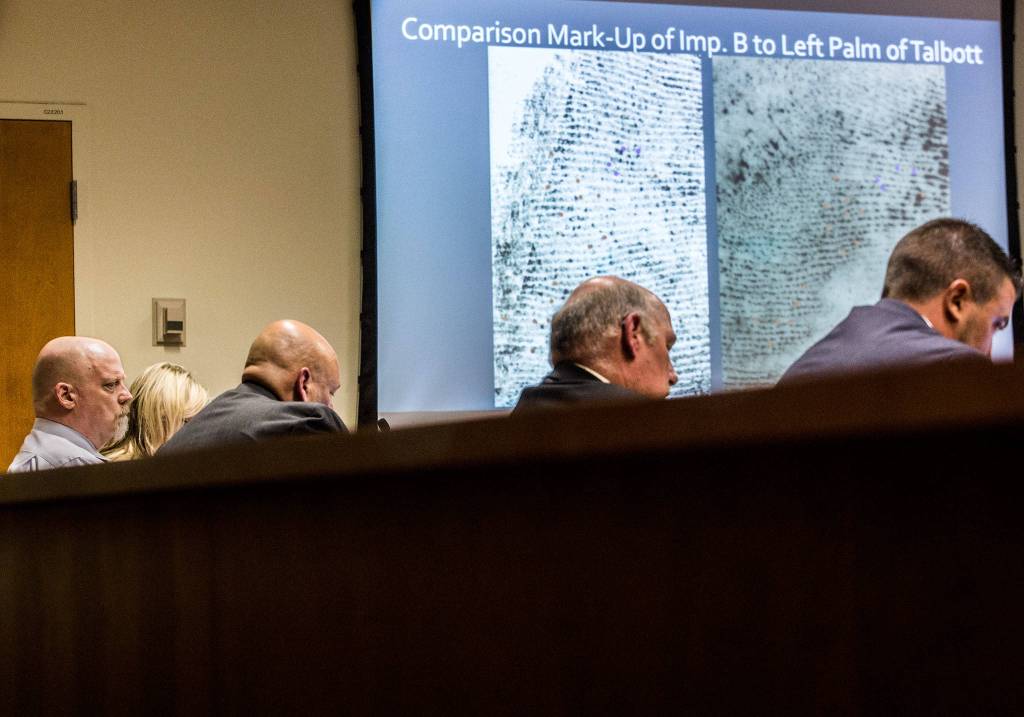
A powerpoint slide displays photos of two palm print comparisons that were analyzed by Washington State Patrol forensic scientist Angela Hilliard during the trial for William Talbott II at the Snohomish County Courthouse on Tuesday in Everett. (Olivia Vanni / The Herald)

A powerpoint slide displays photos of two palm print comparisons that were analyzed by Washington State Patrol forensic scientist Angela Hilliard during the trial for William Talbott II at the Snohomish County Courthouse on Tuesday in Everett. (Olivia Vanni / The Herald)

Van, palm print, DNA come to the fore in double-murder trial

A defense attorney challenged a key piece of evidence — a palm print — in the trial of William Talbott II.

EVERETT — In an early draft of her report in 2018, a fingerprint analyst had ruled out William Talbott II as a possible match for a hand print found on a bronze van.

Then the state crime lab analyst realized she’d been looking at one of the samples upside down. It is now her opinion that the print belonged to the suspect. Talbott is accused of killing a young couple traveling in the van in 1987.

In a double murder trial where cutting-edge technology involving DNA has made national headlines, it was the “so-called science” of palm print analysis that drew a lengthy, vigorous challenge from the defense Tuesday in Snohomish County Superior Court.

The Ford Club Wagon — and evidence found in and on it — has been central to the investigation from its outset.

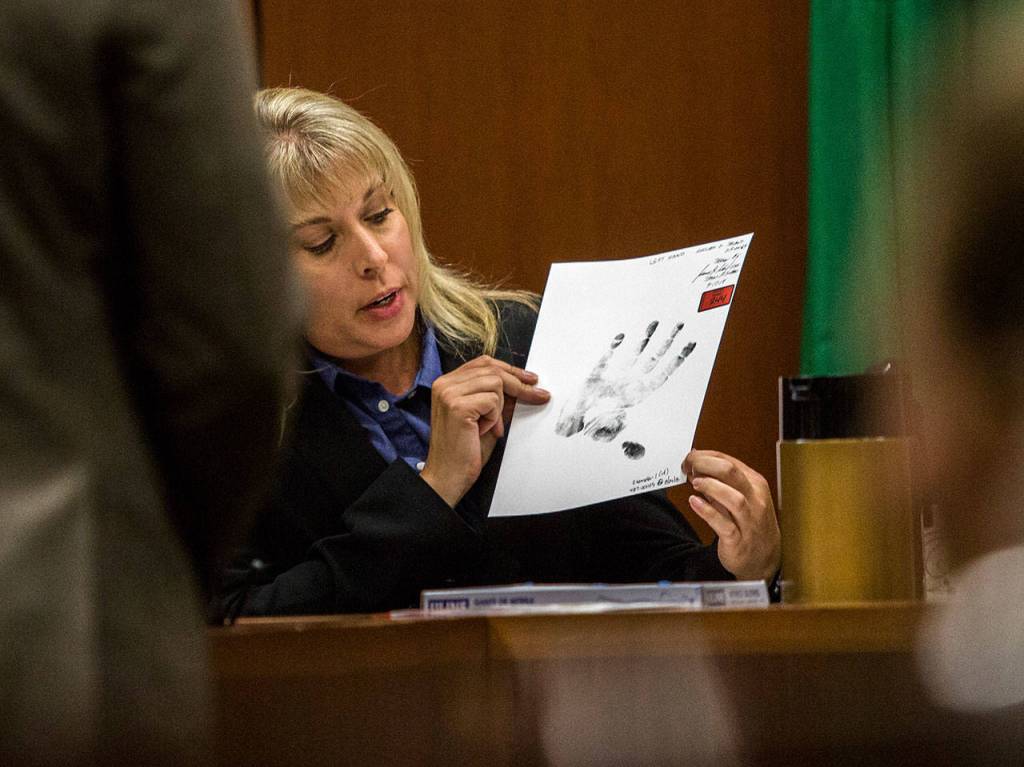
For close to an hour Tuesday, public defender Rachel Forde grilled a forensic scientist from the Washington State Patrol crime lab, Angela Hilliard, about her level of expertise and why she changed her opinion, when a more senior peer told her to go back and check her work.

“Unfortunately it’s because I’m human,” Hilliard said. “Sometimes you just don’t see things at the time you’re evaluating and looking, and you can search and search and search, and sometimes you just don’t find it. … My original opinion was wrong, and the new information and data showed that the information was indeed there.”

Washington State Patrol forensic scientist Angela Hilliard shows and talks about a palm print of William Talbot II during the trial at the Snohomish County Courthouse on Tuesday in Everett. (Olivia Vanni / The Herald)

Washington State Patrol forensic scientist Angela Hilliard shows and talks about a palm print of William Talbot II during the trial at the Snohomish County Courthouse on Tuesday in Everett. (Olivia Vanni / The Herald)

As the trial entered its second week, a jury had been shown evidence gathered from crime scenes scattered across three counties north of Seattle. Retired deputies recounted the discovery of Tanya Van Cuylenborg’s body in north Skagit County.

A passerby saw the remains Nov. 24, 1987, off Parson Creek Road, a quiet paved back route bordered with deciduous trees east of Highway 99.

The Canadian woman, 18, was against a rusty culvert, nude from the waist down except for a pair of socks. She’d been shot in the back of the head.

A day later, a man working an odd-job in downtown Bellingham found her wallet and ID, while cleaning a muddy gravel lot outside Essie’s, a small tavern that has since closed its doors.

Around the corner a police officer found a Ford Club Wagon with British Columbia license plates.

It was a van that belonged to the family of Van Cuylenborg’s boyfriend Jay Cook, 20. The pair grew up in and around Victoria, British Columbia.

On Tuesday, the jury saw photos taken inside the van. Porcelain cups. Empty chip bags. A receipt for $7 in food and supplies from Hood Canal Grocery. A Royal Bank of Canada check for over $750 made out to Gensco, an appliance business in Seattle. A ticket for the Bremerton-Seattle ferry, stamped 10:16 p.m. Nov. 18, 1987.

Cook and Van Cuylenborg were supposed to pick up furnace parts the next morning, in south Seattle.

They never completed the order.

Clues were scarce as to their whereabouts from Nov. 19 to 24. Inside the van was a map of Oregon and Washington. A pair of jeans. A pair of panties. A bloodstain on a car seat. A bloodstain on a comforter. Zip ties looped into a lasso.

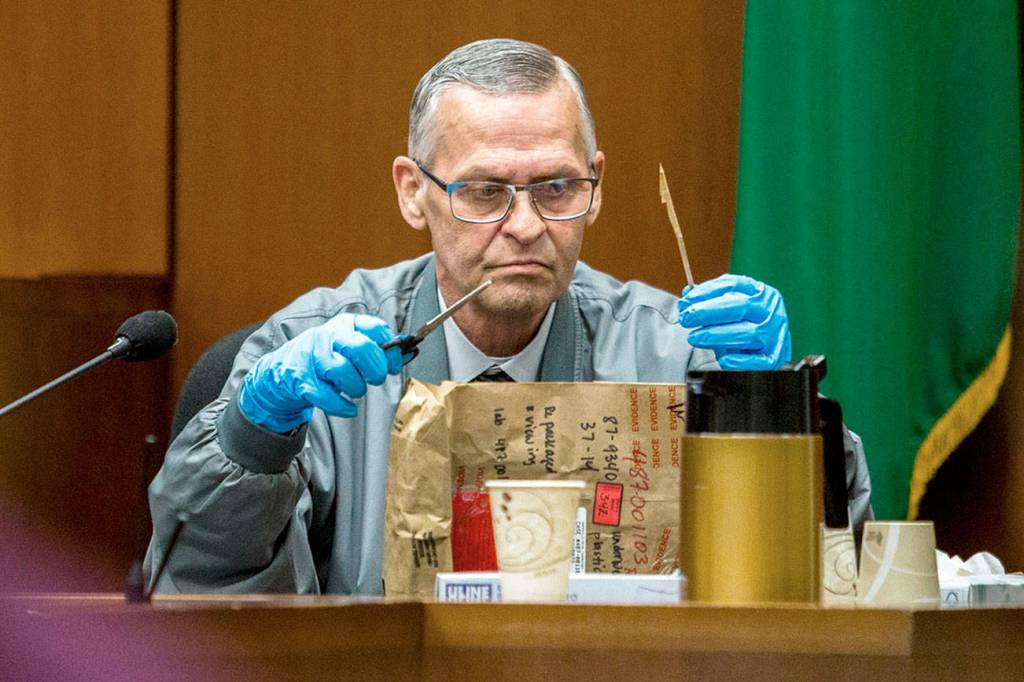
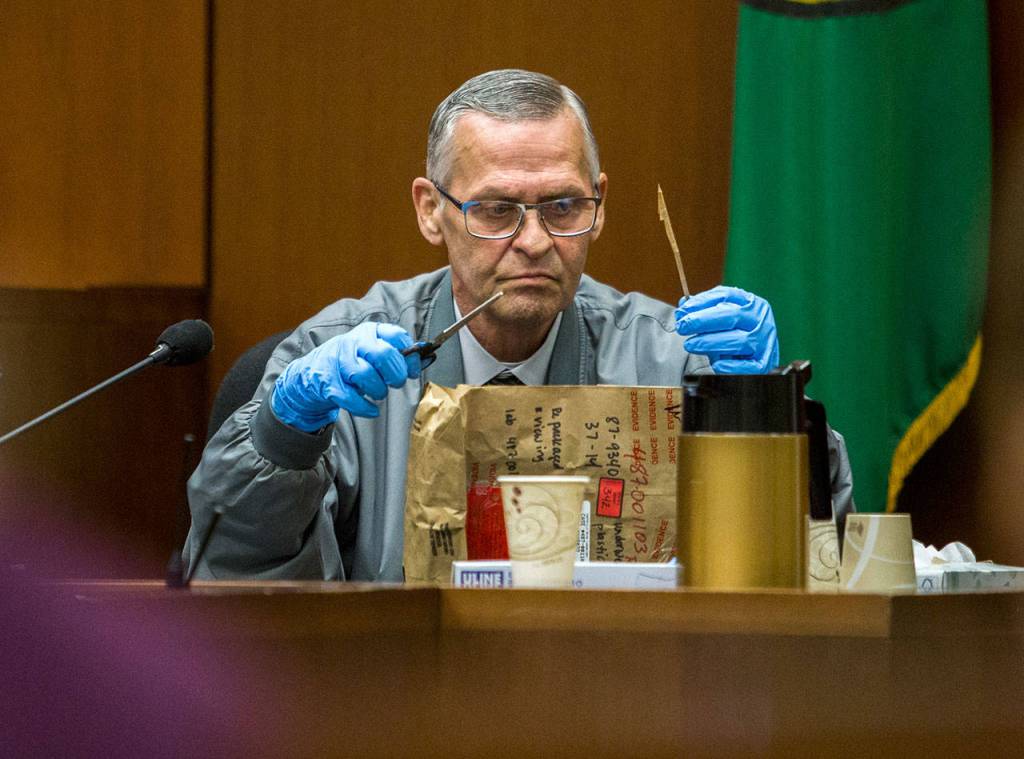
Witness Dave Willard opens an evidence bag during the trial for William Talbott II at the Snohomish County Courthouse on Tuesday in Everett. (Olivia Vanni / The Herald)

Witness Dave Willard opens an evidence bag during the trial for William Talbott II at the Snohomish County Courthouse on Tuesday in Everett. (Olivia Vanni / The Herald)

Cook was found dead south of Monroe, beaten with rocks. He’d been strangled with twine that was tied onto dog collars.

At each of the crime scenes — in Bellingham, rural Skagit County and rural Snohomish County — detectives seized zip ties as evidence.

A pair of black pants had been wedged between foam sleeping pads in the van. On the hem of the pants was DNA evidence, in the form of semen, that would later link Talbott to the murders 30 years later.

In May 2018, a forensic lab uploaded the DNA profile onto the public ancestry site, GEDMatch. Genealogist CeCe Moore built a suspect’s family tree, and traced it to the one son of a married couple near Woodinville.

A state crime lab later confirmed, through two other tests, that Talbott’s genetic profile matched crime scene DNA, according to prosecutors. This is the first case involving the new forensic technique, known as genetic genealogy, that has gone to a trial by jury.

On Tuesday afternoon, however, the defense focused on the fingerprint analyst’s homework.

The analyst had examples of prints from Van Cuylenborg, Cook and Talbott, and she knew which was the suspect. The analysis calls for placing colored markers on two samples, to compare.

“So what you do then after you do your analysis is a visual comparison, right?” Forde asked Hilliard. “So it’s just your eyes looking at one thing and seeing if it looks like another thing, right? Kind of like what they teach you on Sesame Street, is that right?”

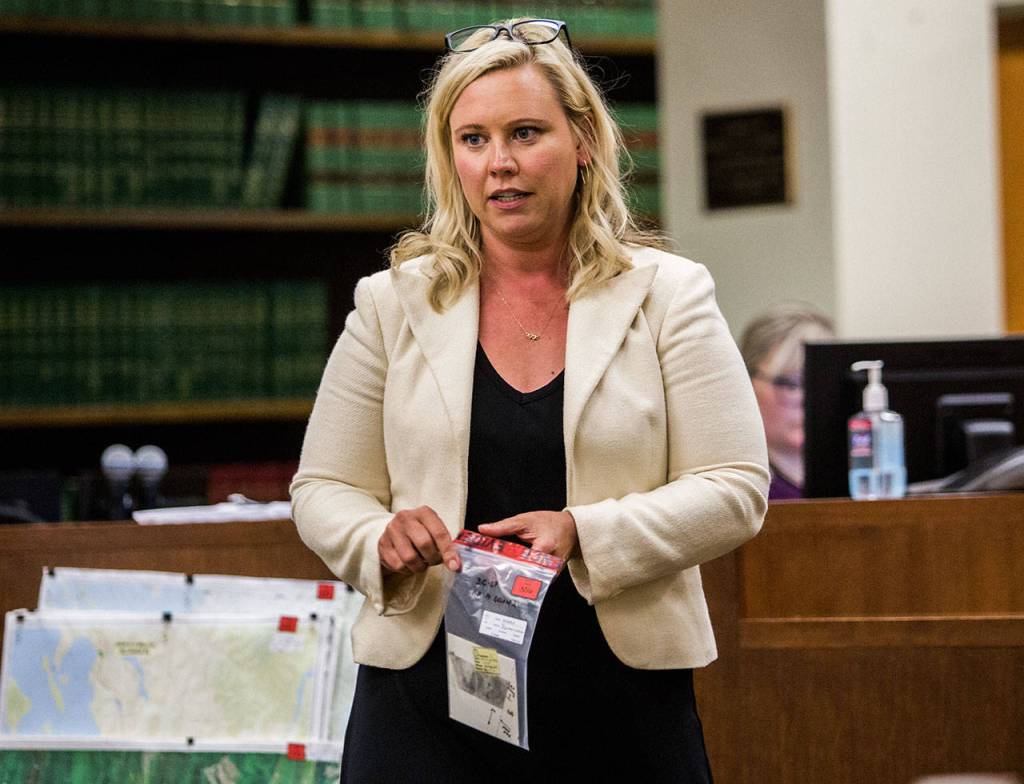
Defense attorney Rachel Forde shows an evidence bag with a palm impression during her cross examination of Washington State Patrol forensic scientist Angela Hilliard during the trial for William Talbott II at the Snohomish County Courthouse on Tuesday in Everett. (Olivia Vanni / The Herald)

Defense attorney Rachel Forde shows an evidence bag with a palm impression during her cross examination of Washington State Patrol forensic scientist Angela Hilliard during the trial for William Talbott II at the Snohomish County Courthouse on Tuesday in Everett. (Olivia Vanni / The Herald)

Forde asked the witness if she was familiar with the case of the Madrid bomber — where the FBI jailed an Oregon man, who was later proven to be innocent — and how it raised serious questions about the validity of fingerprint analysis.

In an opening statement, prosecutors had warned the jury not all of their questions would be answered.

Talbott, 56, a truck driver living in SeaTac, never wed or had children. He has maintained his innocence.

Family and friends of the Canadian couple have been watching the trial since witness testimony began Friday.

Caleb Hutton: 425-339-3454; chutton@heraldnet.com. Twitter: @snocaleb.
Talk to us

> Give us your news tips.

> Send us a letter to the editor.

> More Herald contact information.

More in Local News

People fish from the pier, hold hands on the beach and steer a swamped canoe in the water as the sun sets on another day at Kayak Point on Monday, June 12, 2023, in Stanwood, Washington. (Ryan Berry / The Herald)
Kayak Point Park construction to resume

Improvements began in 2023, with phase one completed in 2024. Phase two will begin on Feb. 17.

Everett
Everett to pilot new districtwide neighborhood meetings

Neighborhoods will still hold regular meetings, but regular visits from the mayor, city council members and police chief will take place at larger districtwide events.

A truck drives west along Casino Road past a new speed camera set up near Horizon Elementary on Wednesday, May 8, 2024 in Everett, Washington. (Olivia Vanni / The Herald)
Crashes, speeding down near Everett traffic cameras

Data shared by the city showed that crashes have declined near its red light cameras and speeds have decreased near its speeding cameras.

Community Transit is considering buying the Goodwill Outlet on Casino Road, shown here on Tuesday, Jan. 6, 2026 in Everett, Washington. (Will Geschke / The Herald)
Community Transit to pay $25.4M for Everett Goodwill property

The south Everett Goodwill outlet will remain open for three more years per a proposed lease agreement.

Logo for news use featuring Snohomish County, Washington. 220118
Parent support collaborative worries money will run out

If funding runs out, Homeward House won’t be able to support parents facing drug use disorders and poverty.

Carlos Cerrato, owner of Taqueria El Coyote, outside of his food truck on Thursday, Jan. 29, 2026 in Lynnwood. (Olivia Vanni / The Herald)
Everett proposes law to help close unpermitted food carts

The ordinance would make it a misdemeanor to operate food stands without a permit, in an attempt to curb the spread of the stands officials say can be dangerous.

An Everett Transit bus drives away from Mall Station on Monday, Dec. 22, 2025, in Everett, Washington. (Olivia Vanni / The Herald)
Everett Transit releases draft of long-range plan

The document outlines a potential 25% increase in bus service through 2045 if voters approve future 0.3% sales tax increase.

Lake Stevens robotics team 8931R (Arsenic) Colwyn Roberts, Riley Walrod, Corbin Kingston and Chris Rapues with their current robot and awards on Thursday, Jan. 29, 2026 in Lake Stevens, Washington. (Olivia Vanni / The Herald)
Lake Stevens robotics team receives world recognition

Team Arsenic took second place at the recent ROBO-BASH in Bellingham, earning fifth place in the world.

Leslie Wall in the Everett Animal Shelter on Jan. 6, 2026 in Everett, Washington. (Will Geschke / The Herald)
Everett Animal Shelter gets $75k in grants, donations

The funds will help pay for fostering and behavioral interventions for nearly 200 dogs, among other needs.

Everett
One man was injured in Friday morning stabbing

Just before 1 a.m., Everett police responded to a report of a stabbing in the 2600 block of Wetmore Avenue.

x
Paraeducator at 2 Edmonds schools arrested on suspicion of child sex abuse

On Monday, Edmonds police arrested the 46-year-old after a student’s parents found inappropriate messages on their daughter’s phone.

Taylor Scott Richmond / The Herald
Getchell High School students protest ICE during their walkout demonstration on Wednesday in Marysville.
Marysville students peacefully protest ICE

Around 150 Getchell High School students walked out of school to line 67th Avenue Northeast as cars drove by on Wednesday morning.

Support local journalism

If you value local news, make a gift now to support the trusted journalism you get in The Daily Herald. Donations processed in this system are not tax deductible.