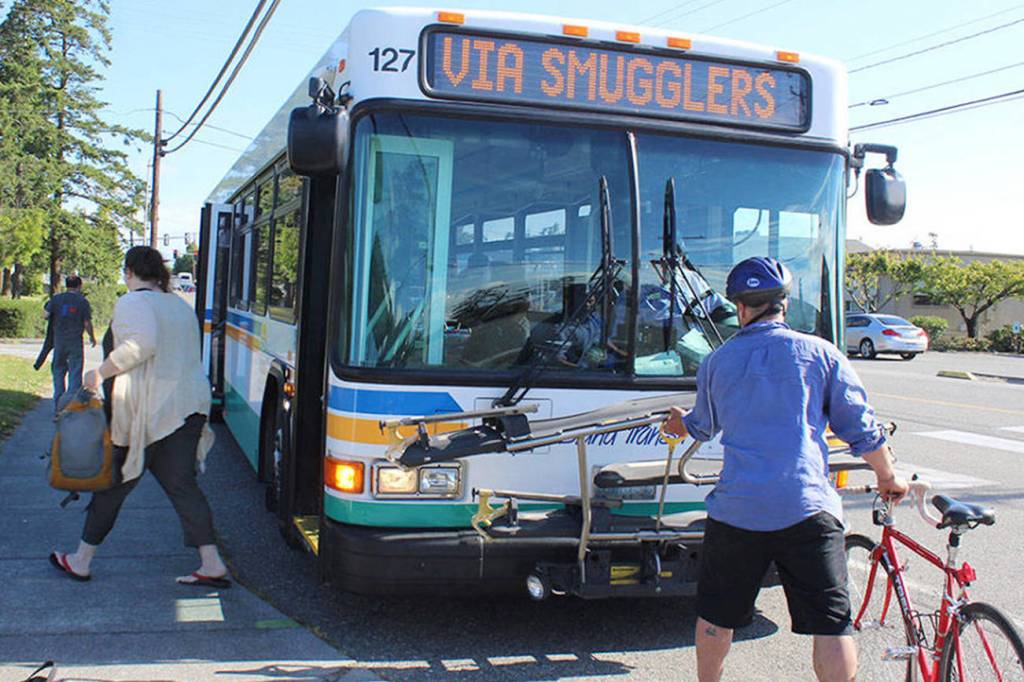
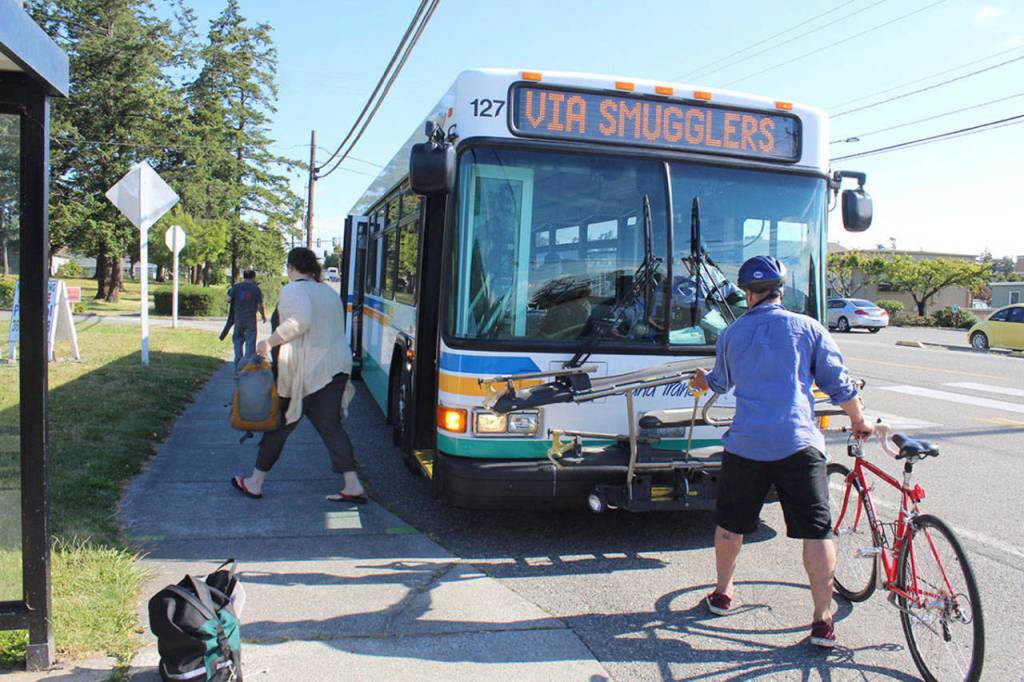
Passengers get off and on in Coupeville on a southbound Island Transit bus Tuesday morning. (Patricia Guthrie/Whidbey News Group)

Passengers get off and on in Coupeville on a southbound Island Transit bus Tuesday morning. (Patricia Guthrie/Whidbey News Group)

Island Transit votes to keep its free rides

Except for that one Camano Island route.

Island Transit will not charge riders fares on its buses, with the exception of one Camano Island route.

Members of the Island Transit board voted 2-3 June 22 against a motion to consider implementing fares. Island County Commissioner Rick Hannold and Oak Harbor Councilman Rick Almberg voted in favor of the motion; Island County Commissioner Helen Price Johnson, Langley Councilman Bruce Allen and Coupeville Councilwoman Jackie Henderson voted against it.

The vote reflects community comments about the question of whether the transit agency should start collecting fares on fixed and paratransit services. The agency gathered comments at meetings and online in the past couple of months. The majority of the 850 comments were from those who were opposed to fares.

Island Transit Director Mike Nortier summarized community comments in a document that’s available at the Island Transit website.

“The broad themes included concerns over the loss of ridership, impacts to the environment, cost of collecting fares versus the revenue generated, impacts on vulnerable populations and operational scheduling impacts,” the summary states.

Island Transit projected an initial ridership loss of 30 percent to 40 percent, with levels returning to current ridership in three to five years.

“Respondents expressed concern that the ridership loss may be greater than anticipated,” the document states, “and would result in a greater number of cars on the road increasing traffic congestion and greenhouse gas emissions, which run counter to the purpose and mission of public transportation.”

Island Transit has been fare free, with the one exception, since its inception more than 30 years ago. It is one of two transit agencies in the state that doesn’t charge fares. It is funded largely through sales tax and grants.

The issue of fares came to the forefront four years ago when Island Transit experienced financial problems and had to lay off staff and cut Saturday service. State lawmakers warned that state grants could be in jeopardy unless the agency started charging fares. State funding for service between Camano Island and Everett was contingent on the agency charging fares on the route.

Almberg said Island Transit is doing well financially because the economy is strong and gas prices are low, but that it won’t last forever. He said it’s better to implement fares and absorb start-up costs when the economy is doing well.

“It’s a lot easier to plan for difficult times during good times,” he said.

Price Johnson, on the other hand, explained her opposition to fares in an opinion piece for the South Whidbey Record. She pointed out that projections show that fares would generate about $200,000 a year, require $300,000 in one-time costs to implement and have over $100,000 in yearly costs. Under the best-case scenario, fares would account for only 2 percent of the annual budget after three years.

“In a time when affordable housing is scarce, housing costs are rising and working families are struggling, needlessly adding to the price of vital transit services is not the right thing to do,” she wrote. “Though there are political pressures to charge fares, there are not state requirements to do so. I’ve heard overwhelming concern from most community members about this big change for the agency and the environmental impacts it will produce.”


Talk to us

> Give us your news tips.

> Send us a letter to the editor.

> More Herald contact information.

More in Northwest

The Washington state Capitol on Friday. (Photo by Bill Lucia/Washington State Standard)
WA income tax on higher earners clears first legislative hurdle

Democrats rejected GOP amendments before pushing their tax on millionaires through a Senate committee. The bill was revised to expand an exemption for small businesses and make other changes.

Washington Gov. Bob Ferguson, left, shakes hands with Cowlitz Indian Tribe Chairman Bill Iyall after signing an executive order to improve the state’s relations with tribal governments on Oct. 22, 2025. (Photo courtesy of Washington governor’s office)
Washington tribes could get more say in management of state logging lands

A bill to add two tribal representatives to the Board of Natural Resources is awaiting a Senate vote. Supporters say the change could add valuable perspective to the panel.

A view of the Washington state Capitol building in Olympia, obscured by a slight mist, Jan. 27, 2025. (Photo by Bill Lucia/Washington State Standard)
The bills that didn’t survive the WA Legislature’s first major deadline

A 60-day legislative session can be a cruel thing if you’re hoping… Continue reading

Washington State Capitol building in Olympia. (Courtesy photo)
Ferguson rejects WA lawmakers’ initial crack at income tax legislation

The Democratic proposal targets household earnings over $1 million.

Senate Majority Leader Jamie Pedersen, D-Seattle, during Senate floor debate on Jan. 28, 2026. (Photo by Bill Lucia/Washington State Standard)
WA Senate leader explains dim outlook for a new tax on big businesses

Senate Majority Leader Jamie Pedersen previously backed the payroll tax, but suggests there’s no political path for it. He and others are forging ahead with an income tax proposal.

State Sen. John Lovick, D-Mill Creek, looks on toward the end of the roll call vote for his Senate Bill 5067, which would lower the blood alcohol limit for drunk driving to 0.05% from 0.08% in Washington. The bill passed the Senate on a 26-23 vote on Jan. 28, 2026. (Photo by Bill Lucia/Washington State Standard)
Lower drunk driving limit approved by WA Senate

The bill drops it to 0.05%, and the state would join Utah with the toughest standard in the nation. It still needs House approval.

Washington state Supreme Court Justice Colleen Melody is sworn in Wednesday, Jan. 21, 2026, in Olympia, Washington. (Photo by Jake Goldstein-Street/Washington State Standard)
Washington’s newest Supreme Court justice is sworn in

Colleen Melody is officially the Washington state Supreme Court’s newest justice. Melody… Continue reading

Washington Gov. Bob Ferguson at his State of the State address on Jan. 13, 2026. Ferguson did not discuss the budget cuts he’s proposing in his speech but they’ve stoked plenty of testimony in the first days of the 2026 legislative session. (Photo by Bill Lucia/Washington State Standard)
An icy reception for Gov. Bob Ferguson’s proposed budget cuts

Advocates for schools, public universities, and climate programs are among those unhappy with the raft of cuts the governor relies on to close a $2.3 billion shortfall.

The log-in page of Instagram’s website. (Photo by Alexander Castro/Rhode Island Current)
Push for youth social media safeguards revived in WA Legislature

A proposal would prohibit addictive feeds and push notifications at certain times for minors. Opponents believe it’s unconstitutional.

State lawmakers are considering bills requiring AI detection tools and disclosures to address deepfakes and to establish new safeguards for children using the technology. (Stock photo)
How Washington state lawmakers want to regulate AI

Reining in chatbots, protecting kids from harmful content, and requiring disclosure of AI-generated material are among the ideas under discussion in Olympia.

Bill Lucia / Washington State Standard
State Sen. Yasmin Trudeau, D-Tacoma, makes floor remarks on Feb. 4, 2026 about Senate Bill 6002, which would set state regulations for license plate readers. The bill passed 40-9, with only Republicans opposed.
WA Senate OKs guardrails for license plate readers

The legislation passed Wednesday mandates that reader data be deleted after 21 days and says it can’t be shared except in court proceedings.

House Bill 1608 seeks to build on a 2024 law banning octopus farming in Washington. (File photo)
Washington may ban sales of farmed octopus

Octopus is back on the policy menu for Washington state lawmakers. A… Continue reading

Support local journalism

If you value local news, make a gift now to support the trusted journalism you get in The Daily Herald. Donations processed in this system are not tax deductible.