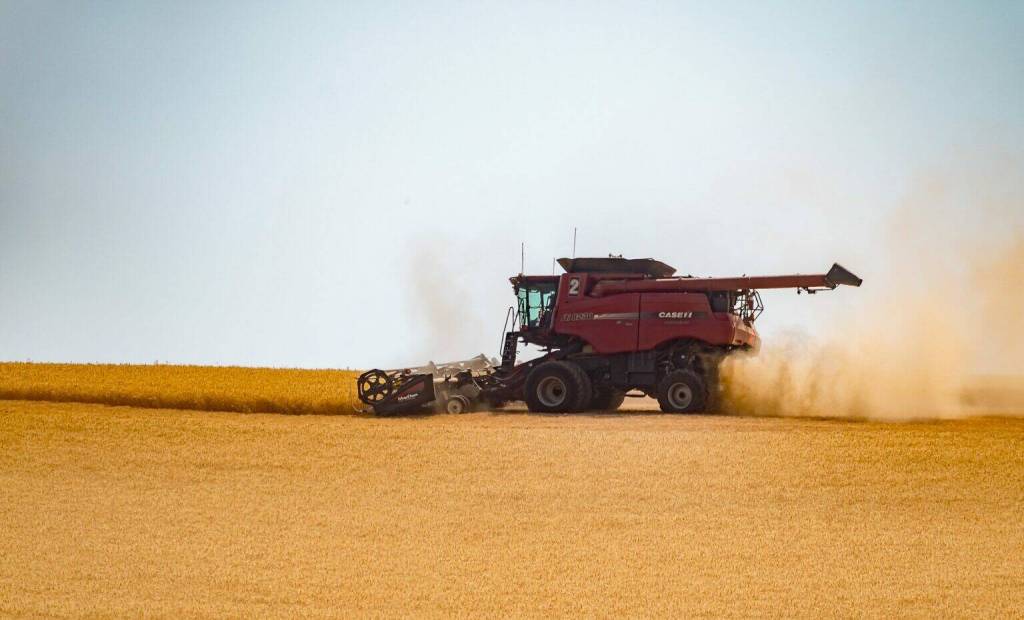
A combine at work in wheat fields in the Walla Walla region during 2018. (Washington State Department of Agriculture)

A combine at work in wheat fields in the Walla Walla region during 2018. (Washington State Department of Agriculture)

State halts rebates to farmers hit with fuel fees under WA climate law

Instead, a new online directory shows retailers who provide the farm fuel exemption by not imposing surcharges.

  • By Jerry Cornfield Washington State Standard
  • Tuesday, October 21, 2025 10:32am
  • Local NewsNorthwest

Washington quietly ended funding this summer for a program that provided millions of dollars in rebates to farmers who paid unfair fuel surcharges under Washington’s landmark climate law.

Lawmakers are hoping instead that legislation enacted in May will make it easier for farm fuel users and haulers of agricultural goods to receive the fuel exemption promised under the state’s cap-and-trade system.

This year’s law directed the Department of Ecology to create an online map of retailers who sell exempt agricultural fuel at a price that excludes any surcharges associated with the Climate Commitment Act.

Rep. Tom Dent, R-Moses Lake, said this will simplify the process for farmers and haulers. Rather than pay a surcharge and submit paperwork to the government for a rebate, they can avoid extra costs up front, at the pump, he said.

“This should be an easier way for farmers to not pay a surcharge,” Dent said.

Complicated carveout

Central to the Climate Commitment Act are auctions for pollution allowances that refineries and other companies need to buy to offset their carbon emissions.

Under the law, the agricultural, maritime and aviation sectors are supposed to be exempt from the law’s cap on emissions and any fees fuel companies might pass to customers to cover the cost of buying the allowances. Fuel used for trucking crops and other agricultural goods on public highways is exempt as well.

Soon after the cap-and-trade program began in 2023, complaints about these exemptions started streaming in.

There were difficulties tracking whether diesel fuel was being used for exempt purposes. A process where exempt fuel buyers had to present certificates to fuel sellers was cumbersome and faulty. One challenge for farmers was knowing where fuel exemption certificates would be accepted.

Bottom line, farmers and truckers said fuel distributors were, in many cases, passing on the cost of allowances to the tune of as much as 70 cents a gallon.

Ecology put together a workgroup that met several times in 2023 to try — unsuccessfully, said farmers and truckers — to iron out the wrinkles.

Even before the panel completed its work, the Washington Trucking Associations and the Washington Farm Bureau were asking a judge to scrap Ecology regulations guiding the exemptions and to open a new rulemaking process.

That fight reached the state Supreme Court this week.

Funding left out of budget

In 2024, the Legislature set aside $30 million for rebates to farm fuel users and transporters of agricultural goods who could show they paid a surcharge tied to the climate law for which they should have been exempt. The Department of Licensing ran the Agriculture Support Program with funding from Climate Commitment Act proceeds.

It launched in August 2024 and ended June 30 this year.

Farmers and transporters could seek rebates for fuel purchased between Jan. 1, 2023, and Dec. 31, 2024. A total of 2,744 applications came in, with $7,887,820 in rebates awarded, according to the Department of Licensing. There were rebate recipients in each of the state’s 39 counties.

Overall, the department spent $9.4 million on the rebate program, with the remaining $20.6 million returned to the climate fund.

Dent said he wanted the rebate program to continue, “but budget writers being budget writers decided not to do so.”

House Bill 1912, which Dent authored this year, says it is the intent of the Legislature to extend the rebate program through the 2025-27 biennium. That is not what occurred, even though the bill passed by margins of 94-2 in the House and 49-0 in the Senate.

The House penciled in $3 million to keep the program going in its budget, but the Senate put no funds in its version. That is what the Legislature passed and Gov. Bob Ferguson signed.

As a result, applications for rebates closed June 2. All those received were processed, with money sent by June 30.

In the meantime, the Department of Ecology developed the new online directory of retailers who have told the department that they sell exempt agricultural fuel at a price that is different from fuel that is not exempt under the climate law.

This directory lists the name, address, county, and, if applicable, city of each exempt retail fuel seller. If additional retailers self-report, the site will be updated.

Dent said this won’t be the last word on how the climate law affects the bottom line of ag businesses.

“The work is not over with,” he said.
Talk to us

> Give us your news tips.

> Send us a letter to the editor.

> More Herald contact information.

More in Northwest

Gov. Bob Ferguson signing Senate Bill 5480, a bill exempting medical debt from credit reports, on April 22. (Photo by Jacquelyn Jimenez Romero/Washington State Standard)
WA’s new ban on medical debt in credit reports at risk of federal override

The Trump administration wants to reverse Biden-era guidance on the issue.

The U.S. Capitol building in Washington, D.C., on May 7, 2025. (Photo by Jennifer Shutt/States Newsroom)
End of shutdown ignites sparring among congressional lawmakers

Meanwhile, U.S. Rep. Marie Gluesenkamp Perez was among six Democrats who sided with Republicans in voting the legislation out of the House.

Attorney General Nick Brown has proposed new advice for locales on how to interpret state public records law, with a focus on providing records faster. (Stock photo)
Need for speed: Plan to unclog WA public records system gets mixed reviews

Washington’s attorney general is seeking to reduce public record backlogs as concerns… Continue reading

Washington state Commissioner of Public Lands Dave Upthegrove waves to the crowd during inauguration ceremonies at the Washington state Capitol, in Olympia, on Jan. 15, 2025. (Photo by Ryan Berry/Washington State Standard)
Dave Upthegrove on land sales, federal funding cuts and wildfire immigration raids

Washington state’s new public lands commissioner came into office with his own ambitious agenda. It’s playing out against a shifting backdrop in D.C.

The so-called “big, beautiful bill” that congressional Republicans approved in July included a total of $50 billion for the Rural Health Transformation Program. The money is meant to offset some of the expected damage to rural hospitals from the law’s steep cuts to Medicaid. (Olivia Vanni / The Herald)
Washington makes pitch to feds for $1B in rural health funding

The money was included in Republicans’ “big, beautiful bill.” The state’s goals include strengthening the rural health workforce and improving care in tribal communities.

Screenshot from the state Employment Security Department’s website at esd.wa.gov. (File photo)
Expected slide in WA unemployment trust fund balance could trigger new tax

Washington businesses would need to shoulder roughly $700 million in additional taxes… Continue reading

The Washington state Capitol. (Jerry Cornfield/Washington State Standard)
State Democrats mull imposing income tax on higher earners

The idea is brewing ahead of the 2026 legislative session. It would target those making above $1 million. The state is one of nine that does not tax wages.

Washington state Commissioner of Public Lands Dave Upthegrove speaks at a press conference on wildfire issues Monday in Tumwater. (Photo by Bill Lucia/Washington State Standard)
Climate dollars eyed to backfill WA wildfire funding

Washington’s lands commissioner, Dave Upthegrove, is on a mission to secure $60… Continue reading

Washington Gov. Bob Ferguson, left, shakes hands with Cowlitz Indian Tribe Chairman Bill Iyall after signing an executive order to improve the state’s relations with tribal governments on Wednesday. (Photo courtesy of Washington governor’s office)
WA governor moves to improve state consultation with tribes

A new directive expands tribal relations training for state workers among other actions. Tribal leaders voiced support.

New map tracks measles exposures across Washington

Afraid you may have been exposed to measles? Washington’s Department of Health… Continue reading

A combine at work in wheat fields in the Walla Walla region during 2018. (Washington State Department of Agriculture)
State halts rebates to farmers hit with fuel fees under WA climate law

Instead, a new online directory shows retailers who provide the farm fuel exemption by not imposing surcharges.

Washington transportation officials say a lack of funding means dollars intended for preservation and maintenance are the ones diverted to deal with emergency situations. Before (left) and after (right) photos of the mudslide and cleanup on State Route 20 following an Aug. 11 mudslide. (Washington State Department of Transportation)
‘Early stages of critical failure’: Outlook grim for road upkeep

Billions more dollars are needed for preserving highways and bridges, WSDOT says. The agency’s leader didn’t request more maintenance money for 2026.

Support local journalism

If you value local news, make a gift now to support the trusted journalism you get in The Daily Herald. Donations processed in this system are not tax deductible.