Parts flew thousands of feet from 767 that burned in Chicago
Published 1:30 am Saturday, October 29, 2016
Associated Press
CHICAGO — Engine pieces from an American Airlines plane that caught fire Friday on a runway at Chicago’s O’Hare airport were found thousands of feet away, a federal investigator said.
Lorenda Ward, a National Transportation Safety Board senior investigator, confirmed Saturday that the fire was caused by engine failure. What caused the engine to fail has not yet been determined, she said at a press conference.
She says the fire started in a pool of fuel under the right wing of the Boeing 767.
One piece of General Electric engine was found nearly 3,000 feet away at a UPS warehouse. Another was found about 1,500 feet away but on airport property.
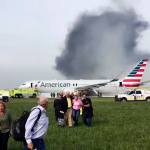
Pilots aborted the takeoff of American Airlines Flight 383 to Miami. All 161 passengers and nine crew safely evacuated as smoke billowed into the air. Twenty people were taken to the hospital with injuries mainly from the evacuation, officials said. They had all been released by late Saturday, Ward said.
The fire burned the fuselage of the plane but did no major damage to the inside of the cabin, she said.
The airplane has been moved off the runway to a location where the investigation can continue.
Chicago Department of Aviation spokeswoman Karen Pride said the runway will reopen sometime Sunday after it is cleaned of debris.
(Earlier version)
Associated Press
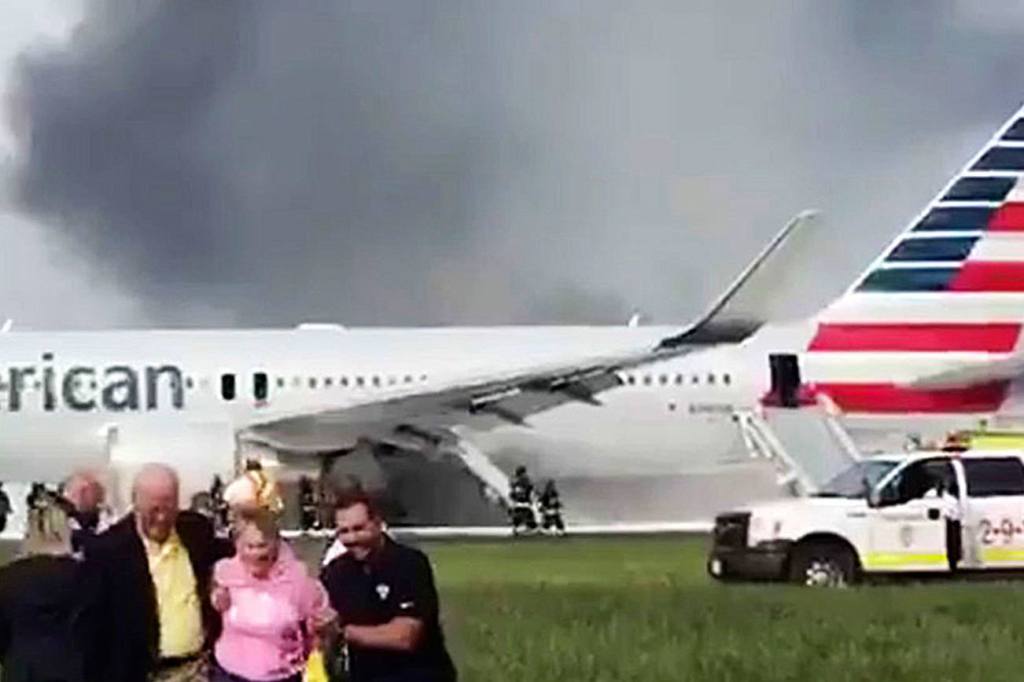
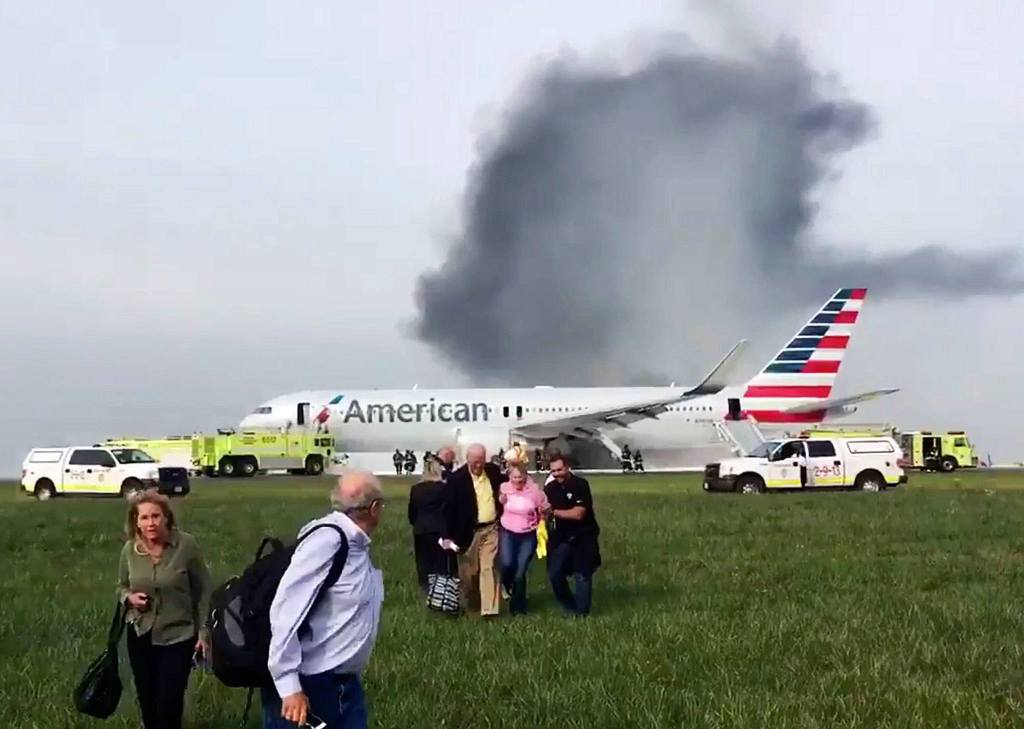
CHICAGO — Pilots were forced to abort a takeoff and evacuate passengers from a burning American Airlines flight on a runway at Chicago O’Hare International Airport after the airliner experienced what a federal official said was a rare and serious type of engine failure.
American Airlines Flight 383 to Miami experienced an “uncontained engine failure,” in which engine parts break off and are spewed outside the engine, the official said. The danger of such a failure is that engine pieces effectively become shrapnel and can cause extensive damage to the aircraft.
Flames and heavy black smoke poured from the side of the Boeing 767 jet as it sat on the runway Friday after the aborted takeoff. Officials said the incident left 21 people injured. Footage from the scene showed passengers coming down emergency slides and hurrying across grass next to the runway as emergency vehicles surrounded the plane. The right wing was drooping toward the ground and appeared to have partially melted.
Passenger Sarah Ahmed told WLS-TV the plane was speeding down the runway when she heard an explosion and saw flames and black smoke. She said everyone on the right side of the aircraft jumped from their seats and moved to the left side.
“People are yelling, ‘Open the door! Open the door!’ Everyone’s screaming and jumping on top of each other to open the door,” Ahmed said. “Within that time, I think it was seven seconds, there was now smoke in the plane and the fire is right up against the windows, and it’s melting the windows.”
The pilots reported an engine-related mechanical issue and aborted the takeoff, according to American Airlines spokeswoman Leslie Scott.
The Federal Aviation Administration said the plane made an emergency stop around 2:35 p.m. after experiencing a problem during takeoff.
Chicago Deputy Fire Commissioner Timothy Sampey said 20 passengers suffered minor injuries as they used the emergency chutes to evacuate.
Uncontained engine failures are unusual thanks to improvements in designs and the metallurgy. There are many possible causes, including overheating, runway debris or large birds that get sucked into the engine or parts that break when they wear out but aren’t replaced during maintenance checks.
Tom Walsh, an airline pilot who also works as a security consultant, said that engines that break apart can be especially serious if the parts end up cutting fuel lines or damaging other vital components of the aircraft.
But he said even such catastrophic failures don’t necessarily doom a plane — even if a pilot runs out of runway and must take off.
“Planes are meant to fly with one engine,” said Walsh, who has also flown Boeing 767s. “We are trained so that we can lose the engine at the worst possible time … and then still successfully take off and land.”
The aircraft involved in Friday’s incident was built in 2003 and is among American’s youngest planes of that model. According to data from FlightGlobal, an aviation news and industry data company, at the start of this year the plane had flown more than 47,000 hours and made more than 7,500 cycles — each takeoff and landing is one cycle. American is flying 767 aircraft that have more than 100,000 hours and 18,000 cycles.