There’s hope for walkers in Marysville
Published 10:38 pm Saturday, November 1, 2008
MARYSVILLE — A walk from Comeford Park through downtown to Ebey Slough isn’t likely to wind up in an interactive video on the Chamber of Commerce Web site anytime soon.
It’s a walk past rushing traffic, fast-food joints, gas stations, strip malls large and small, and quiet streets that hint of Marysville’s past but now seem practically deserted.
Four features stand out: Concrete, cars, neon and exhaust.
All this means downtown Marysville has a ways to go before it’s friendly for walkers, according to a nationally recognized expert in pedestrian access.
It’s all symptomatic of modern American society’s dependence on the automobile, said Dan Burden, who led about 25 people on a “walking audit” of downtown Thursday.
And yet, there’s hope for pedestrians here, said Burden, of Orlando, Fla. He said he’s conducted 4,000 such walking audits in cities around the world. He works both independently and for the firm Glatting Jackson Kercher Anglin.
Unlike many other suburban cities, Marysville has an original core and a waterfront upon which it can build as it encourages redevelopment, Burden said.
“I like its size, I like its scale,” he said.
Burden’s standards are high. On his own scale, with the best cities in the 90s, Marysville scored somewhere in the 60s. He liked Third Street, with its small, old-fashioned shops and awnings.
“This is the kind of town that’s becoming more and more popular,” Burden said.
The city hopes to spur a makeover of the area to create a more intimate, pedestrian-friendly downtown core. It’s paying Makers, a Seattle urban design firm, $75,000 for a set of recommendations, expected at the end of the year.
The city paid Burden $6,000 for the walking tour on Thursday and a training session for the staff on Friday, city planning director Gloria Hirashima said.
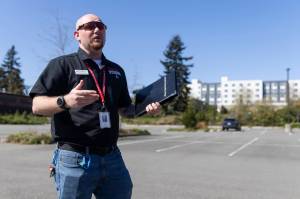
Burden, dressed in a bright-orange road worker’s vest and orange hat, drew nervous laughs from the group on Thursday as he stepped out into the middle of busy streets and plopped a metal tape measure down onto the asphalt.
In some cases, the side streets in downtown Marysville are too wide, inviting cars to drive too fast, he said. Adding angled parking on those streets could slow cars down and reduce the need for asphalt for off-street parking, he said.
Both on the tour and during the training, Burden challenged the city staff’s emphasis on trying to move as many cars through the city as quickly and efficiently as possible.
Staff members have said traffic is the No. 1 complaint they receive, and they scramble to find money to widen streets to move cars through. This, however, just invites more congestion, Burden said during the walk on Thursday.
“Once you dedicate your town to the car, all you get is a town full of cars,” he said.
The discussion was sparked as the group stood at the intersection of First Street and State Avenue, near the waterfront. On Thursday at 2 p.m., the street was quiet, causing Burden to do a double-take when city staff told him it carries 20,000 vehicles a day.
A lot of that traffic is during the morning and afternoon rush hours, when people are cutting through on their way to or from work, staff members said.
To change those habits would require a major change in lifestyles, city public works director Kevin Nielsen said. More people would need to live closer to where they work.
“We’re talking social engineering,” he said.
Burden acknowledged that some of his ideas are hard for auto-addicted Americans to swallow. With the recent spike in fuel prices, however, that change in thinking might be coming sooner than later.
“It’s a cultural shift,” he said.
City staff had been mulling the idea of expanding First Street to five lanes, with two lanes and a center turn lane, Hirashima said. Burden, however, said five-lane roads don’t move any more cars and can lead to more accidents. A four-lane boulevard with a divided center, or even a three lane road, moves just about as much traffic and is safer, Burden said.
Hirashima said the city will give serious consideration to Burden’s ideas.
“He’s given us an outside perspective that challenges us to go back and take a look at ideas we’ve never really considered,” she said.
Other observations by Burden:
Marysville could use more population density in its core to generate the customers for businesses that thrive on foot traffic.
Roundabouts are helpful for moving traffic and increasing safety, and it’s a myth that they’ve bad for pedestrians. Roundabouts and other types of islands give pedestrians a halfway, stopping-off point.
Pedestrian overpasses aren’t good because they’re expensive, ugly and often underused.
Some examples of good walking towns comparable in size to Marysville are downtown Kirkland, Edmonds and Port Townsend; Victoria, B.C., for a mid-size city; and Vancouver, B.C., and Washington, D.C., for larger cities.
“I’ve never found the perfect block in North America,” Burden said. “So far, it’s never been built.”
Reporter Bill Sheets: 425-339-3439 or sheets@heraldnet.com.