Here is what you’ll be seeing in the October night sky
Published 1:30 am Sunday, October 2, 2016
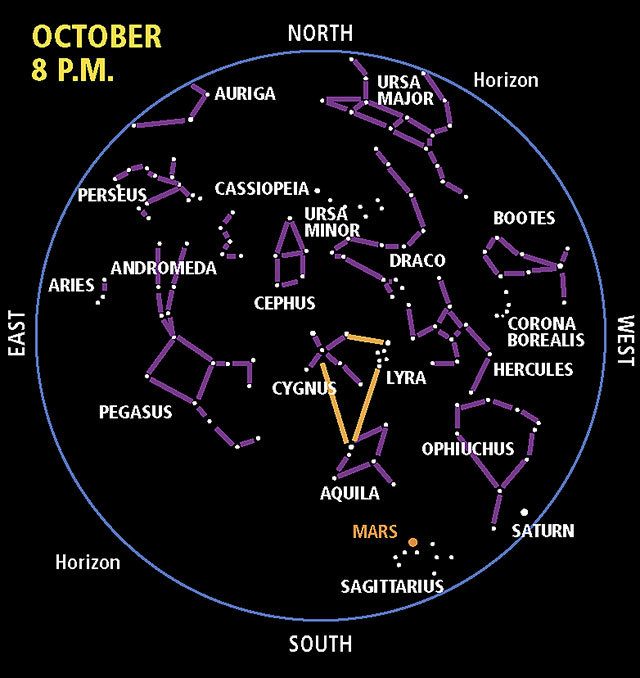
It’s really autumn now, and it’s a really wonderful time to get out and enjoy the absolute beauty of the Everett night sky. We’re entering the prime time of stargazing season. The nights are longer and because there’s less moisture in the air the skies are more transparent and the stars really pop out at you. Even if you’re not a big time stargazing fan, you owe yourself the treat of lying back on a reclining lawn chair and taking in the celestial happenings. The dark skies away from heavy light pollution are best, but even city skies can be great show.
The planets Mars and Saturn are still both visible in early October, but only for a brief time in the early evening hanging in the low southwestern skies. They’re the brightest star-like objects in that part of sky. Mars is on the left and Saturn is close by to the lower right. Check them out as soon as you can after dark because they pretty much disappear below the horizon after 9:30 or so. These planets are not going to be all that impressive through a telescope. They’ll be pretty fuzzy and that’s because they’re so close to the horizon, where Earth’s thicker layer of atmosphere comes between us and the residents of the night sky. You should be able to make out Saturn’s ring system, but I’m afraid Mars will just be a fuzzy red dot. Later this week the new crescent moon will track above those planets. On Thursday evening, the moon will be parked just to the right of Saturn. On Friday and Saturday nights the moon will have advanced eastward and will be just to the upper right, and then to the upper left of Mars on those successive evenings.
Even though it’s autumn, summer is hanging on in the western sky. You can still easily see the famous “Summer Triangle” high above the western horizon, made up of three bright stars from three separate constellations. There’s Vega in the constellation Lyra the Harp; Altair in Aquila the Eagle; and Deneb, the brightest star in Cygnus the Swan. Cygnus is also known by a lot of stargazers as the “Northern Cross”.
If you’re far enough away from the city lights, you may see the bright Milky Way Band, the thickest part of our home galaxy, stretching from the northeast to southwest horizon.