Donald Trump’s ‘armada’ can’t knock down North Korean missiles
Published 1:30 am Wednesday, April 26, 2017
By Tony Capaccio, Bloomberg
The U.S. Navy flotilla sailing toward the Korean peninsula to deter Kim Jong Un’s regime lacks a key capability: It can’t shoot down ballistic missiles.
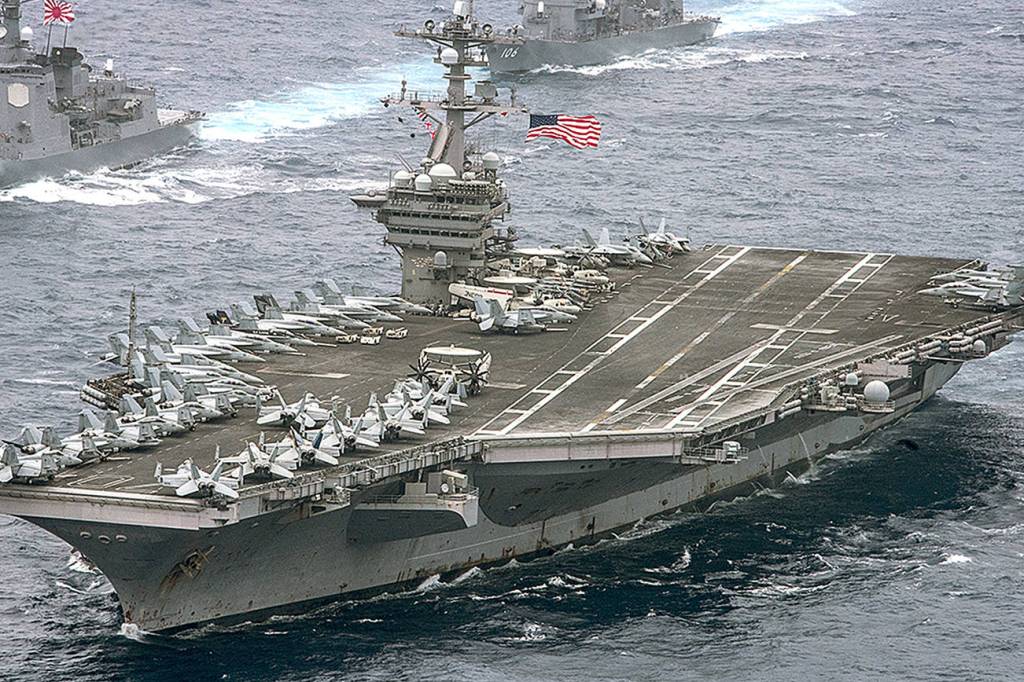
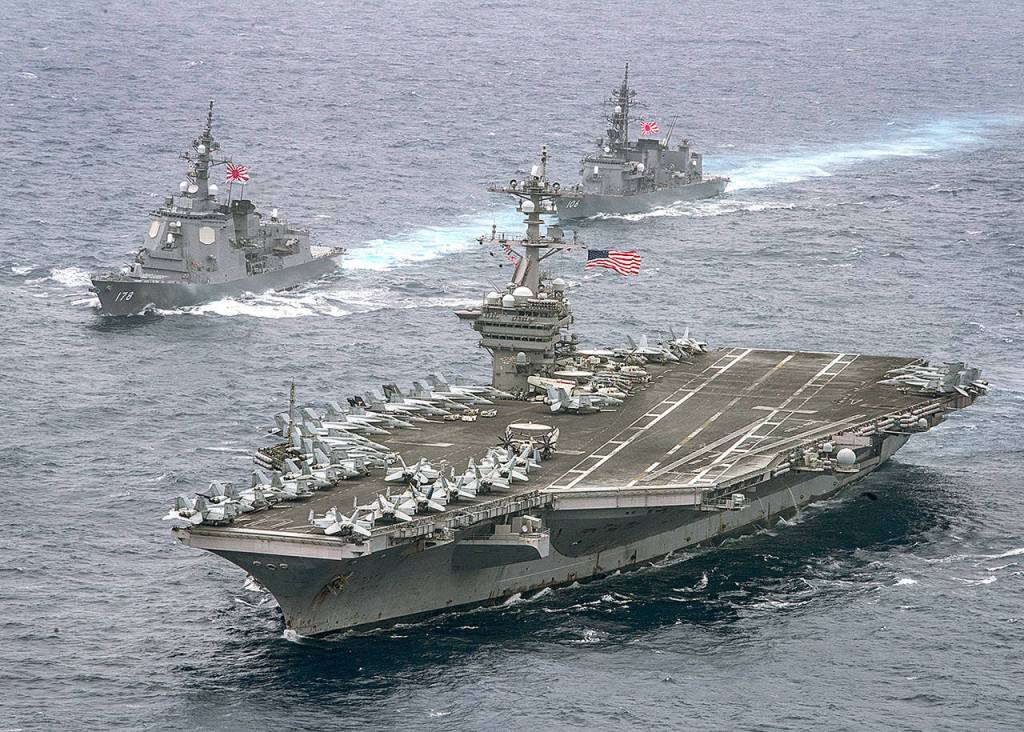
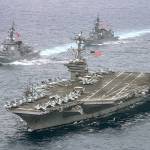
The USS Carl Vinson and the aircraft carrier’s accompanying destroyers and cruiser are expected to arrive in waters near the peninsula this week, carrying a full complement of weaponry, including scores of Tomahawk cruise and anti-ship missiles, radar-jamming aircraft and non-stealthy “Super Hornet” jets built by Boeing.
That firepower brings a lot to any fight, but the Navy’s lack of ballistic missile defense capability on the scene means the Trump administration’s high-profile show of force has a significant gap as it warns North Korea against another missile test and pressures it to back down from its nuclear program.
“One carrier by itself is not a game changer,” Omar Lamrani, a senior military analyst at Stratfor, a company that does geopolitical analysis, said in an interview. Although the Vinson-led group is getting a lot of attention, it’s “not going to do terribly much by itself,” he said.
Tensions on the peninsula have ratcheted up as President Donald Trump and Kim face off over North Korea’s continuing development of its nuclear and intercontinental ballistic missile program. Trump vowed in January that he wouldn’t let North Korea develop a nuclear weapon capable of reaching the U.S., and he said this month that the U.S. was sending an “armada” to the region. North Korea, in turn, called the Vinson’s deployment “intimidation and blackmail” and promised it would “react to a total war with an all-out war.”
This week the regime in Pyongyang conducted a live-fire artillery exercise east of the capital, while the USS Michigan, a nuclear-powered submarine capable of carrying 154 Tomahawks, arrived at the South Korean port of Busan. In a highly unusual move, the Navy publicly announced the visit. But North Korea, which marked the 85th anniversary of its army during the week, didn’t conduct another nuclear test.
Accompanying the Vinson, which is en route from the Philippine Sea south of Japan, are the destroyers USS Wayne E. Meyer and USS Michael Murphy and the Ticonderoga-class guided-missile cruiser USS Lake Champlain. They aren’t equipped with the version of the Aegis surveillance system made by Lockheed Martin that can track long-range ballistic missiles or Raytheon’s SM-3 interceptors that are capable of bringing down medium and longer-range ballistic missiles.
Nor are the modern Japanese Navy destroyers JS Samidare and JS Ashigara that joined the Vinson group for exercises equipped for missile defense detection or intercepts, a Japanese Navy spokesman confirmed. And the three South Korean “Sejong the Great”-class destroyers currently in operation don’t have ballistic missile defense capability, Tom Callender, a naval forces analyst with the Washington-based Heritage Foundation, said in an interview.
While the Obama administration began the process of deploying Thaad, a high-altitude missile defense system, to the South Korean mainland, the hardware isn’t fully operational yet either. That leaves Seoul — just 35 miles (56 kilometers) south of the demilitarized zone — and the rest of the country more vulnerable to attack.
Asked about the Vinson carrier group, Navy Cmdr. Gary Ross, a Pentagon spokesman, said via email that “we don’t discuss specific capabilities of weapons systems.” He added that “no single capability defends against all threats. Rather it is the employment of integrated, multi-layered land and sea-based systems that provide missile defense” for the U.S. and allies.
If the Trump administration wants to buttress its threats — at the risk of escalating the crisis — it could deploy toward Korea some or all of the six Navy vessels capable of defending against ballistic missiles that are now based at Yokosuka, on the eastern side of Japan. Just moving those ships toward the Korean peninsula would signal to the world U.S. action to stop a missile test is more imminent and would be seen as an urgent threat by Pyongyang.
The six vessels are the cruiser USS Shiloh and the destroyers USS Stethem, Barry, Benfold, Curtis Wilbur and John S. McCain. A seventh, the Fitzgerald, is currently at sea conducting a maritime exercise in waters west of Japan, the Navy said in a statement.
Those U.S. ships “would be in a good position to engage medium-range ballistic missiles going into the Sea of Japan, which is where the previous North Korean test shots have gone,” said Bryan Clark, a naval analyst with the Washington-based Center for Strategic and Budgetary Assessments, who previously served as a special assistant to the Chief of Naval Operations.
That presence off of Japan means that “when the Vinson gets there, it will not need to bring additional BMD capability,” Clark added, referring to ballistic missile defense.
The cruisers and destroyers “bring a significant capability to the region,” Lieutenant Commander William Knight, spokesman for the Navy Pacific Fleet, said in an email.
Yet even if Aegis-equipped vessels are stationed near Korea and Japan, in the case of a North Korean ICBM test they wouldn’t be able to shoot it down immediately after launch, said David Wright, a missile defense analyst with the Union of Concerned Scientists.
“There is a misconception that if it was close enough,” a U.S. Navy BMD vessel “could shoot a missile down during boost phase,” Wright said. “But it doesn’t have that capability. During boost phase the missile is an accelerating target, and Aegis doesn’t have the maneuverability to home in on such a target.”
“Similarly, it would not be able to shoot down shorter-range missiles, like the Musudan, during boost phase,” he said. “You might be able to shoot it down after boost phase, but by that time North Korea would be able to get information about the most critical part of the trajectory, so that strategy is unlikely to slow” the regime’s missile development process, he said.
The Carl Vinson and its four strike squadrons of aircraft plus escort vessels with more than 300 Tomahawk and air-defense missiles “provide an impressive non-nuclear strategic deterrent,” the Heritage Foundation’s Callender said. The Vinson’s aircraft include the latest Super Hornets and Growler electronic jamming aircraft.
Tomahawks are highly capable of striking surface targets such as air defense systems, but they aren’t designed for missile defense or penetrating deeply buried facilities, bunkers or caves. The current “Tactical Tomahawk” version is capable of loitering over an area and being re-directed against new targets, such as wheeled or tracked missile launchers and mobile artillery.
If the U.S. were to conduct a preemptive strike on North Korea, the Vinson’s role would be to enable missions by stealthy B-2 bombers and F-22 fighters, Clark said.
The Vinson fleet would need to use its radar-jamming capabilities and Tomahawks to degrade North Korea’s existing air defense system “before conducting strikes against North Korean nuclear or missile facilities,” Clark said.
Strafor recently completed an assessment of North Korea’s nuclear challenge and plausible U.S. responses that concluded the regime has more than 1,000 missiles of various ranges and destructive power that could strike from across North Korea.
But their military utility is limited by the relatively small number of launchers, which would have to be reloaded for successive launches and vulnerable to U.S. and South Korean strikes.