An aerial photo shows the locations of two earthquakes and five aftershocks in and near Monroe, which rattled the Puget Sound region on July 12. The first was the magnitude 4.6 quake at upper right, 13 miles under the intersection of U.S. 2 and Fryelands Boulevard SE at 2:51 a.m. The second, magnitude 3.5, occurred 18 miles under the Old Snohomish-Monroe Road at 2:53 a.m. The aftershocks followed during the ensuing two hours. This image depicts an area about 3 miles wide. (Herald staff and the Pacific Northwest Seismic Network)

An aerial photo shows the locations of two earthquakes and five aftershocks in and near Monroe, which rattled the Puget Sound region on July 12. The first was the magnitude 4.6 quake at upper right, 13 miles under the intersection of U.S. 2 and Fryelands Boulevard SE at 2:51 a.m. The second, magnitude 3.5, occurred 18 miles under the Old Snohomish-Monroe Road at 2:53 a.m. The aftershocks followed during the ensuing two hours. This image depicts an area about 3 miles wide. (Herald staff and the Pacific Northwest Seismic Network)

July’s Monroe earthquake is informing plans for future danger

Gathered by lucky accident, data from the 4.6-magnitude quake could help assess bigger hazards.

MONROE — The magnitude 4.6 Monroe earthquake felt by thousands of Puget Sound-area residents in July is helping scientists assess how future quakes will impact the region.

The relatively tame event was serendipitous for a group of scientists from Harvard, the University of Washington and the Pacific Northwest Seismic Network.

Just over a week before the earthquake hit, the group placed seismometers throughout the Seattle-Tacoma area to record how background noises like traffic or swaying trees interacted with the area’s geology.

The scientists planned to study the Seattle and Tacoma sedimentary basins — depressions filled with soft sediment, rather than rock — to learn more about how they’re shaped.

But when the Monroe earthquake hit, they got more data than they bargained for.

Seattle, Tacoma and Everett all lie within some of Puget Sound’s largest basins. These areas magnify how much the ground shakes in an earthquake.

“You can think of a basin as a bowl of Jello-O,” said Alex Hutko, a project lead with the Seismic Network.

If the bowl is shaking, the stack of Jell-O inside it shakes even more.

Seattle, Tacoma, Everett and Mukilteo all lie within some of Puget Sound’s largest basins. These areas magnify how much the ground shakes in an earthquake. (Erin Wirth)

Seattle, Tacoma, Everett and Mukilteo all lie within some of Puget Sound’s largest basins. These areas magnify how much the ground shakes in an earthquake. (Erin Wirth)

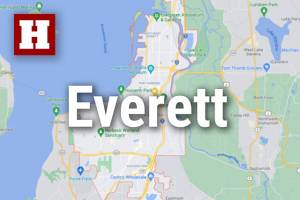
Everett’s basin is centered under Hat Island in Possession Sound and extends north to Marysville, east to Granite Falls and west past Whidbey Island.

With the data retrieved during the Monroe earthquake, U.S. Geological Survey geophysicist Erin Wirth said scientists are now able to study just how much basins amplify ground shaking.

The amount a basin increases shaking is the same regardless of an earthquake’s magnitude, so the data will help them determine how future, bigger quakes will impact Puget Sound’s urban areas, Wirth said.

But each basin is unique. The Seattle Basin won’t magnify shaking the same way Everett’s will.

Scientists are still combing through the data, and results won’t be published for months to a year. In the meantime, Wirth said, they’re learning just how crucial it is to know how urban basins will respond to larger-magnitude earthquakes.

The amplification will affect tall structures the most, she said, so the research could inform how buildings are built to withstand shaking.

“This has driven home the need to have these (instruments) in these basins permanently,” Wirth said.

Julia-Grace Sanders: 425-339-3439; jgsanders@heraldnet.com.
Talk to us

> Give us your news tips.

> Send us a letter to the editor.

> More Herald contact information.

More in Local News

People fish from the pier, hold hands on the beach and steer a swamped canoe in the water as the sun sets on another day at Kayak Point on Monday, June 12, 2023, in Stanwood, Washington. (Ryan Berry / The Herald)
Kayak Point Park construction to resume

Improvements began in 2023, with phase one completed in 2024. Phase two will begin on Feb. 17.

Everett
Everett to pilot new districtwide neighborhood meetings

Neighborhoods will still hold regular meetings, but regular visits from the mayor, city council members and police chief will take place at larger districtwide events.

A truck drives west along Casino Road past a new speed camera set up near Horizon Elementary on Wednesday, May 8, 2024 in Everett, Washington. (Olivia Vanni / The Herald)
Crashes, speeding down near Everett traffic cameras

Data shared by the city showed that crashes have declined near its red light cameras and speeds have decreased near its speeding cameras.

Community Transit is considering buying the Goodwill Outlet on Casino Road, shown here on Tuesday, Jan. 6, 2026 in Everett, Washington. (Will Geschke / The Herald)
Community Transit to pay $25.4M for Everett Goodwill property

The south Everett Goodwill outlet will remain open for three more years per a proposed lease agreement.

Logo for news use featuring Snohomish County, Washington. 220118
Parent support collaborative worries money will run out

If funding runs out, Homeward House won’t be able to support parents facing drug use disorders and poverty.

Carlos Cerrato, owner of Taqueria El Coyote, outside of his food truck on Thursday, Jan. 29, 2026 in Lynnwood. (Olivia Vanni / The Herald)
Everett proposes law to help close unpermitted food carts

The ordinance would make it a misdemeanor to operate food stands without a permit, in an attempt to curb the spread of the stands officials say can be dangerous.

An Everett Transit bus drives away from Mall Station on Monday, Dec. 22, 2025, in Everett, Washington. (Olivia Vanni / The Herald)
Everett Transit releases draft of long-range plan

The document outlines a potential 25% increase in bus service through 2045 if voters approve future 0.3% sales tax increase.

Lake Stevens robotics team 8931R (Arsenic) Colwyn Roberts, Riley Walrod, Corbin Kingston and Chris Rapues with their current robot and awards on Thursday, Jan. 29, 2026 in Lake Stevens, Washington. (Olivia Vanni / The Herald)
Lake Stevens robotics team receives world recognition

Team Arsenic took second place at the recent ROBO-BASH in Bellingham, earning fifth place in the world.

Leslie Wall in the Everett Animal Shelter on Jan. 6, 2026 in Everett, Washington. (Will Geschke / The Herald)
Everett Animal Shelter gets $75k in grants, donations

The funds will help pay for fostering and behavioral interventions for nearly 200 dogs, among other needs.

Everett
One man was injured in Friday morning stabbing

Just before 1 a.m., Everett police responded to a report of a stabbing in the 2600 block of Wetmore Avenue.

x
Paraeducator at 2 Edmonds schools arrested on suspicion of child sex abuse

On Monday, Edmonds police arrested the 46-year-old after a student’s parents found inappropriate messages on their daughter’s phone.

Isaac Peterson, owner of the Reptile Zoo, outside of his business on Tuesday, Aug. 19, 2025 in Monroe, Washington. (Olivia Vanni / The Herald)
On Monday, The Reptile Zoo is slated to close for good

While the reptiles are going out, mammals are coming in with a new zoo taking its spot.

Support local journalism

If you value local news, make a gift now to support the trusted journalism you get in The Daily Herald. Donations processed in this system are not tax deductible.