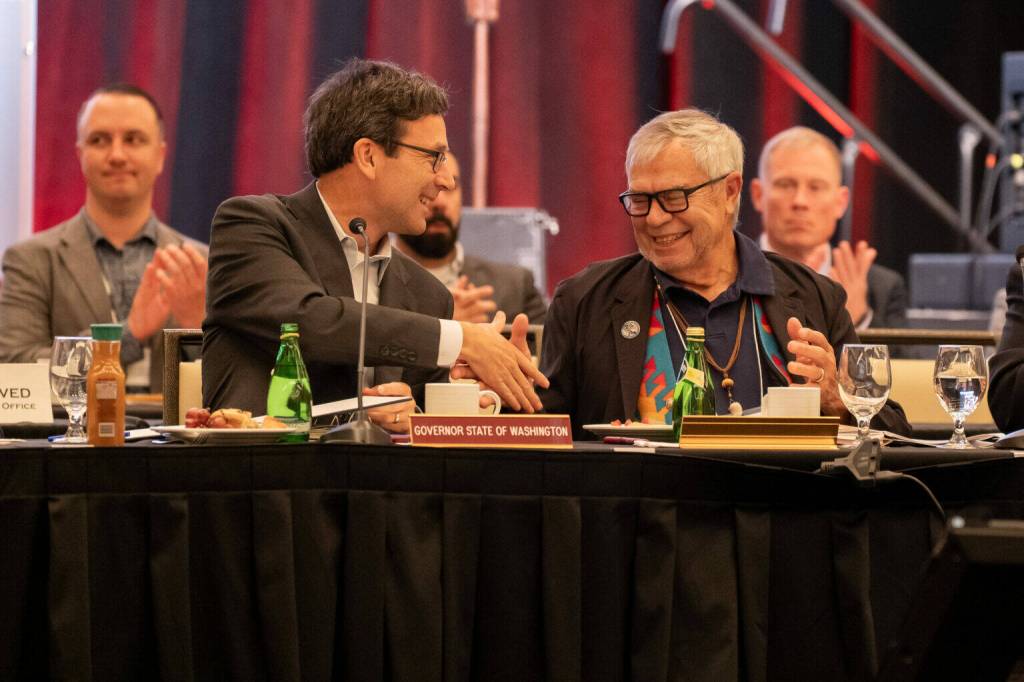
Washington Gov. Bob Ferguson, left, shakes hands with Cowlitz Indian Tribe Chairman Bill Iyall after signing an executive order to improve the state’s relations with tribal governments on Wednesday. (Photo courtesy of Washington governor’s office)

WA governor moves to improve state consultation with tribes

A new directive expands tribal relations training for state workers among other actions. Tribal leaders voiced support.

  • By Jerry Cornfield Washington State Standard
  • Thursday, October 23, 2025 1:58pm
  • Local NewsNorthwest

Gov. Bob Ferguson signed an executive order Wednesday to strengthen how the state consults and works with Native American tribes in Washington.

It calls for drafting new policies for tribal consultation and requires expanded training for state workers on sovereignty and other issues related to understanding the unique nature of the ties between the state and tribal governments.

Tribal leaders applauded the move, but also flagged ongoing tensions in the relationship.

In addition, the Governor’s Office of Indian Affairs will get a permanent seat in Ferguson’s executive cabinet and expanded authority and responsibility to carry out the order’s directives.

“I’ve heard from Tribal leaders about how we can improve our partnership with Tribal governments,” Ferguson said in a statement. “I’m putting that feedback into action and laying out my vision for fostering meaningful government-to-government relationships.”

Ferguson signed the six-page order to kick off Wednesday’s session of the 2025 Centennial Accords meeting hosted by the Cowlitz Indian Tribe in southwest Washington. This was Ferguson’s first time attending as governor.

The Centennial Accord, a 1989 agreement signed by then Washington Governor Booth Gardner and leaders of federally recognized tribes, is a framework for relations between the state and tribal governments. Representatives gather each year to take stock of how the relationship is evolving. Historically open to the media, this year’s event was closed to the press.

Washington has several laws concerning interactions with tribes. Agencies must have a tribal liaison, for example. And there are already training mandates for employees.

In Wednesday’s meeting, tribal leaders said the executive order provides the heft needed to improve relations in a material way.

“It means a lot to Indian Country,” said Cindy Marchand, secretary of the Colville Confederated Tribes.

Kadi Bizyayeva, vice-chair of the Stillaguamish Tribe, told Ferguson the order “definitely demonstrates that you’re being perceptive of tribal concerns. I’m grateful for the opportunity to continue forging ahead and building relationships together with the state.”

Cowlitz Indian Tribe Chairman Bill Iyall, reached during the lunch break, said the provisions will solidify the executive branch’s commitment to consultation.

“In the past, it was mostly checking a box. This is a new mandate for early communication and regular communication,” he said.

Ferguson, in the meeting, said the order is a step toward ensuring sovereignty is respected and encouraged tribal leaders to reach out when it’s not working.

“For those of you who know me, you know, I don’t mind direct conversations,” he said. “I don’t take things personally if you’ve got a challenge with what’s going on with the state or a decision I’m making. Direct and candid. That’s how we move forward.”

Loni Greninger, vice chair of the Jamestown S’Klallam Tribe, did so a few minutes later.

“Why is it so hard for the state to uphold trust and treaty obligations and other obligations that are described outside of treaties?” she said. “I want to ask this challenging question, to be transparent and to be direct, but also in a sense of how we figure this out together.”

She theorized it was because state laws get passed without taking those agreements into account. Those statutes become a barrier to finding a remedy, she surmised.

In response, Ferguson spoke more generally on how changing the culture of government is hard. The training envisioned in the executive order should expand knowledge of employees and lead to lasting change, he said.

Teri Gobin, chair of the Tulalip Tribes, flagged the importance of the training, noting that sometimes what is discussed with agency leaders is not passed down to the staff. “So thank you for moving ahead in this way and listening to our concern,” she said.

Another element of the executive order calls for protecting sensitive information, described as Indigenous Knowledge, exchanged in the course of government-to-government discussions. Tribes want to prevent information, such as locations of cultural resources, from being divulged.

“We’ve been victimized,” Iyall said, referring to when people disturb cultural sites or objects.

The Office of Indian Affairs must deliver a report to Ferguson by next October with recommendations for improvements to existing policies or practices.

The Centennial Accord meetings will continue Thursday with discussions on natural resources, education, state budget, tribal economies and health care.

This story was originally published in the Washington State Standard.

Talk to us

> Give us your news tips.

> Send us a letter to the editor.

> More Herald contact information.

More in Northwest

Gov. Bob Ferguson signing Senate Bill 5480, a bill exempting medical debt from credit reports, on April 22. (Photo by Jacquelyn Jimenez Romero/Washington State Standard)
WA’s new ban on medical debt in credit reports at risk of federal override

The Trump administration wants to reverse Biden-era guidance on the issue.

The U.S. Capitol building in Washington, D.C., on May 7, 2025. (Photo by Jennifer Shutt/States Newsroom)
End of shutdown ignites sparring among congressional lawmakers

Meanwhile, U.S. Rep. Marie Gluesenkamp Perez was among six Democrats who sided with Republicans in voting the legislation out of the House.

Attorney General Nick Brown has proposed new advice for locales on how to interpret state public records law, with a focus on providing records faster. (Stock photo)
Need for speed: Plan to unclog WA public records system gets mixed reviews

Washington’s attorney general is seeking to reduce public record backlogs as concerns… Continue reading

Washington state Commissioner of Public Lands Dave Upthegrove waves to the crowd during inauguration ceremonies at the Washington state Capitol, in Olympia, on Jan. 15, 2025. (Photo by Ryan Berry/Washington State Standard)
Dave Upthegrove on land sales, federal funding cuts and wildfire immigration raids

Washington state’s new public lands commissioner came into office with his own ambitious agenda. It’s playing out against a shifting backdrop in D.C.

The so-called “big, beautiful bill” that congressional Republicans approved in July included a total of $50 billion for the Rural Health Transformation Program. The money is meant to offset some of the expected damage to rural hospitals from the law’s steep cuts to Medicaid. (Olivia Vanni / The Herald)
Washington makes pitch to feds for $1B in rural health funding

The money was included in Republicans’ “big, beautiful bill.” The state’s goals include strengthening the rural health workforce and improving care in tribal communities.

Screenshot from the state Employment Security Department’s website at esd.wa.gov. (File photo)
Expected slide in WA unemployment trust fund balance could trigger new tax

Washington businesses would need to shoulder roughly $700 million in additional taxes… Continue reading

The Washington state Capitol. (Jerry Cornfield/Washington State Standard)
State Democrats mull imposing income tax on higher earners

The idea is brewing ahead of the 2026 legislative session. It would target those making above $1 million. The state is one of nine that does not tax wages.

Washington state Commissioner of Public Lands Dave Upthegrove speaks at a press conference on wildfire issues Monday in Tumwater. (Photo by Bill Lucia/Washington State Standard)
Climate dollars eyed to backfill WA wildfire funding

Washington’s lands commissioner, Dave Upthegrove, is on a mission to secure $60… Continue reading

Washington Gov. Bob Ferguson, left, shakes hands with Cowlitz Indian Tribe Chairman Bill Iyall after signing an executive order to improve the state’s relations with tribal governments on Wednesday. (Photo courtesy of Washington governor’s office)
WA governor moves to improve state consultation with tribes

A new directive expands tribal relations training for state workers among other actions. Tribal leaders voiced support.

New map tracks measles exposures across Washington

Afraid you may have been exposed to measles? Washington’s Department of Health… Continue reading

A combine at work in wheat fields in the Walla Walla region during 2018. (Washington State Department of Agriculture)
State halts rebates to farmers hit with fuel fees under WA climate law

Instead, a new online directory shows retailers who provide the farm fuel exemption by not imposing surcharges.

Washington transportation officials say a lack of funding means dollars intended for preservation and maintenance are the ones diverted to deal with emergency situations. Before (left) and after (right) photos of the mudslide and cleanup on State Route 20 following an Aug. 11 mudslide. (Washington State Department of Transportation)
‘Early stages of critical failure’: Outlook grim for road upkeep

Billions more dollars are needed for preserving highways and bridges, WSDOT says. The agency’s leader didn’t request more maintenance money for 2026.

Support local journalism

If you value local news, make a gift now to support the trusted journalism you get in The Daily Herald. Donations processed in this system are not tax deductible.