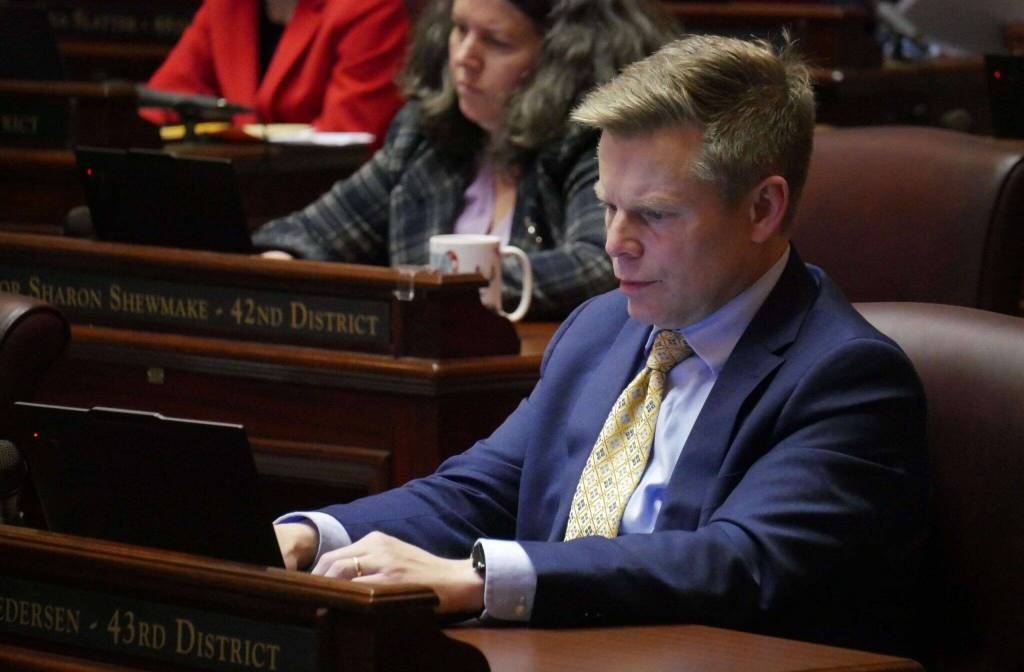
Senate Majority Leader Jamie Pedersen, D-Seattle, during Senate floor debate on Jan. 28, 2026. (Photo by Bill Lucia/Washington State Standard)

Senate Majority Leader Jamie Pedersen, D-Seattle, during Senate floor debate on Jan. 28, 2026. (Photo by Bill Lucia/Washington State Standard)

WA Senate leader explains dim outlook for a new tax on big businesses

Senate Majority Leader Jamie Pedersen previously backed the payroll tax, but suggests there’s no political path for it. He and others are forging ahead with an income tax proposal.

  • By Jerry Cornfield Washington State Standard
  • Tuesday, February 3, 2026 12:26pm
  • Northwest

A year ago, Senate Majority Leader Jamie Pedersen, D-Seattle, signed onto legislation to create a statewide version of a Seattle tax on the payrolls of Washington’s largest employers.

But it didn’t gain traction as the Democrat-led Legislature settled on other means of raising more than $9 billion in taxes from businesses over four years to bridge an operating budget gap.

This year, Pedersen has signalled the payroll expense tax is a nonstarter, even as his district seatmate in the House, Democratic Socialist Rep. Shaun Scott, has become the driving force for it.

Pedersen’s focus is an income tax bill he’s authored on households earning over $1 million a year. It will be unveiled Tuesday.

Pro-tax activists are frustrated at the lack of interest in the payroll tax from Democratic legislative leaders and Democratic Gov. Bob Ferguson.

They want both tax ideas pursued with equal exuberance. They also suspect a fix is in: That corporate interests won’t fight the “millionaire’s tax” as long as the payroll levy — which business leaders detest — doesn’t move.

Washington faces a budget challenge with a slowing economy and expected increased demand for services due to changes in federal law. Payroll tax proponents argue that the tax can raise money quickly to solve these pressures, whereas the income tax will take years to implement.

With the imminent arrival of the income tax legislation, the Standard tracked down Pedersen for a quick conversation on the situation. The following interview was lightly edited for clarity and length.

The payroll expense tax you sponsored last session is still alive. And there’s a new version in the House. Yet you’ve made clear the Senate bill won’t be heard and have made less than friendly comments toward the House bill. What’s changed?

We had a big discussion about it. The end result was that by the time we had to decide what our strategy was going to be for funding the budget last year, we probably didn’t have 10 votes in our caucus for that bill.

Did you make a deal with leaders of big companies that if you did not pass the payroll expense tax, they wouldn’t oppose your efforts on the millionaire’s tax?

There isn’t any deal right now.

Some of them were concerned that the approach (last session) was more adversarial than it needed to be, that there was a way of working together that they wanted us to get back to so that they could help us solve the problems that we have.

Where that may be possible on the millionaire’s tax, that is absolutely not a possibility on the payroll tax. For a lot of them, that is existential about their ability to grow in this market.

But you still need revenue for this budget. The payroll tax would produce it faster than the income tax.

That is a falsehood that is coming from certain people who want to make people believe that there’s not a problem in the current budget that we can’t solve with additional revenue. Both of them could go into effect in 2028.

A persistent criticism from leaders of the largest statewide business organizations is that a payroll tax will drive companies from the state. Do you share their concern?

No matter what tax we do, there’s some suggestion like, ‘Oh, you’re gonna cause people to leave.’ That is a universal claim, sometimes borne out, sometimes not borne out.

Speaking for myself, I have learned over the last few years that when we do badly is when our tax system is out of alignment with the mainstream.

Probably the most hated tax that we have in the state is the B&O (business and occupation) tax. It’s riddled with exemptions and preferential rates. It’s constantly being lobbied and it’s not a surprise that 91 years after we enacted it, there’s not one single other place on Earth that has decided to follow us in taxing gross receipts.

We have pretty high aggregate business taxes. We’re probably in the top five. Our estate tax, when we increased the top marginal rate, we were the highest in the entire country. That echoes some of the concerns that we heard from the governor and others about the wealth tax (last year) and being the only state in the country that would have something like that.

By contrast, we did something like capital gains tax, which is just very middling in terms of how most places tax capital gains. Not much of a ripple on that and a good revenue stream that started up for the state. Similarly the millionaire tax establishes this relatively modest tax on income only above $1,000,000. Forty-one states have income taxes. You’re not creating a giant incentive (to leave).

Now, how do you evaluate the payroll tax? We’ve certainly imposed some other payroll taxes where that has not caused a giant exodus. There’s some indication that some of our more prominent employers have grown jobs more in Bellevue than in Seattle since the imposition of the JumpStart tax, you know. So that’s a factor to consider.

It’s also probably worth noting that they, the people who really didn’t want that tax to happen, were in the process of amassing a pretty significant war chest with a direct threat that they were going to undo it with an initiative.

Speaker (Laurie) Jinkins, Representative (Joe) Fitzgibbon, and I have been consistently engaging the business community to figure out how we can get them at least to be neutral, if not to being supportive, of an individual tax on millionaires.

This story was originally published by the Washington State Standard.

Talk to us

> Give us your news tips.

> Send us a letter to the editor.

> More Herald contact information.

More in Northwest

Senate Majority Leader Jamie Pedersen, D-Seattle, makes remarks on Monday during the floor debate over legislation he sponsored to tax personal income over $1 million a year. (Photo by Bill Lucia/Washington State Standard)
Washington state Senate approves tax on personal income over $1M

The bill will next go to the House, as Gov. Bob Ferguson is indicating he’d like to see more changes.

Sen. John Lovick, D-Mill Creek, on the Senate floor on Feb. 12, 2026, remarks about his bill to set stricter standards for sheriffs. The legislation was approved, sending it to the House. (Photo by Bill Lucia/Washington State Standard)
Stricter standards for Washington sheriffs approved in state Senate

A lead law enforcement group and Republicans are opposed. The bill would provide a way for the state to remove elected sheriffs and restrict volunteer posses.

A voter puts a ballot in the drop box at the Ballard branch of the Seattle Public Library in King County in August 2024. This voting location is one of the most popular in the county. (Laurel Demkovich/Washington State Standard)
Tighter rules for challenges to voter registrations clear WA House

A spike in challenges by conservatives is fueling Democrats’ desire to make changes that will curtail frivolous claims. The bill next goes to the Senate.

The Washington state Capitol on Friday. (Photo by Bill Lucia/Washington State Standard)
WA income tax on higher earners clears first legislative hurdle

Democrats rejected GOP amendments before pushing their tax on millionaires through a Senate committee. The bill was revised to expand an exemption for small businesses and make other changes.

Washington Gov. Bob Ferguson, left, shakes hands with Cowlitz Indian Tribe Chairman Bill Iyall after signing an executive order to improve the state’s relations with tribal governments on Oct. 22, 2025. (Photo courtesy of Washington governor’s office)
Washington tribes could get more say in management of state logging lands

A bill to add two tribal representatives to the Board of Natural Resources is awaiting a Senate vote. Supporters say the change could add valuable perspective to the panel.

A view of the Washington state Capitol building in Olympia, obscured by a slight mist, Jan. 27, 2025. (Photo by Bill Lucia/Washington State Standard)
The bills that didn’t survive the WA Legislature’s first major deadline

A 60-day legislative session can be a cruel thing if you’re hoping… Continue reading

Washington State Capitol building in Olympia. (Courtesy photo)
Ferguson rejects WA lawmakers’ initial crack at income tax legislation

The Democratic proposal targets household earnings over $1 million.

Senate Majority Leader Jamie Pedersen, D-Seattle, during Senate floor debate on Jan. 28, 2026. (Photo by Bill Lucia/Washington State Standard)
WA Senate leader explains dim outlook for a new tax on big businesses

Senate Majority Leader Jamie Pedersen previously backed the payroll tax, but suggests there’s no political path for it. He and others are forging ahead with an income tax proposal.

State Sen. John Lovick, D-Mill Creek, looks on toward the end of the roll call vote for his Senate Bill 5067, which would lower the blood alcohol limit for drunk driving to 0.05% from 0.08% in Washington. The bill passed the Senate on a 26-23 vote on Jan. 28, 2026. (Photo by Bill Lucia/Washington State Standard)
Lower drunk driving limit approved by WA Senate

The bill drops it to 0.05%, and the state would join Utah with the toughest standard in the nation. It still needs House approval.

Washington state Supreme Court Justice Colleen Melody is sworn in Wednesday, Jan. 21, 2026, in Olympia, Washington. (Photo by Jake Goldstein-Street/Washington State Standard)
Washington’s newest Supreme Court justice is sworn in

Colleen Melody is officially the Washington state Supreme Court’s newest justice. Melody… Continue reading

Bill Lucia / Washington State Standard
State Sen. Yasmin Trudeau, D-Tacoma, makes floor remarks on Feb. 4, 2026 about Senate Bill 6002, which would set state regulations for license plate readers. The bill passed 40-9, with only Republicans opposed.
WA Senate OKs guardrails for license plate readers

The legislation passed Wednesday mandates that reader data be deleted after 21 days and says it can’t be shared except in court proceedings.

Washington Gov. Bob Ferguson at his State of the State address on Jan. 13, 2026. Ferguson did not discuss the budget cuts he’s proposing in his speech but they’ve stoked plenty of testimony in the first days of the 2026 legislative session. (Photo by Bill Lucia/Washington State Standard)
An icy reception for Gov. Bob Ferguson’s proposed budget cuts

Advocates for schools, public universities, and climate programs are among those unhappy with the raft of cuts the governor relies on to close a $2.3 billion shortfall.

Support local journalism

If you value local news, make a gift now to support the trusted journalism you get in The Daily Herald. Donations processed in this system are not tax deductible.