Comment: Shutdown? America getting used to broken government
Published 1:30 am Thursday, October 16, 2025
By Abby McCloskey / Bloomberg Opinion
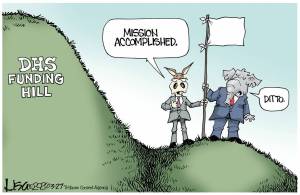
The government shutdown barrels on. From my home in Texas, it’s easy to forget how many days it’s been going on.
I had a friend who was coming from D.C. to visit me over the weekend whose congressional trip was canceled, but that’s been the extent of my interaction with it. Down here, it feels like the usual Washington dysfunction.
We’re getting used to broken government. That’s not a good thing.
During these shutdowns, there are bad, practical implications for a great many people outside the Beltway. National parks close, retirees and the military rightly worry about being paid, lines get longer at the airport and the vulnerable can’t depend on timely benefits like food stamps.
Polls show most people are unsupportive of shutdowns, which is then used by the media to scold politicians and cajole them to reopen the government. Blame gets spread on both parties like a smear, regardless of who starts it because of course, it takes two to tango. This time, seemingly equal numbers blame Republicans (67%) and Democrats (63%), according to a recent Reuters poll, which included at least some people blaming both.
But I suspect that although shutdowns are generally disliked, they’re also not top of mind. How could they be, with everything else people have going on in their lives?
I’m reminded of Elon Musk’s short-lived chainsaw to the government, which horrified my friends in D.C. but was met with emotion ranging from nonchalance to glee by many people I know across the country. It’s easy to ignore or cheer something when you are distanced from its human cost.
Each shutdown has its unique sticking points. This time, Senate Democrats have demanded that the Affordable Care Act’s enhanced premium tax credits (temporarily raised in 2022 and set to expire at the end of this year) be extended. They believe they have the upper hand: Around 24 million Americans are now enrolled in the ACA and for many of them, health-care costs will double if these tax credits expire, according to KFF estimates.
House Republicans passed a budget stopgap measure so that this issue could theoretically be sorted out without shutting the government down. Thus, the GOP believes its hands are clean. Republicans also point out that these health-care tax credits are expensive and that our nation is taking on a historic level of debt as it is. But that didn’t bother the GOP when they passed the largely unfunded One Big Beautiful Bill Act and its tax cuts, adding trillions to the deficit.
I don’t understand why Senate Democrats didn’t let Republicans fall on their own sword. The disappearance of the health-care subsidies would be felt around the midterms. Democrats could say: Look around, this is what a Republican Congress and Administration have done to you. Sure, they passed big tax cuts, but the tariffs and now higher health-care costs have eaten into that and then some. They could use public discontent to get back into power. (Of course, the short-term cost of this would be low-to-moderate income people stomaching increased health-care costs.)
But maybe the shutdown’s not about all that at all.
I was on a text thread with an old friend and Washington insider and there the scuttlebutt is that this shutdown isn’t about a Democrats-versus-Republican showdown, but a Democrats-versus-Democrats knife fight. It’s about the polarization within parties, not just between them. Schumer didn’t shut down the government in March, and now he’s worried about being challenged by the more progressive members of the party if he doesn’t lean into the theatrics of red lines and partisan demands. There’s probably something to this.
No wonder the public blames everybody involved.
None of this is good for functional governance; playing to the parties’ extreme wings, failing to pass budgets on time, threatening the paychecks of federal workers, or using the shutdown as an excuse for more mass firings of public servants.
And what’s most worrisome is the least tangible: The public is getting used to the idea that there’s little difference between a functional deliberative body and a hostage-taking one. Because even when something dramatic like a shutdown happens, it feels like nothing to most of us.
The less government breakdown seems to matter, the more it all feels like sport. The more it feels like sport, the more dysfunction and theatrics we’ll not only tolerate, but desire; because, what’s the harm?
The irony is that the federal government has never been bigger and more powerful than it is today … and rarely has the country been so politically divided.
The fallout from continued political dysfunction won’t always stay at arm’s reach. We must not get used to this.
Abby McCloskey is a columnist, podcast host, and consultant. She directed domestic policy on two presidential campaigns and was director of economic policy at the American Enterprise Institute.