Editorial: Lawmakers should make it easier to ticket distracted drivers
Published 1:30 am Wednesday, March 1, 2017


By The Herald Editorial Board
Close your eyes and count off five seconds.
Now imagine doing the same while driving. If you were going 55 miles per hour, you would have traveled a good 100 yards with your eyes closed. That’s the approximate distance you would have traveled with your eyes off the road if you had been texting on a smartphone.
Before you got to three-Mississippi, you might have plowed into the back of the car ahead of you that slowed for heavy traffic.
Distracted driving has long been a problem for drivers as we fiddled with stereos and CDs, ate and drank, dealt with rowdy kids and pets or even groomed ourselves. But as smartphones and the social interaction they offer became a greater part of our lives, driving while distracted has increased to the point of being one of the three leading causes of road fatalities and injury accidents, now behind only impaired driving and speeding.
That’s the conclusion confirmed in a statewide observational survey by the Washington Traffic Safety Commission released in mid-February, one that mirrors the earlier findings of a similar study by the Harborview Injury Prevention and Research Center between 2013 and 2014 in King, Spokane and Whatcom counties.
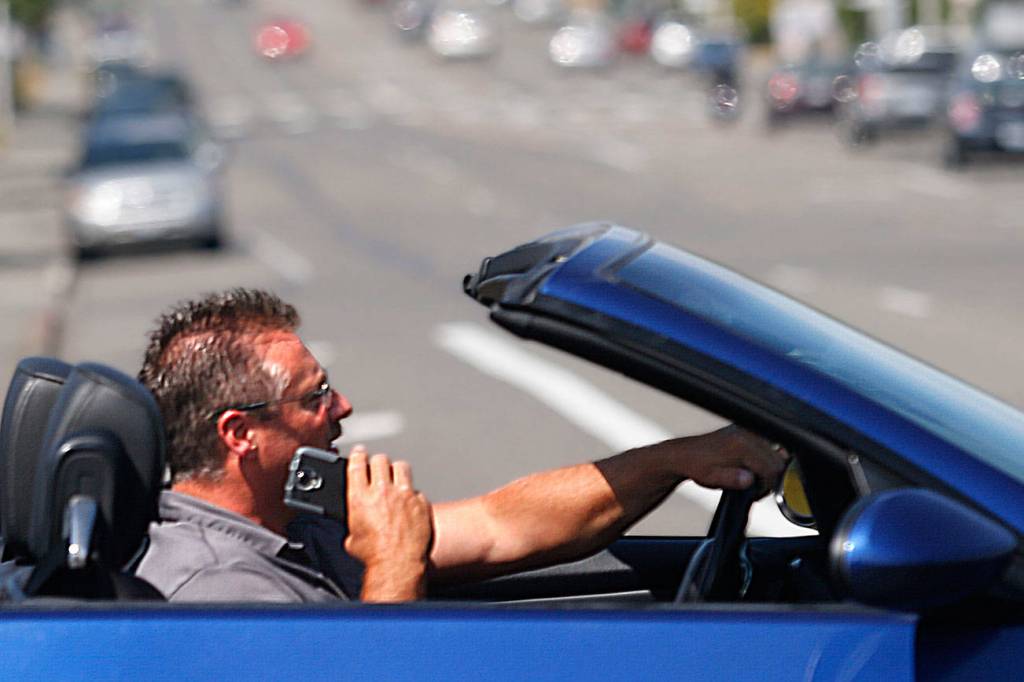
In the statewide survey, observers posted at major intersections throughout the state found that about 9.2 percent of drivers were distracted; 6.9 percent were holding a phone or had the phone up to their ear — currently a violation of state law — while 2.3 percent were otherwise distracted.
The percentage of distracted drivers observed in Snohomish County was slightly higher at 9.4 percent.
That relatively new distraction is responsible for an increasing number of accidents that result in death and injury. Between 2011 and 2015, distracted driving was found to be a factor in nearly 3 of every 10 traffic fatalities in the state and in more than 5 of every 10 accidents with serious injuries.
In 2014, the National Highway Traffic Safety Administration reports, 3,179 people were killed and 431,000 were injured in accidents that involved distracted drivers.
Among those most vulnerable to the lure of a “ping” from a text message are teenage and young adult drivers. NHTSA reports that 71 percent of young drivers admit to having sent a text while driving.
Washington is among 46 states that ban text messaging while driving. But the problem for Washington state’s traffic cops has been proving who’s sending a text message and who is just holding his or her phone. Current state law allows drivers to hold a phone, as long as it’s not held up to the ear.
That would change with the passage of House Bill 1371, which would prohibit holding and using phones and other handheld devices to conduct a range of activities. Minimal use of a finger to turn a function off or on would be allowed as would controlling a vehicle’s touch screen for various controls. Use of citizen’s band radios, as well, would be exempt.
Barring drivers from holding devices would make traffic enforcement easier. And an increase of the current $136 fine to $235 for second and subsequent offenses within a five-year period would add needed emphasis, particularly for young drivers.
It’s not that most of us don’t recognize that distracted driving, particularly the use of smartphones, is a bad idea. A 2014 study by the AAA found that nearly 68 percent of drivers supported restrictions on smartphone use while driving, but at the same time 69 percent admitted to having talked on a phone while driving within the past 30 days.
Maybe we just can’t help ourselves.
A Seattle Times reporter this week talked with a psychologist at the University of Utah whose research on distracted driving found that people often are compelled to respond to their phones because the pings and other alerts trigger our “dopaminergic neurotransmitters.” In other words, we get a little shot of dopamine — the same brain chemical that can reinforce behaviors tied to sex, gambling and other activities — when our phones alert us to a new message.
If so, all the more reason to make enforcement easier and add some negative reinforcement that’s a little stronger than dopamine. Another $100 ought to do it.