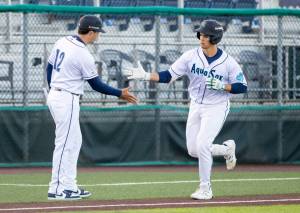
Seattle sluggers suddenly dominate ALCS in Toronto
Published 8:00 pm Monday, October 13, 2025
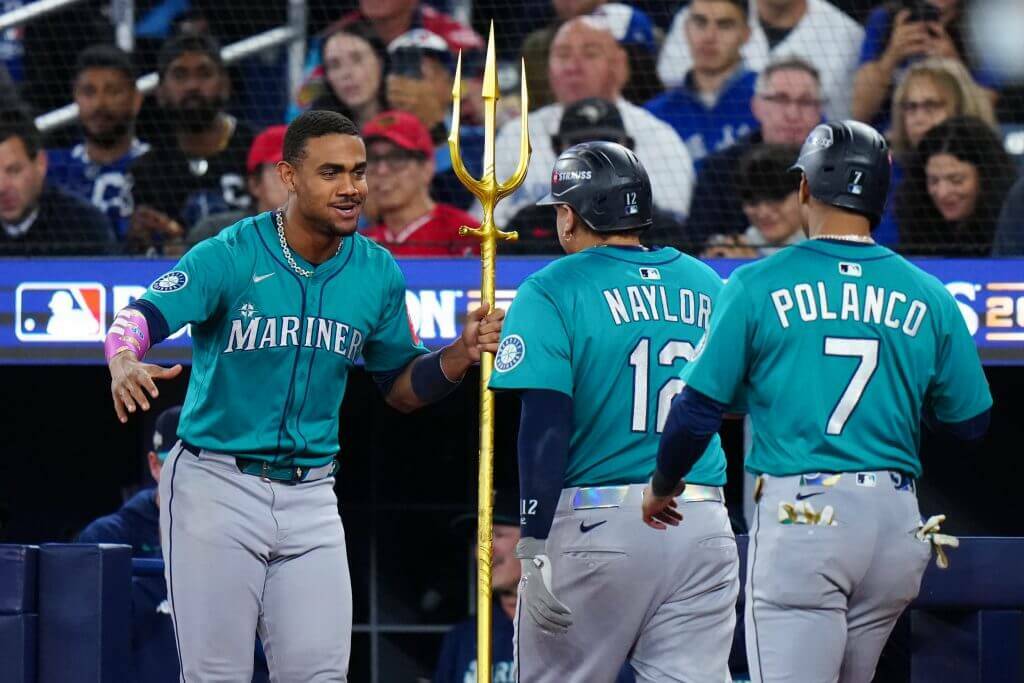


TORONTO — The Seattle Mariners are halfway to the first pennant in franchise history, and they haven’t even played a home game yet in this American League Championship Series.
Seattle flattened the Toronto Blue Jays, 10-3, in Game 2 at Rogers Centre on Monday. Julio Rodríguez and Jorge Polanco ripped three-run homers for the Mariners, and Josh Naylor — who had three hits — connected on a two-run blast in the seventh.
The Mariners started two pitchers who were working on short rest, getting six innings from Bryce Miller in Game 1 and three from Logan Gilbert on Monday. They now return to T-Mobile Park for Game 3 on Wednesday, when George Kirby will start on regular rest, with Luis Castillo lined up for Game 4.
Seattle has lost its previous three trips to the ALCS, winning two games in 1995 and 2000 and one in 2001. The Mariners, then, have never been closer to the World Series than they are right now.
Polanco is becoming Mr. October
You’ve heard of winning streaks and losing streaks and hitting streaks. How about game-winning-RBI streaks? Polanco’s is up to three.
Polanco, the Mariners’ second baseman, smoked a three-run homer off Louis Varland in the fifth inning of Game 2, breaking a 3-3 tie and giving the Mariners the lead for good. He also had the go-ahead single in the sixth inning of Game 1 and won the ALDS clincher in Seattle on Friday with a single in the 15th inning.
The switch-hitting Polanco, whose .821 OPS this season was his best in four years, also homered twice off Detroit ace Tarik Skubal in Game 2 of the ALDS, putting Seattle in position for its first victory this October. His homer on Monday came as a lefty hitter, and his homers off Skubal came while batting righty.
“Seeing what he’s been able to do from both sides has been just outstanding,” Mariners manager Dan Wilson said.
Trey Yesavage’s first-inning struggles flash in October
Toronto’s bullpen began to bustle just 10 minutes after first pitch. Trey Yesavage, a week after throwing 5 1/3 no-hit innings in his postseason debut, hit Randy Arozarena, walked Cal Raleigh and allowed a silencing three-run homer to Rodríguez in Monday’s first inning.
First innings have been Yesavage’s biggest difficulty along his meteoric rise to the big leagues. In the minors, he allowed 13 walks and 10 runs in 22 first innings this year.
Those first-inning issues hadn’t flashed for Yesavage in the majors. He allowed just one run in the first in his initial four outings with the Jays. But on Monday, early trouble sunk his start. The righty didn’t get help on a questionable ball call to Arozarena, but he still allowed three runs in the first. Yesavage also threw 33 pitches to open his start, forcing Toronto’s bullpen into early action. He recovered in the later innings, but lasted just four-plus overall.
If the Jays are going to claw back in this series, dragging it to Toronto once more, Yesavage is set to make another start. The Jays’ bullpen will likely be more depleted by then. To work deep into a potentially crucial Game 6, Yesavage will have to bury his first-inning struggles once more.
For Gilbert, short rest leads to a short start
There’s a big difference between 34 pitches in the bullpen and 34 pitches in extra innings of a winner-take-all playoff game. The latter applied to Gilbert, the Mariners’ Game 2 starter, who tried to convince himself he wasn’t all that taxed by relief duty in the ALDS finale. “I treat it as a bullpen (session),” Gilbert said Sunday night. “Or very high-intense bullpen.”
In Game 2, though, Gilbert lacked his usual put-away stuff. George Springer fouled off three of his first six pitches before a leadoff double, and Ernie Clement led off the second with another two-strike hit. Both would score as Toronto collected five hits and three runs (two earned) before chasing Gilbert after three innings and 58 pitches. Eduard Bazardo, who appeared in all five ALDS games before a well-earned rest in Game 1, followed Gilbert with two scoreless innings.
John Schneider’s questionable decisions pile up for Jays in fifth inning
John Schneider is more comfortable as a big-league manager than ever before. His communication with players, they say, has significantly improved. He led the Jays to 94 wins and their first playoff series win in nine years. He’s a clear candidate to win American League Manager of the Year. But Monday’s fifth inning was not his finest moment.
Despite Yesavage’s velocity dropping to 91.5 mph in the fourth, the Jays sent him back out to start the next inning. Schneider then challenged that a misfired throw from Andrés Giménez should not have sent the Mariners runner to second base, as it hit Eugenio Suárez on the dugout’s top step. The Jays then elected to intentionally walk Raleigh. Two batters later, with reliever Louis Varland entering the game, Polanco launched a crushing homer to push Toronto down 6-3.
Every game, managers face high-stress decisions with the correct call sometimes unclear. In October, those choices are magnified to an extreme degree. None of Schneider’s moves in Game 2 were objectively catastrophic, in isolation.
The decision to challenge, Schneider indicated on the Fox broadcast, was due to home plate umpire Alfonso Marquez telling the manager that if Suárez was in play, the runner would return to first. The choice to intentionally walk Raleigh was likely because he hit 60 homers in the regular season and launched a blast to flip Sunday’s Game 1. Leaving in Yesavage, despite waning stuff, was likely due to the righty sitting at just 69 pitches and the Jays using five relievers the night before.
All the moves could be justified, but none of them worked out. Ultimately, that’s what matters. In tight games and short October series, backfiring choices are backbreaking.
Anthony Santander’s chance for redemption in Toronto hits a snag
Anthony Santander, Toronto’s primary offseason addition, signed for $92.5 million. His first regular season with Toronto went belly-up quickly, as Santander suffered hip and shoulder injuries that held him to just 54 games, a .175 average and -1.0 WAR, per Baseball Reference.
Returning for October and Toronto’s postseason run was an opportunity for Santander to bury his bad first year. A strong playoffs could’ve wiped it all away, replacing four months of missed time with clutch hits. Hours before Monday’s Game 2, a smiling Santander discussed the chance his playoff return provided.
“I know it was a long shot,” Santander said. “But very grateful to be here in the playoff and try to help the team win some games.”
Then Santander’s fall redemption hit a roadblock. He was removed from the Game 2 lineup with lower back tightness two hours before first pitch. It’s unclear if he was able to pinch hit, as Santander did not appear in the game, or if the ailment will prevent him from future contributions.