Got a bear in your yard? The problem is people
Published 1:30 am Monday, May 27, 2019

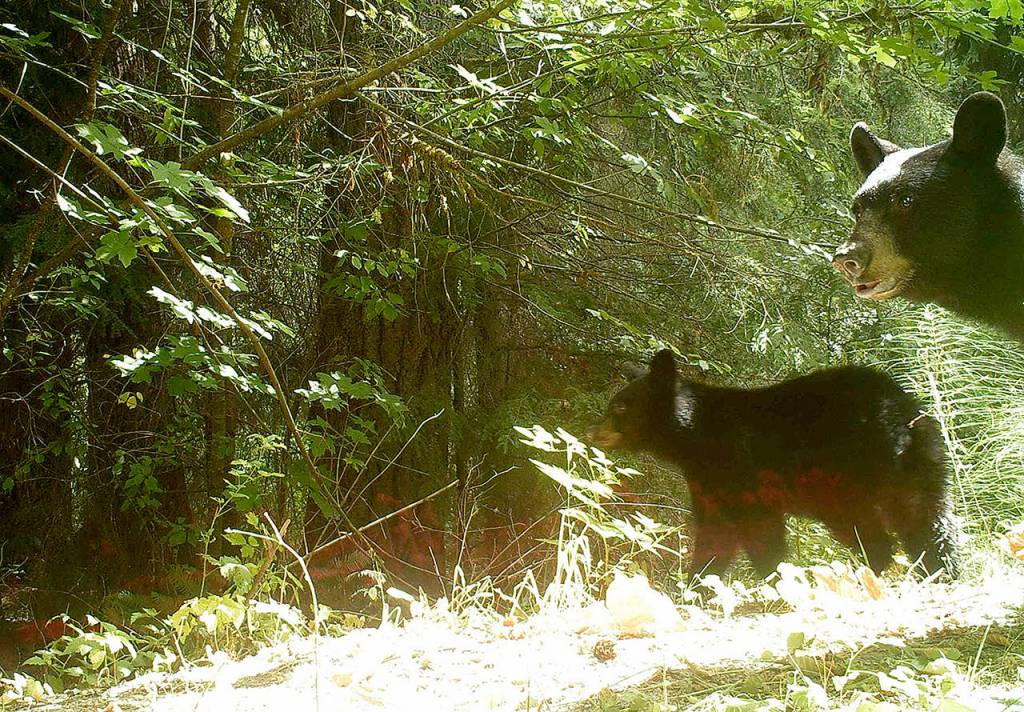


WOODINVILLE — Meandering through the lush underbrush of Paradise Valley Conservation Area in early May, a black bear made its way toward a favorite snack — the waxy leaves of skunk cabbage.
Oblivious to the trail cam tracking its movements, the bear traveled along a well-worn path toward a dense patch of the plants, many as tall as the creature itself.
Footage from the trail cam shows the bear munching near the edge of the forest, with a clearing visible through the trees. That clearing is Paradise Farm.
Located on a 793-acre conservation area, black bears, bobcats and coyotes are a common sight at the farm. The 30-acre property is skirted by a wildlife corridor, a path forged by animals and commonly used by black bears to reach patches of skunk cabbage or the farm’s century-old apple orchard.
With beehives and outdoor tanks of catfish used in their aquaponics system nearby, director Zsofia Pasztor said the farm is a “sitting sushi bar for bears.”
But Pasztor believes it’s possible to coexist with the wildlife that calls Paradise Valley home. She’s working with the Snohomish County Parks, Recreation and Tourism Department and a group of passionate volunteers to establish Paradise Farm as a demonstration for farming safely with predators.
Paradise Farm is part of Pasztor’s broader organization, Farmer Frog. The nonprofit works with schools to turn unused areas into environmentally friendly, food-producing farms and gardens.
Pasztor signed a lease with the county parks department for Paradise Farm in 2017 to serve as Farmer Frog’s headquarters, as well as an education facility.
While laying out plans for the farm, they spotted black bears frolicking in the field they had slated as a location for hoop houses.
That’s when Farmer Frog’s Wildlife Program Director Jane Hutchinson launched the “Bear With Me” Wildlife Friendly Farming Program, with the goal of spreading awareness on ways to keep bears at bay.
At Paradise Farm, a combination of bear dogs, fencing and trail-camera monitoring do the trick.
The farm’s two dogs, a Great Pyrenees named Sirius and Fergus, a Kangal, are charged with protecting the pen of chickens and goats.
With human visitors, like the kids that come to the farm on field trips, Sirius and Fergus are all fluff.
But if a bear or bobcat wander too close, the dogs ward them off with a chorus of ferocious barks. Predators learn to respect the dogs’ territory, Hutchinson said.
Up the hill, the farm’s aquaponics system is laid out inside a hoop house. A series of pumps and pipes filter water from the catfish tanks through raised garden beds to fertilize and hydrate plants.
Farmer Frog worked with the University of Washington Bothell to create a “smart fence” around this area.
In 2018, four mechanical engineering students developed a camera system that recognizes bears, then activates a light and electric wire. The camera can distinguish bears from deer, dogs and other critters, mechanical engineering professor Pierre Mourad said.
The light will also serve as a warning to people in the area. Bears that get zapped by the electric fence will likely learn to see the light as a sign to stay away.
Once the farm routes power to the fence, it’ll be live.
Eight trail cams around the property’s perimeter help determine the placement for all the farm’s deterrent methods.
Beginning in 2016, Hutchinson began surveying the farm’s surrounding area to get a sense for resident wildlife.
She had previously worked with Western Wildlife Outreach and the state Department of Fish & Wildlife to collect data. She took Paradise Farm on as a passion project.
Growing up in Lake Forest Park, Hutchinson said she’s seen the impact of development on wildlife.
“From an early age I watched animals leave my space,” she said.
She now visits Paradise Valley monthly to collect the memory cards and analyze how predators are moving around the farm.
“By knowing where their activity is happening we can be respectful of their space, because we want them to be respectful of our space,” Hutchinson said.
In 2017, she followed three mother bears and their six cubs as they spent the summer months near the farm.
Next, Hutchinson and Pasztor plan to apply for funding to incorporate the monitoring into educational programming at Paradise Farm.
As development pushes into bear country, state Department of Fish & Wildlife Sgt. Kim Chandler said conflict with humans is commonplace. He gets more calls from distressed residents in a day than he can respond to.
“These bears are opportunistic,” he said. “If you look at these places where all these conflicts are happening, it’s in neighborhoods that have been carved right out of the mountainside.”
Bears have been forced to adapt to living around people, state Wildlife Officer Nicholas Jorg said. Oftentimes, he said, lowland neighborhoods — with warmer, longer summers — are better habitat for bears than forestland.
Almost every human-bear conflict is the result of human error, Jorg said. People leaving out trash, birdseed and chicken feed are offering up an easy, high-density snack for animals trying to hit 20,000 calories a day.
In Snohomish County, Jorg said small-scale hobby farms are bothered by bears more often than commercial operations.
Thanks to a donation-based bear dog program started in 2008, most human-bear conflicts today can be resolved with canine intervention, rather than euthanization. Prior to the program, Jorg said the department would have to kill about a dozen bears a year.
The dogs have helped prevent 300 bear deaths in the past decade, Jorg said.
But if every person took precautions such as those at Paradise Farm, he said human-bear friction would disappear almost completely.
“The only reason bears get into conflaict is because people were feeding it, intentionally or unintentionally,” he said. “It’s much easier to train the bears than the people, actually.”
Julia-Grace Sanders: 425-339-3439; jgsanders@heraldnet.com.