Island County rehires jailer who was fired after death of inmate
Published 1:30 am Wednesday, July 20, 2016
COUPEVILLE — An Island County Jail lieutenant who was fired after Keaton Farris died of dehydration inside the Coupeville lockup is back to work after an arbitrator ruled that the woman shouldn’t have lost her job.
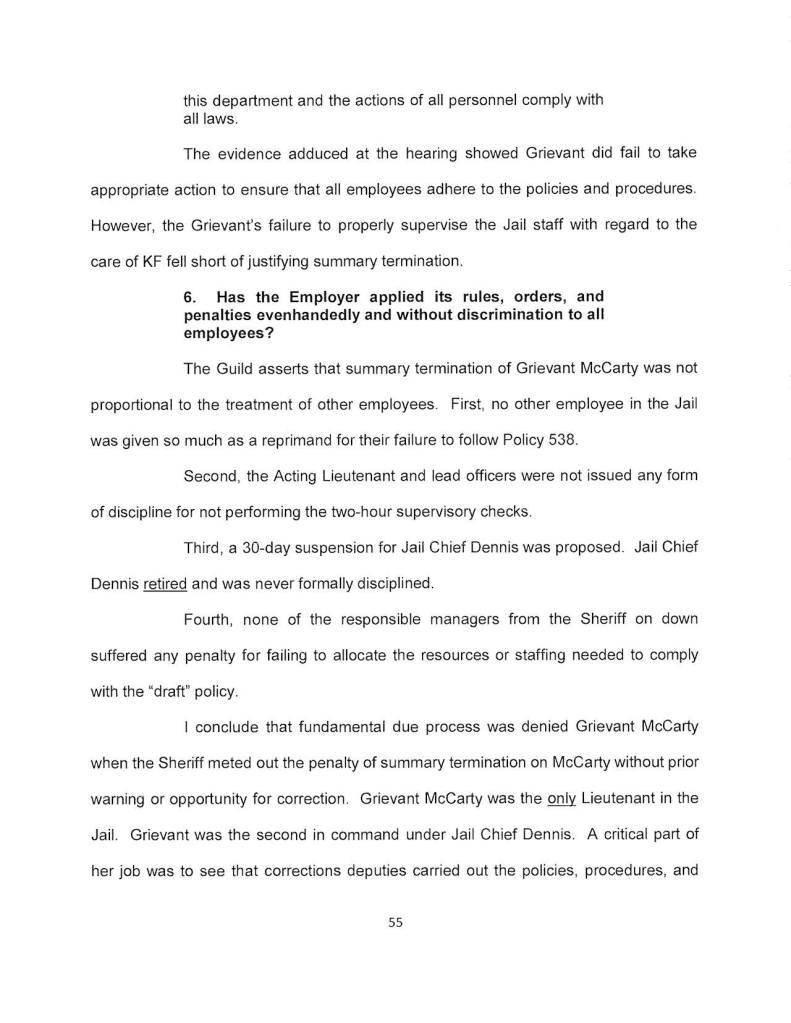
The arbitrator concluded that Pamela McCarty’s conduct in the days leading up to Farris’ death last year was “serious and justified substantial discipline,” but didn’t warrant termination. McCarty, he wrote, shouldn’t be held solely liable for a series of systematic failures inside and outside the jail that led to the young man’s death.
Under binding arbitration, the county was ordered to offer McCarty a job as a corrections officer — a demotion. The arbitrator also awarded McCarty back pay for the past 13 months.
“In the judgment of this arbitrator, McCarty failed to recognize the critical role she played in providing for the safety of (Keaton Farris) who was suffering from significant mental health problems. It is because of this lack of concern and indifference for the well being of (Farris) that I am compelled to conclude greviant McCarty should be demoted back to a corrections deputy position,” Gary Axon wrote in his decision dated June 16.
The jail will benefit from McCarty’s 26 years of experience, and she will benefit by remaining employed by the county, he added.
McCarty met with the new jail chief, Jose Briones, and was back on the county payroll July 6, Island County Sheriff Mark Brown said Wednesday. She started work at the jail last week.
“I’m going to work with the ruling of the arbitrator,” Brown said. “We’ll make it work. She will be trained and she will follow the new policies and procedures that Chief Briones has established.”
Farris’ dad called the arbitrator’s decision a step backward in the much-needed reforms at the 58-bed jail.
“Where is the individual accountability?” Fred Farris said. “She admitted she didn’t do her job. That should be plenty enough to fire her, regardless of what protocols there were.”
Farris and his family settled a wrongful death lawsuit with the county last year for $4 million. As part of the settlement, the county agreed to hire an expert to monitor jail operations and the ongoing reforms there.
Fred Farris didn’t learn of the arbitrator’s decision until earlier this week, when he was contacted by a reporter from the Whidbey News Times. He had just met with two county commissioners Friday to discuss the installment of a memorial outside the jail in hopes of preventing future deaths. They hadn’t mentioned McCarty’s reinstatement.
“It was like a big punch to the gut,” Farris said of the news.
He questioned why McCarty would be allowed to return to work when a criminal investigation remains open. The Whatcom County Prosecuting Attorney’s Office and the FBI continue to investigate Farris’ death for possible criminal charges and civil rights violations.
“We’ve done interviews and we’ve assembled a number of things. It’s going to take more time,” Whatcom County Prosecutor David McEachran said Wednesday.
Keaton Farris was housed in the Island County Jail for 12 days. He missed a court hearing, and a San Juan County judge issued a $10,000 warrant. Farris had been charged with identity theft for forging a $355 check in San Juan County.
He was housed in the jails in Snohomish and Skagit counties before being moved to Coupeville in Island County, which provides jail services under contract with San Juan County.
Island County corrections officers shut off the water to his cell after he flooded it. An investigation showed that Farris, 25, was in the throes of a mental health crisis. The investigation also revealed that corrections officers failed to routinely check on Farris and failed to take any action when he repeatedly refused water and food.
His fluid intake was at best 185 ounces of water — less than a quarter of the amount considered minimum for survival. He’d also lost about 20 pounds.
Farris died in his cell April 7, 2015. Corrections officers didn’t discover his death until the next day. A coroner concluded that Farris died of dehydration and malnutrition.
His family had spoken with corrections staff and explained that Farris had bipolar disorder and likely needed his medication. When he was arrested in Lynnwood, he had a prescription in his pocket for an anti-anxiety medication. Farris never received any medication at the Island County Jail.
His parents were assured that Farris was being seen by a nurse. Corrections officers didn’t ask the jail nurse to evaluate Farris until the day before he died.
The nurse, Nancy Barker, admitted that she didn’t go into his cell or do an adequate medical screening. She had been told that Farris was dangerous. Barker resigned from her job in the middle of an investigation by her employer, Island County Public Health. The state nursing commission declined to take action against her license.
The jail chief, De Dennis, was placed on paid leave and later resigned. Two corrections officers also resigned after allegations surfaced that they falsified paperwork after Farris died.
Brown also placed McCarty on paid administrative leave pending the death investigation. By June 23, 2015 he had fired her. The sheriff had concluded that the longtime jail officer violated numerous policies, including failing to properly supervise jail staff, failing to inspect jail logs to ensure that officers were regularly checking on inmates in segregation and failing to request a medical or mental health assessment for Farris.
“Unfortunately, in addition to violating policy, your acts and omissions contributed to the systematic failures that may have prevented staff from properly recognizing and identifying and addressing the health conditions leading to the death of inmate (Farris),” Brown wrote in a letter, spelling out his grounds for terminating McCarty.
The corrections officer guild fought back, arguing that the jail policies were in a state of disarray and had been implemented without proper training. They alleged that McCarty was a scapegoat who was being blamed for failings of the former jail chief, Brown and the undersheriff.
“The Guild concludes the Sheriff’s emotional reaction to a terrible situation and to the pressure he was under from outside forces, demonstrated the Sheriff made an emotional decision and failed to rationally weigh the decision to terminate (McCarty),” the arbitrator wrote, summarizing the union’s position.
The labor dispute went to the arbitrator, as spelled out in the corrections officers’ union contract. The decision is binding under the labor agreement.
Back in 2013, an arbitrator ordered the state Department of Corrections to reverse the firings of three Monroe Correctional Complex officers and the demotion of one sergeant after the 2011 murder of officer Jayme Biendl.
The arbitrator in that case concluded that safety failures at the prison were widespread, and it was unfair to single out individual employees for institutional problems.
In Island County similar issues were raised. Axon concluded that McCarty couldn’t be held responsible for violating policies that hadn’t been properly instituted and were ignored by her boss, the jail chief. The Island County detective who investigated the death testified at the arbitration hearing that the implementation of jail policies was “a train wreck.”
Axon also concluded that limited resources at the jail “provided major barriers to complying with the rules.” In his decision, he called out the beleaguered Western State Hospital and its refusal to admit Farris for a competency evaluation despite a court order. McCarty, he said, couldn’t be held accountable for the state hospital’s failings.
The county had proven that McCarty didn’t provide adequate supervision of jail staff in Farris’ case, Axon wrote. No amount of discipline would correct her failures as a supervisor, he said. The just remedy was a demotion. He concluded that McCarty should receive back pay and benefits at the lieutenant rate until she returned to work or declined the position.
How much money McCarty will be paid wasn’t immediately available. Brown said Wednesday the back pay and benefits were still being negotiated.
Diana Hefley: 425-339-3463; hefley@heraldnet.com. Twitter: @dianahefley.
[documentcloud url=”http://www.documentcloud.org/documents/3004476-McCarty-arbitration.html” sidebar=false pdf=false]