Judge race pits candidates running on ‘diverse’ resume vs. legal resume
Published 1:30 am Thursday, November 2, 2023
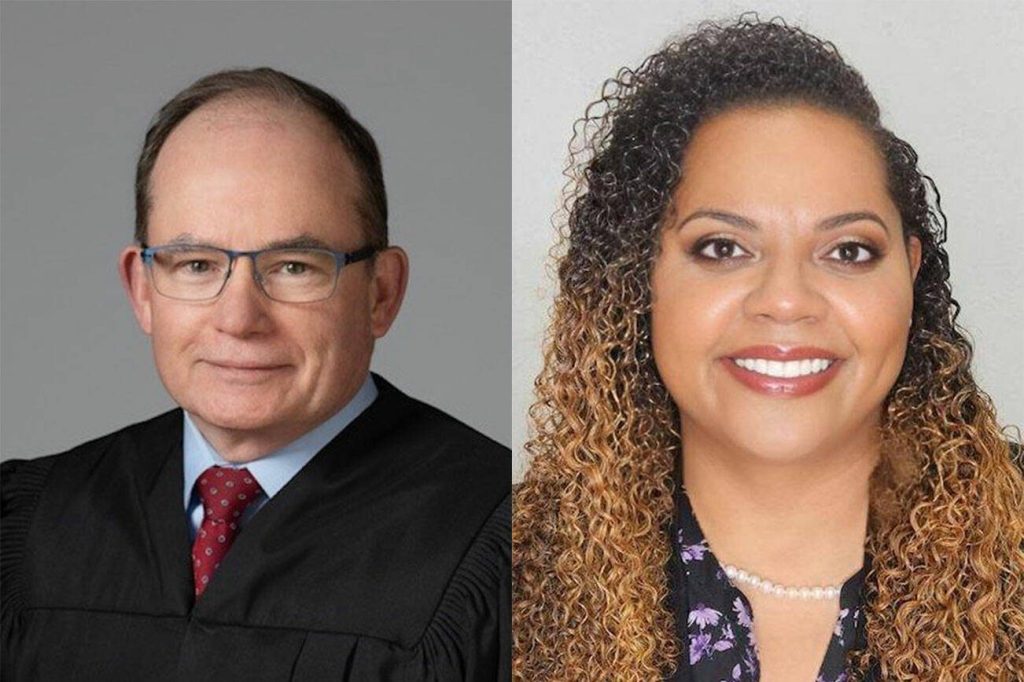
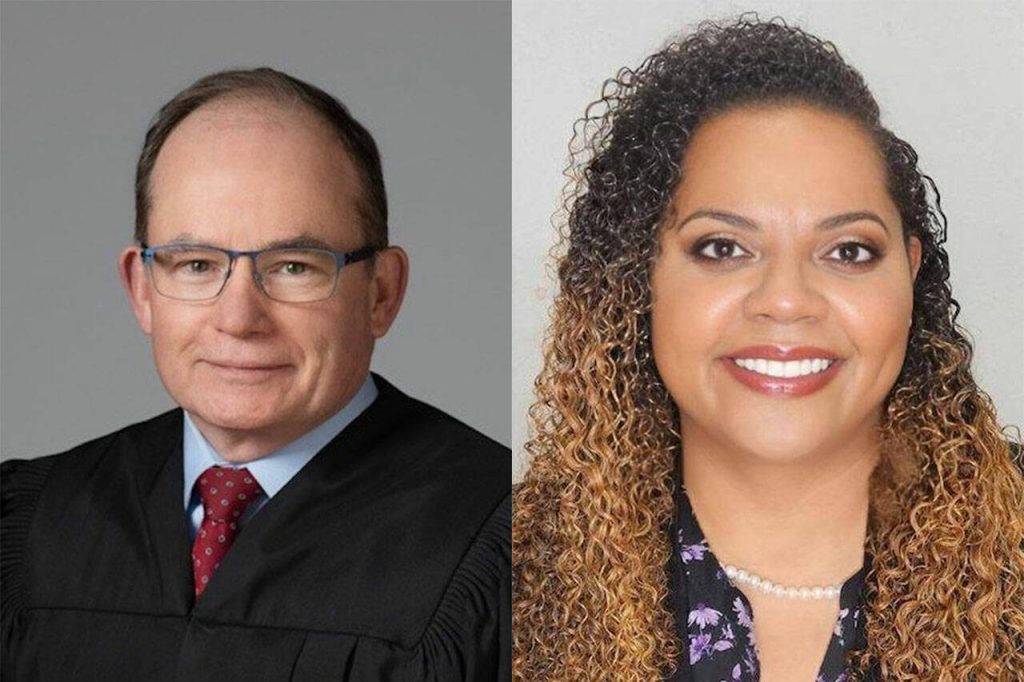


EVERETT — What is the role of a Superior Court Judge?
For Mary Anderson, a challenger for a spot on the Snohomish County Superior Court, it’s about being impartial.
“I’m a really balanced human being, and I just look at the facts and I apply the law,” Anderson said. “Your job as a judge is to apply the law, equally.”
Incumbent Judge Patrick Moriarty agrees a judge should be fair and impartial — adding that keeping the courts accessible is also a critical duty for those who wear the robes.
“It’s important for people to have access to the court system, to not be intimidated by it, and respect it, and feel like it is a place where they can go and have their issues heard and have a fair and impartial decision made,” Moriarty said. “As a judge, you’re able to do that.”
Last year, state lawmakers added two more Superior Court judges in Snohomish County, bringing the total to 17.
The two seats are the only judicial positions up for election on the Snohomish County Superior Court. Seat 16 also has two candidates: incumbent Judge Miguel Duran and Brett Rogers.
In the three-way August primary for Seat 17, Moriarty led with 42.1% of the vote, Anderson garnered 34% and Jody Cloutier trailed with 23.6%.
Superior Court judges handle felony criminal cases, juvenile cases and a wide range of civil cases. Judges are paid about $200,000 annually and serve a four-year term.
Mary Anderson
Mary Anderson, 49, would be the first Black woman to serve on the county’s Superior Court. She decided to run because she wanted the court to be more reflective of the community it serves.
“I want judges to have diverse thought,” Anderson said. “We need individuals with different ways of life, walks of life and lived experiences.”
She has lived in Snohomish County for over 40 years.
Law is Anderson’s third career. Before attending law school at Seattle University, she had her own construction firm, ran a mortgage brokerage firm and worked as a licensed real estate agent. Out of law school, she opened her own firm, Guidance to Justice, based in Bothell, where she has been working as a trial attorney specializing in real estate law for over a decade.
Since February 2022, she has served as judge pro tem on the Snohomish County District Courts, handling over 1,700 cases, she said.
Anderson said her varied background sets her apart from Moriarty, especially her experience arguing cases in front of the state Supreme Court.
“I understand the different nuances a judge should be able to see and make, to make sure they’re not making an error of law,” Anderson said. “Not only do I have that trial experience, transactional experience and judicial experience, the combination of all of those experience and my business experiences makes me the best person for this position.”
Asked which sitting judge she admires most, Anderson said every U.S. Supreme Court justice and state Supreme Court justice.
“You don’t get there by happenstance,” Anderson said. “You get there by hard work, and having the ability to have a great legal mind to be able to articulate and discuss the major legal issues that will impact the community.”
Anderson has received endorsements from the Snohomish County Democrats, the Snohomish County Republican Party, and state Supreme Court justices Debra Stephens and Barbara Madsen.
Patrick Moriarty
Gov. Jay Inslee appointed Patrick Moriarty, 58, to the position in June 2022. He had been a Superior Court commissioner since 2018, overseeing family law, probate and other proceedings.
“I started in 1991 as a public defender,” Moriarty said. “I ended up loving it and the opportunity to help people.”
From there, he worked as a prosecutor in Seattle in the late 1990s.
After working in private practice and the prosecutor’s office in Seattle, Moriarty went back to being a public defender in Snohomish County, specializing in drug cases involving teenagers, work he considered some of the most rewarding he’s ever done.
“You can visibly see the difference you are making in their lives,” Moriarty said.
He still keeps in touch with some of his former clients. Recently, he said, the mother of one of his former drug court clients, who had died, called Moriarty to lend her support.
“That type of reward is better than any money you might get from doing a job,” Moriarty said.
Moriarty also worked both publicly and privately in criminal defense, family law and drug law throughout Snohomish County. Moriarty also served as judge pro tem in municipal and district courts throughout the county for 17 years.
Moriarty wants to keep the Superior Court job because he has enjoyed serving the community.
Asked which judge he admires most, Moriarty named Superior Court Judge Bruce Weiss. Moriarty and Weiss used to argue against each other in court. Now they are judicial colleagues, and Moriarty frequently looks to Weiss as an example of what a judge should be.
Moriarty has received endorsements from every Superior Court judge in Snohomish County and over 200 lawyers, some of whom he argued against in court, as well as police unions and labor unions.
Concerning your opponent?
Anderson lives in Everett. Moriarty lives in Woodinville, just south of the county line.
Anderson believes that should be a concern for voters.
“We as Snohomish County residents pay for the judges’ salary,” Anderson said. “When we pay for the judge’s salary, the expectation is that they live in Snohomish County.”
Moriarty said his experience of over 30 years in Snohomish County makes him well qualified. And he noted his offices have been in Everett and Lynnwood.
“It’s not a legal requirement, there’s nothing that mandates the judge lives in the community, but I live 500 feet off the county line,” Moriarty said. “If I had a better arm, I could throw a rock into Snohomish County.”
On the other side, Moriarty said his opponent doesn’t have Superior Court experience.
“As I understand, she’s been an attorney for 12 years, has worked in a real estate practice and owned two businesses before she became a lawyer,” Moriarty said. “That does not make you necessarily qualified to sit as a judge. It’s my experience that does qualify me.”
Campaign finance records show Moriarty has raised about $86,000, though about $17,000 is his own money. Anderson has raised about $70,000, with close to $28,000 from her own funds.
The Daily Herald spoke with both candidates this month. Here are excerpts from their interviews.
Are sentencing guidelines healthy for the judicial system, or should judges be given more discretion during sentencing?
Anderson: I think it’s up to the legislative body to determine what’s appropriate. We as judges just have to interpret or follow the guidelines of what the legislative branch has given up. If we as a people decide that judges should be given more discretion, then we should make that law. Other than that, judges have to follow what the guidelines are.
Moriarty: That’s a hard question. As judges, we like to have discretion, because we have to do things that we don’t particularly care to do. But at the same time, I understand the purpose of the sentencing format. I could juxtapose it against district and municipal courts where there are gross misdemeanors: If it’s a gross misdemeanor, (it’s) anywhere from zero days of jail to 365 days in jail. On a felony first offense property crime, we may have 12 months to 14 months. But I think it’s a good thing on the basis of making sure people are being treated equally for the same type of history that they have, to make sure there is not a disparity in sentencing for people of color and different backgrounds.
How does the public feel about the judicial system? If there is a lack of trust, what would be ways that we could restore that trust?
Anderson: I declared my candidacy in May and started campaigning in June or July. Since I’ve been campaigning, I would have to say 70% of the people I speak with don’t trust the judiciary. The reason they don’t trust it is because it appears that folks are not getting a fair hearing. I communicate with both Democratic folks and Republicans, and they are saying the same thing. I really believe how we fix that is by bringing more transparency to the courtroom. Even having cameras in the courtroom, to ensure that judges are being fair to both sides, and that when they are making their ruling they are making it fairly, without a biased lens. As the next Snohomish County Superior Court Judge, all the cases I preside over — it’s easy and accessible to the public. So they can see how I’m ruling, why I’m ruling what I’m ruling, and what are the facts. People want to know what’s going on — don’t hide the ball.
Moriarty: From going out and talking to people, knocking on doors, I’ve seen a lot of people think the judicial system is a slap on the wrist and out the door the person goes, a lot of people who are like, “Why aren’t we putting homeless people in jail because they’re causing problems in the community?” One of the things I’ve told them is that we’re coming out of a huge change in our world from COVID. We were locked up for a couple of years, people were in homes together, and the ills of our society didn’t stop. Issues of child abuse didn’t stop, behavioral health issues didn’t go away just because you didn’t see them. If anything, they were being exacerbated by the isolation people were in.
All these problems, we’re seeing the aftermath. But we’re coming out of it, cases are still being prosecuted, as much as some people see it as a revolving door of people that get in criminal trouble over and over again. I’ve talked to the police unions, and they say, “We’re understaffed because of the distrust the public has in us over those racial issues, and now people don’t want to be a law enforcement officer.” But if people communicate, go down to the court and watch — it’s open and an amazing thing to watch the system in action and the good it does to the people in the community.
Correction: A previous version of this article listed the incorrect amounts both candidates contributed to their own campaigns, and incorrectly stated Mary Anderson argued in front of the Court of Appeals. Anderson argued in front of the state Supreme Court.
Jonathan Tall: 425-339-3486; jonathan.tall@heraldnet.com; Twitter: @snocojon.