Huge crowd protests in Seattle as criticism of police mounts
Published 5:35 am Thursday, June 4, 2020


By Gene Johnson / Associated Press
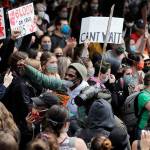
SEATTLE — A sea of protesters packed streets in Seattle on Wednesday in a sixth straight day of demonstrations over the killing of George Floyd, amid increasing criticism of the police department’s repeated use of tear gas and flash-bangs to disperse mostly peaceful crowds.
By mid-afternoon thousands had descended upon City Hall, where police holding batons formed lines behind metal barricades. The demonstrators carried “Black Lives Matter” signs, called for cutting the department’s budget and shifting the money to social programs, chanted for officers to remove their riot gear, and knelt or sat together as they surrounded the building.
After a weekend of chaos that saw police vehicles burned and stores looted, officers on Monday and Tuesday nights unleashed pepper spray, tear gas, flash bangs and rubber bullets to disperse crowds with little apparent provocation, compounding concerns about police power and racial injustice highlighted by Floyd’s death in Minneapolis on May 25.
Floyd, a black man, died after a white Minneapolis police officer pressed his knee on his neck for several minutes, not lifting it even after Floyd stopped moving and pleading for air. It was another in a litany of unarmed black men killed by police in the U.S.
Protests and rioting have occurred in cities across the country and in Washington state, including in Olympia and Spokane. Demonstrators in Tacoma have also protested the March 3 death of a black man who was being held down by police, Manuel Ellis, after the medical examiner’s office determined the restraint caused his death.
Ellis had an enlarged heart and methamphetamine in his system, and police said he attacked officers who tried to calm him down, The News Tribune reported. The four officers involved were placed on leave Wednesday.
Seattle leaders sought to address some of the concerns raised by the protesters. Mayor Jenny Durkan met with protest leaders, including former mayoral candidate Nikita Oliver, in City Hall before speaking with demonstrators outside for a second straight day.
“What we and you are protesting today is not just the death that we saw in Minneapolis,” Durkan told the crowd during a contentious appearance. “It is that that murder resonates over generations of black experience in America.”
But the crowd booed the mayor after she said some changes — including a planned requirement that officers not cover up their badge numbers, a concern of many demonstrators — would not happen overnight.
Durkan said Wednesday evening that she was ending the city-wide nightly curfews of the previous days after she and Police Chief Carmen Best met with community members who asked for it to be abolished.
“Chief Best believes we can balance public safety and ensure peaceful protests can continue without a curfew,” she said.
Durkan and Best, who is black, addressed the Community Police Commission on Wednesday. Best also addressed city council members, acknowledging concerns while also insisting that officers had a right to defend themselves from assault, noting that a small number of protesters had thrown water bottles and rocks at officers.
City Attorney Pete Holmes announced that he would withdraw a recent motion filed in federal court that sought to lift much of the reform-oriented consent decree that the police department has operated under since a 2012 settlement with the Justice Department. He noted that citizens had filed some 12,000 complaints over the department’s handling of the protest, saying in a news release, “we are about to witness the most vigorous testing ever of our City’s accountability systems.”
Among the reports the city’s Office of Police Accountability are reviewing are those of a young girl being tear-gassed, officers placing their knees on the necks of two people who were being arrested, and protesters twice grabbing unattended rifles out of police cars before being disarmed by a television news crew’s security guard. Many of those were captured on video.
Gov. Jay Inslee said Wednesday he was troubled by some of the police actions he had seen.
“It’s just really important to have a full investigation of each one of those to figure out if something was awry and see if we can learn from and improve,” he told a news conference. “Seattle has a very extensive way to do those investigations and those need to take place.”
Durkan has a long history of working on police accountability issues; she served as a citizen observer on a Seattle police firearms review board in the late 1990s, and as Seattle U.S. attorney she brought the Justice Department investigation that found officers too quick to use force, leading to the consent decree.
Reviews by an independent monitor have determined that the changes under the consent decree have led to a stunning drop in how often police use force, but critics have said the department’s actions of recent days demonstrate that not enough progress has been made.
“All weekend I saw peaceful and legal protests being terrorized by police officers while they laughed, smiled and made gestures to antagonize peaceful people,” one participant, Patrick Burke, told the council’s public safety committee Wednesday, saying he was shot in the spine with a less-than-lethal round.
Another commenter told the committee he, his wife and their 3-month-old son were inside their apartment in the Capitol Hill neighborhood Monday night when tear gas seeped inside. Their sleeping son began gagging and turned red from the exposure, he said. They fled to their car, and his wife doused their son’s eyes with breast milk to ease the burning. They haven’t returned home, he said.
City council members suggested that it’s not enough for the department to review its actions and issue findings after the fact; because the protests are ongoing, it needs to change on the fly, they said. Council Member Teresa Mosqueda urged the police department to stop using blast balls, tear gas and pepper spray to control the crowds, saying that the disproportionate force only generates additional anger and more protests.
“I’ve never in 25 years of being in protests in the city of Seattle experienced such an indiscriminate use of tear gas, pepper spray and flash bombs against people who aren’t doing anything wrong,” said Council Member Lisa Herbold.
AP Correspondent Rachel La Corte in Olympia contributed.