Forum: What makes an 0-5 record a winning season? Family.
Published 1:30 am Saturday, November 22, 2025
By Cory Armstrong-Hoss / Herald Forum
Phoenix, Ariz., early 1990s: Seven-year-old Michael Lewin is in the park with his cousins, practicing football plays, running routes on the grass.
“I was born into football. My uncles, they paid for everything, so my Mom didn’t have to. They paid for me to do Pop Warner football.”
At first the kids on his team played all the positions, but later Michael found his place on defense: middle linebacker, outside linebacker, cornerback. He could track a runner or receiver, anticipate the ball, tackle with speed and fury.
He loved everything about the game.
“The camaraderie. We used to make up chants to start the game. It was a family thing. I didn’t have brothers of my own, but I had brothers on the football team.”
Everett, September, 2025: Assistant Coach Michael Lewin and new head Coach Nicholson welcomed 50 middle schoolers to the first day of Explorer football practice.
Within a week, over half of those kids had dropped out; including those returning from last year, eighth-graders who’d played last year under a different, softer head coach.
Included among the players left, 13 seventh-graders and seven eighth-graders, including my son, Sam. None had ever played middle school tackle football. Sam thinks the hard-core conditioning drove some away. Players had to do the “snake,” running up and down every white line across the field, and “gassers,” running 50 yards within 30 seconds, over and over again.
And there was the new head coach. “Coach Nicholson’s coaching style is the opposite of forgive and forget,” said Sam. If a kid messed up, the whole team did five push-ups.
Assistant Coach Lewin, who began coaching at Explorer in 2019, was optimistic.
“This year we had a new [turf] field, new athletic building. It was the first year with no hump on the field. In the past, you couldn’t see one sideline from the other, because the middle of the field had a big hump.” He liked the intensity of Coach Nicholson, who’d coached in Texas before moving to Washington this year.
During the day Coach Lewin is Mr. Lewin, teaching special ed math. After school he becomes Coach Lewin, poring knowledge into the kids, teaching technique: the footwork, how to blast off the line, how to make an open-field tackle with your head up. He loves the game, loves coaching, enjoys connecting with kids outside, free for a moment from individualized education program reports and paperwork. “I wanted to see my students in a different light.”
He was impressed with the 20 kids that stuck around.
“The heart, the grit of these kids. They get 45 plays thrown at them that they’ve got to learn, and they keep showing up,” Lewin said.
That heart was tested by their five regular season games with Eisenhower, North, Harbour Pointe, Olympic View and Voyager. All were losses. Some close. Some not close. The Explorer Eagles had a knack for getting down early in games, but coming on strong late, scoring one or two touchdowns in the fourth quarter.
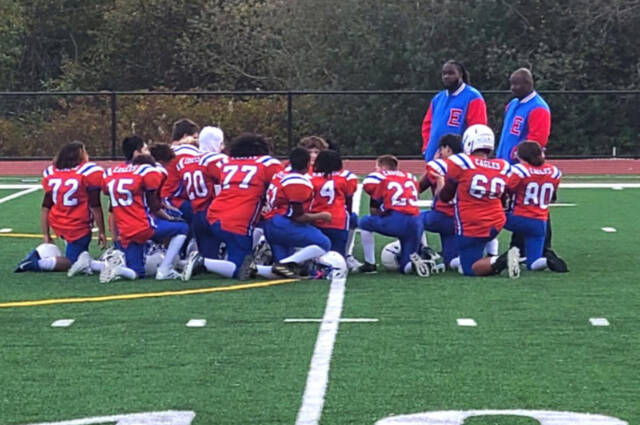
Some teams had 35 players on their sidelines and four coaches, different personnel groups for offense, defense and special teams. Explorer often had only 15 suited up. Most kids like Sam played both sides of the ball, and there were only a few specialists.
Angie was one.
“Angie could outrun most of the kids on the team. Very strong. Very fit. She had the heart of a lion,” Lewin said. One of the only girls in the league, undersized but fierce, the coaches put her on special teams, where she’d have a chance to receive and run back a punt.
She got rocked in a game against Voyager. It was a blindside hit that took her off her feet, knocked her to the turf, made me gasp on the sideline and stop myself from running on the field to check on her. After the season I brought up that play and Coach Lewin remembered it instantly. A few minutes after she took the hit, she wanted back in. After the game, “I told her, I was really proud of her,” he said.
The coaches put Sam at center and guard on offense and tackle on defense. Within a few games, at center, he was calling out assignments to his 0ffensive line making sure they knew who to block. Coach Lewin couldn’t believe it was Sam’s first year: “The fact that he can hear a play, soak it in, know where to go. He mastered his position, then he directed the line like a center should. He owned that position and that offensive line.”
Phoenix, mid-1990s: Lewin had a decent freshman year in high school, a good track season. But there was not enough gravity to hold him, keep him headed straight and steady. The magnetic pull that calls to young men – to make bad choices in the moment, to abandon the future – called to him. Without a counterweight, a man to call forth his best effort and call him out, he drifted away from football and school. Lost his way. Lost his sense of family outside of his home.
Everett, October 2025: After every practice Coach Nicholson and Coach Lewin gathered their team, huddled them up, led the same cheer as players raised their helmets in the air: “One, Two, Three, Eagles! Four, Five, Six Family!”
I’d be waiting for Sam up the hill, by the brand new Explorer gym. Coach Lewin would unlock the door to the locker room, give his players a fist bump and a few words on their way in.
He’d say something to encourage them for the way they played today, or call out something they can do better tomorrow.
He’d say something to each of those boys and Angie, players who know two coaches who care enough to make them do push ups and run snakes and gassers.
He’d say something for that young kid who grew up in Phoenix 30 years ago, who didn’t have a Coach Lewin.
Something so these kids always know that they do.
“Watch out for Explorer, next year,” said the coach, thinking about all those returning players who are just starting to elevate their game. “We’re going to be a force.”
Cory Armstrong-Hoss lives in Everett with his wife and three kids. His kids have played ten different sports. He’s a lifelong athlete, and he’s served as a coach, ref, and youth sports administrator. Find him at substack.com/@atahossforwords