The Port of Everett charts upcoming development in annual report
Published 1:30 am Wednesday, July 15, 2026
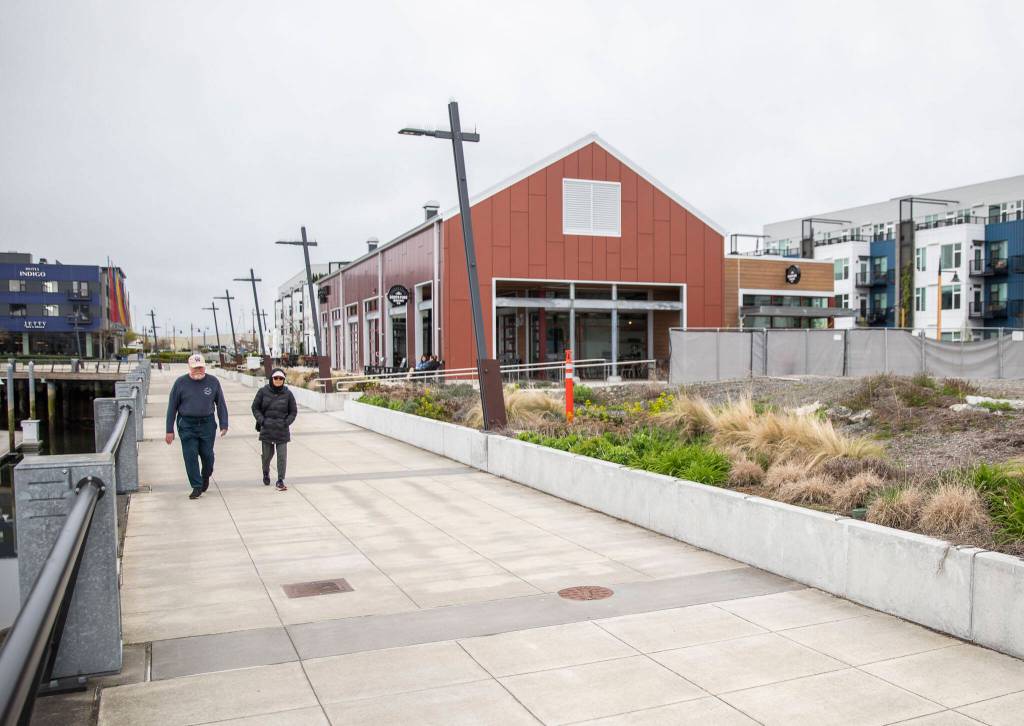
EVERETT — Port of Everett officials discussed recent developments and the future of the waterfront Monday at the 2026 Port Report.
One hundred and eight years have passed since Everett citizens voted to form the Port of Everett. In recent years, the port has extended beyond the maritime sector and become a hub for restaurants and community spaces.
As community members and business partners gathered at the waterfront Hotel Indigo, Economic Alliance Snohomish County’s President and CEO Ray Stephanson opened the report by remarking on the port’s milestone year as “one of the most significant economic engines in our region.”
“The port supports more than 40,000 jobs and generates more than $433 million in annual state and local tax revenue,” he said.
During the report, the port’s CEO, Lisa Lefeber, touched on the top 10 notable events from the past year and another 10 in the waterfront’s future.
The top 10 events from the past
Lefeber discussed how the port has responded to tariffs, turmoil and investment. The port specializes in bringing in oversized cargo, airplane parts and military cargo, which left the port susceptible to tariffs, she said.
Ever since his inaugural address, where Trump promised to “tariff and tax foreign countries to enrich our citizens,” Trump has imposed tariffs on imported goods from a variety of industries.
The port has not rebounded from the impacts of tariffs, as officials initially thought, but it has stabilized, Lefeber said.
“Our saving grace for the last 18 months has actually been aerospace and military,” she said in the report. “Which has been the foundation of our business for many, many years.”
On the positive side, Lefeber said, the shipyard has seen recent improvements.
One of these is Everett Ship Repair acquiring Hercules, the largest dry-dock in Puget Sound. The 820-foot-long dock allows crews to work on larger vessels, including those at Naval Station Everett, with which the port shares a harbor.
The port also received an $11.25 million grant in April to upgrade Pier 3, a five-decade-old pier at the international seaport. The Pier 3 improvements will diversify what cargo types it can handle and allow cargo-handling equipment operation on the pier.
The shipyard wasn’t the only area of the port that underwent infrastructure changes. The waterfront saw advancement in two of its ongoing projects.
Lefeber cited the 2022 authorization from the port’s commission to sell a $15 million treasury note to the treasurer’s office. This allowed the port to leverage its A2 bond rating and debt service capacity to fund the construction of the Millwright Loop Roadway.
After the port wrapped up its final work, the project was $13 million, the port reported in its winter 2025 edition of the port’s newsletter, Portside.
Roads, utilities and infrastructure are not cheap, but “it set the stage for the next phase,” Lefeber said.
The Millwright District, part of the Waterfront Place mixed-use development, will add residential units, retail, commercial and public spaces.
On Thursday, the port celebrated the replacement of a section of the Central Marina bulkhead, which stabilizes a section of Highway 529 and West Marine View Drive.
The project allowed the port to expand the wharf, add public access amenities, increase the Music at the Marina area and separate the pedestrians from traffic, Lefeber said.
Since December, five new restaurants have opened their doors at the port, including the Rustic Cork Wine Bar, Menchie’s at the Marina, Tapped Public House, The Net Shed and, most recently, Marina Azul Cocina & Cantina.
“One of the last pieces that we didn’t have down here on the waterfront was a Mexican flair,” Lefeber said about the newest eatery.
Last year, the port opened a fuel dock at the marina, Lefeber said.
Over recent months, the port installed new art, such as a bronze-cast sculpture of a girl inspired by a historic photo, and increased transportation opportunities.
Transportation upgrades include the launch of the “Harbor Hopper,” which ferries people between Everett and Langley.
The port also acquired more of the Mukilteo waterfront in February, including accepting transfer of the former National Oceanic and Atmospheric Administration site and purchasing a .55-acre property which houses Ivar’s Mukilteo Landing.
“Ivar’s isn’t going anywhere,” Lefeber assured the audience.
Over the past several years, the environmental cleanup of timber company Weyerhaeuser’s former Mill A site has been a big focus for the port, Lefeber said.
“Unfortunately, the company that made their fortune at the expense of the Everett environment doesn’t want to pay to clean it up,” she said. “It’s about a $250 million cleanup.”
The contamination has left around 50,000 truckloads of contaminated material at the site, Lefeber said. The case is set to go to trial later this year.
In September, the port partnered with the Maritime Institute and Sno-Isle TECH Skills Center to launch the maritime high school program. Through the program, high school seniors from Snohomish and Island counties can become fully credentialed and professionally trained mariner by graduation.
Lefeber highlighted the Waterfront Watch Parties for the 2026 FIFA World Cup.
Over the course of four watch parties, the city’s fan zones saw about 17,000 visitors, The Daily Herald previously reported.
“That’s probably the best attended thing,” Lefeber said. “I was amazed.”
The top 10 events in the port’s future
As the port charts its future, Lefeber said the community can expect a focus on seaport resiliency and diversification.
“With the pause on tariffs, we are starting to see an uptick in requests for business on cargo,” she said.
The port is also working to close a loophole with trade policy where cargo can enter Canada, cross the border by truck or rail and be pre-cleared by customs without paying the harbor maintenance tax, according to Lefeber.
“It just makes me mad because Canada is busier than they were even during COVID,” she said. “If that doesn’t tell you our trade policy isn’t working, that should.”
The port will also continue working on advancements to its current projects, such as the Millwright District.
Officials are hopeful the project will be financed and kicking off “if not this year, early next year,” Lefeber said.
New buildings are on the horizon, such as a structure in the parking lot near Tapped Public House and an annex building around the Scuttlebutt parking lot, where the Maritime Institute will be, she said.
In the meantime, the institute is in the process of adding portable classrooms as enrollment is expected to quadruple next year, Lefeber said.
The port is also looking for one more restaurant, which Lefeber described as a “Japanese steakhouse experiential dining concept.”
“Japan’s our No. 1 trading partner, so we kind of need to have something from the Pacific Rim,” she said.
Construction and improvements will continue on Chamfer and 13th streets, Lefeber said. Chamfer Street will be a festival street built as part of the housing project and officials will add a light signal to 13th Street this fall.
Currently, the south marina, between Port Gardner Landing and Marina Village, is empty, Lefeber said.
“We want to bring in these temporary structures and build public spaces in between them to be able to activate the South Marina during the summer season,” she said.
Next year, the port hopes to create two temporary structures and then phase more in over three years so eventually there are six structures lining South Marina, Lefeber said.
Later this year and into the next, the port will rebuild the boat launch.
“If you guys have launched your boats, you can see why we need to do that,” Lefeber said.
Additionally, the port will rebuild South Guest Dock 1 by Anthony’s HomePort Everett.
“We’ll be seeking future grant dollars,” Lefeber said. “It’s about a $17 million project, so these things aren’t very cheap.”
Later this year, the port will undergo a $5 million project to electrify the shipyard, Lefeber said. Currently, the shipyard runs entirely on diesel generators, and the switch will allow the port to generate clear air credits.
Next year, the port will start planning and permitting for the NOAA facility at the Mukilteo waterfront, Lefeber said. The port is also looking for tourism elements and businesses it can bring to the site.
The port will also discuss boundary enlargement again. Since Port of Everett is not a countywide port, it has a competitive disadvantage to other ports in Seattle and Tacoma, Lefeber said.
In 2024, voters were seemingly convinced by arguments that the boundary increase would raise property taxes and denied the expansion, The Daily Herald previously reported.
The port wants to put the issue on the 2028 November ballot, Lefeber said.
“It’s really about creating jobs and economic opportunity for the whole region,” she said.
The Economic Alliance Snohomish County presented the report in partnership with the Port of Everett, Boeing, Hotel Indigo Seattle Everett Waterfront, Herald Media and North Sound Media, according to a press release.
Jenna Millikan: 425-339-3035; jenna.millikan@heraldnet.com; X: @JennaMillikan