High stakes for county in Tulalips’ tax-collection lawsuit
Published 8:18 pm Thursday, June 25, 2015
TULALIP — When the Tulalip Tribes opened the Quil Ceda Village retail area on tribal land along I-5, they hoped to share in sales tax dollars that shoppers racked up by the millions.
Instead, tribal leaders say, they’ve watched money flow to Olympia for the past 15 years, with few benefits in return.
The tribes filed a federal lawsuit this month seeking control of more than $40 million in taxes that go each year to the state of Washington and Snohomish County.
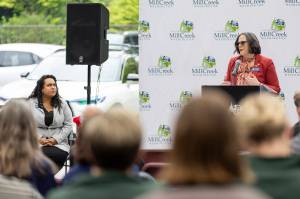
“Since 2000, we’ve sent a lot of money down to Olympia,” said Tulalip Chairman Mel Sheldon Jr.
By contrast, the tribes built Quil Ceda Village with their own money and bridge loans, which came at the expense of providing more services to their own community, such as education and social services, he said.
“All those things that a city does, that government does, need funding,” Sheldon said.
Today, Quil Ceda Village includes 150 businesses, among them Wal-Mart, Home Depot, Cabela’s and Seattle Premium Outlets.
While it is an issue of sovereignty for the tribes, the suit has worried county leaders, who fear it could result in a painful budget shock and dozens of layoffs.
Recent discussions have used $9 million as a starting point. That’s nearly 4 percent of the county’s $226 million yearly operating budget, most of which funds public safety.
That makes County Councilman Ken Klein nervous.
“We’re in a very precarious situation and this just exacerbates it,” Klein said. “The biggest part of our budget is law and justice. Extrapolate that out and what does that mean? And people are already talking about delayed response times.”
A worst-case scenario, to Klein, would mean cutting 90 jobs from the county’s 2,800-employee payroll. Many likely would come from the ranks of sheriff’s deputies, deputy prosecutors and other public safety officials, Klein said.
The real budget effect, however, could be far less. There’s also talk in both tribal and county governments of reaching an agreement to avoid disruptions.
“We should try to do what we can to make the tribes and the county whole,” said County Councilman Brian Sullivan, whose district includes Tulalip.
Unique status
The tribes filed their lawsuit June 12 in U.S. District Court in Seattle. As defendants, it names state revenue director Vikki Smith, the county and county tax officials.
The tribes are joined as plaintiffs with the Consolidated Borough of Quil Ceda Village, a political subdivision of the Tulalip Tribes built on reservation lands held in trust by the U.S. government. As a federally recognized city with its own taxing and police powers, Quil Ceda Village has a unique status that the tribes say provides the legal justification for their suit but might also limit any legal ramification to just the Tulalip Tribes.
The tribes said they filed the lawsuit after years of negotiations failed.
Even so, discussions have continued. Both sides recognize a “valued and respectful relationship,” said Jason Cummings, the county’s chief civil deputy prosecutor.
“The tribes have been upfront about their concerns regarding taxation at Quil Ceda Village as well as their desire to resolve their legal concerns with the state tax system,” Cummings said. “Our office is reviewing the complaint, will discuss its allegations with our elected officials, and will respond accordingly.”
State officials reason they’re merely exercising the taxing authority recognized by the 9th U.S. Circuit Court of Appeals and the U.S. Supreme Court. They’re allowed to tax the sales of non-Indian goods by non-Indian retailers to non-Indian customers, said Kim Schmanke, a spokeswoman for the state Department of Revenue.
“Nothing in state law precludes the tribe from imposing its own taxes,” Schmanke said in a prepared statement.
The Tulalip Tribes have chosen not to in order to keep Quil Ceda Village attractive to businesses, Sheldon said.
“We as sovereign tribes have that ability,” he said, adding, “We are not going to double-tax people.”
The tribes also say that if they win the suit, they intend to impose their own sales tax at a comparable rate.
It’s unclear if a Tulalip legal victory would force the state to stop collecting sales tax at non-Indian owned business associated with the state’s other 28 federally recognized tribes. A narrow decision could limit its effect to Quil Ceda Village.
“It depends on how the court rules,” Schmanke said.
Much at stake
Sales tax is the biggest prize in the lawsuit.
Shoppers at Quil Ceda Village pay 8.6 percent in sales tax.
Of that, 6.5 percent goes to the state and 2.1 percent to the county.
For the most recently completed fiscal year, which ended in June 2014, Snohomish County received a little more than $9.5 million in sales tax from Quil Ceda Village commerce. Of that, more than $4 million gets redistributed to Community Transit, county spokeswoman Rebecca Hover said. The money for Tulalip-area bus service was passed by voters there in 1997, but it’s unclear whether that portion could be changed by the lawsuit.
The state collects about $2.1 million in yearly business-and- occupation tax from Quil Ceda businesses. That tax is based on a business’ gross income.
The tribes also are seeking authority over so-called personal property taxes currently collected by the county at Quil Ceda. Those are taxes on business equipment, not to be confused with the taxes paid on land and improvements. The tribes estimate the personal property taxes are worth about $1 million per year, of which $823,000 now stays with the county and $177,000 goes to the state.
Tulalip Chairman Sheldon said that in addition to what the tribes feel is a legal issue grounded in sovereignty, the lawsuit also is about keeping more tax money local and benefiting the larger community.
The tribes routinely donate more than the 2 percent minimum amount from casino revenue to local causes. The Tulalip Charitable Fund has contributed more than $64 million since 1993 to local charities, including $6.7 million in 2014.
The tribes created something that benefits not only Quil Ceda Village and Tulalip, but the north end of Snohomish County, Sheldon said.
“We’re all in this together at the end of the day,” he said.
The lawsuit isn’t raising a new issue.
The Tulalip Tribes have been arguing for the right to collect their own taxes since Quil Ceda Village’s first store, a Wal-Mart, opened in 2001.
In 2005, as construction was getting under way for the Seattle Premium Outlets, the state House passed a bill that would allow the tribes to collect up to 1 percent sales tax from Quil Ceda Village businesses.
The bill died in the Senate partly out of concern that it would have set a precedent for all tribes and triggered a loss of money for many local governments.
Then in 2013, a federal appeals court decision determined that the state and local government could not collect property taxes at the Great Wolf Lodge, which is on the Chehalis Reservation.
As a result, Snohomish County had to refund $5 million in property taxes to businesses and residents on the Tulalip Reservation.
The tribes then imposed their own property taxes on the property at the same rate previously charged by the county.
At the time, the tribes indicated that controlling sales tax on their land was the next goal.
Noah Haglund: 425-339-3465; nhaglund@heraldnet.com. Twitter: @NWhaglund.