Indiana wins a college football national championship
Published 8:30 am Tuesday, January 20, 2026
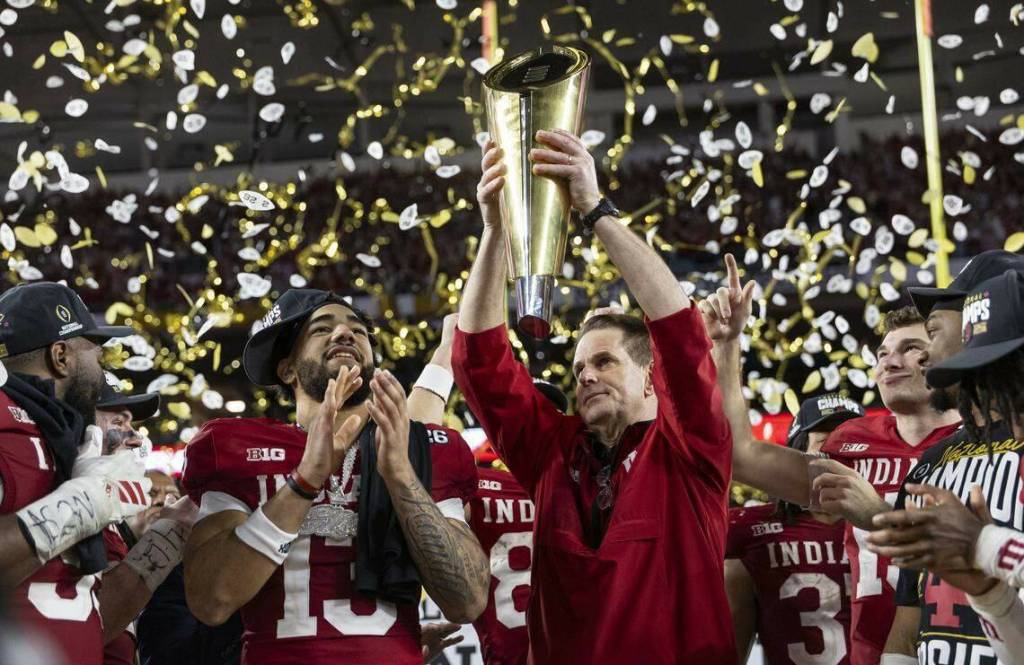
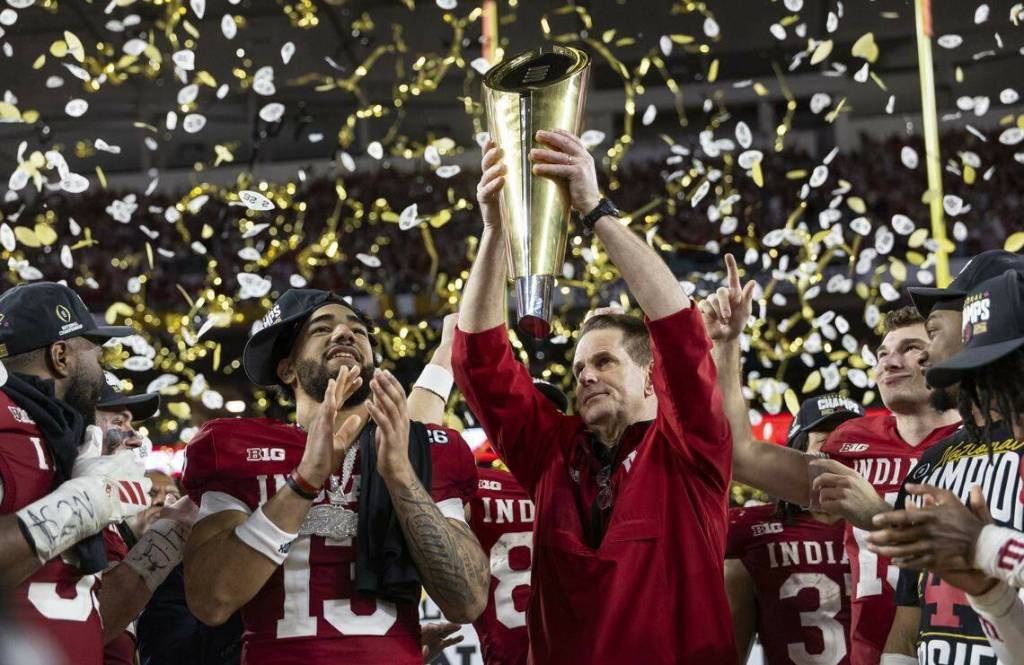
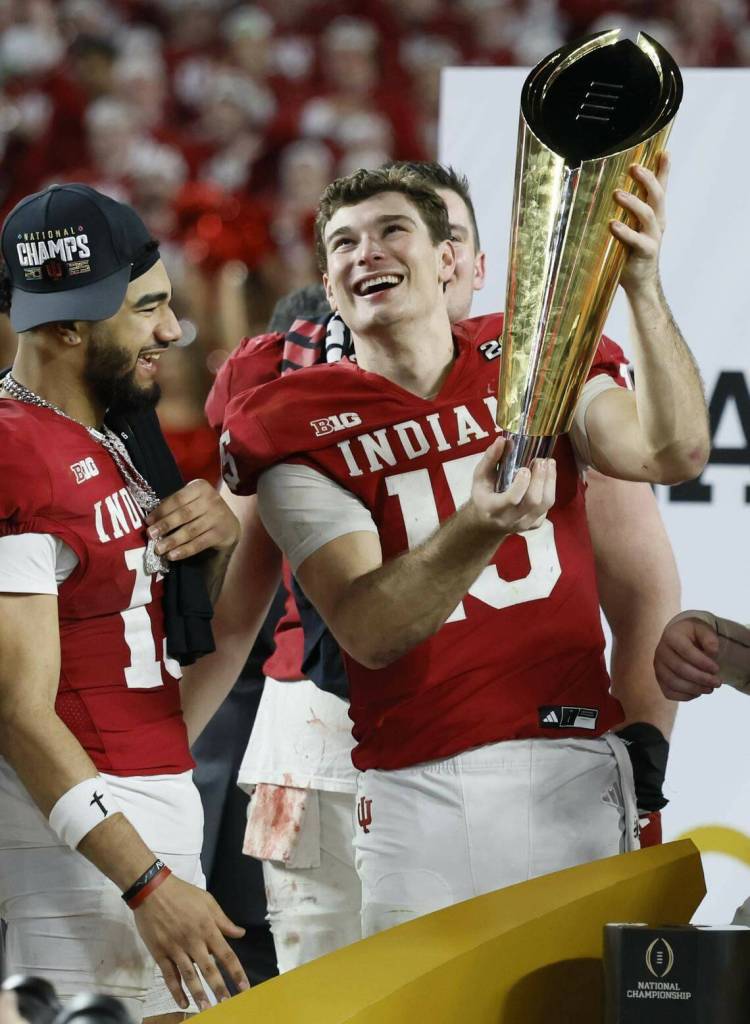


MIAMI GARDENS, Fla. — Maybe sometime this month or this summer or this century, all the fans and alumni widely known as Hoosiers and all the people who follow college football might scale a deeply human mental hurdle about the rousing theater of Monday night. They might find a way to believe what they saw.
They might believe the gobsmacking truth that when a storybook five months ended, the confetti in Hard Rock Stadium rained down on Indiana crimson-and-cream. Many of the 67,227 might comprehend that, indeed, as the videotape shows, they hung around with their joy and their goose bumps and belted out “We Are The Champions.” They might grasp that they heard a revolutionary 64-year-old coach in his second Indiana season tell of “waxing tables” among the unglamorous tasks of a Division II coach a decade ago, at which time, of course, “I never really thought this was possible.”
By reliving, reliving and reliving Indiana’s stirring 27-21 win over a bruising Miami, they might even manage to believe this: Indiana, which spent a century-plus buried so dimly in the American football consciousness that it seemed less an afterthought than not really a thought at all, won the national championship Monday night, yet exceeded even that delirium. It elbowed its way into thousands of future conversations about the best teams and stories in all sports lore, given its dizzying ascent to a dazzling precision that seemed to stir up out of the dust. Its 27-2 run through two playoff seasons, and its 16-0 trek through this one, will float above college football and enter some sort of realm near the 1969 New York Mets, or the 1980 United States Olympic men’s hockey team, or the 1999 St. Louis Rams or, if we’re going to get global about it, 2016 Leicester City F.C.
“It’s a great story, a tremendous story,” said its leading author, Curt Cignetti, the second-season coach. “Probably one of the greatest stories of all time.”
It’s just that comprehending it could prove elusive, if giddy.
The first 16-0 team in the top level since Yale in 1894 was the losingest program in college football history as of 2023 when it hired Cignetti from James Madison to very little national ripple on an innocuous Thursday in late November. It’s the one that began football in 1887 but never seemed to cotton to it as much as that other sport, that existed for so long as both a basketball school and a record-padding instrument for empires such as Ohio State and Michigan, that considered 7-5 party-worthy, that had eked into five bowls this century: the Insight, the Pinstripe, the Foster Farms, the Gator and the Outback.
It had lost all five.
It’s that program.
Then somehow, the people are supposed to believe that when the whole thing bent toward unspeakable agony just before the curtain dropped, when Miami (13-3) turned up at the Indiana 41-yard line with 51 seconds left down 27-21, the last throw of veteran Carson Beck floated toward the deep left and toward imminent interception by … an erstwhile kid from Miami.
“It’s an amazing feeling, man,” interceptor Jamari Sharpe said on the field afterward. “Being where I came from, Miami, I always wanted to play for the national title, always wanted to play in the Dolphins’ stadium.”
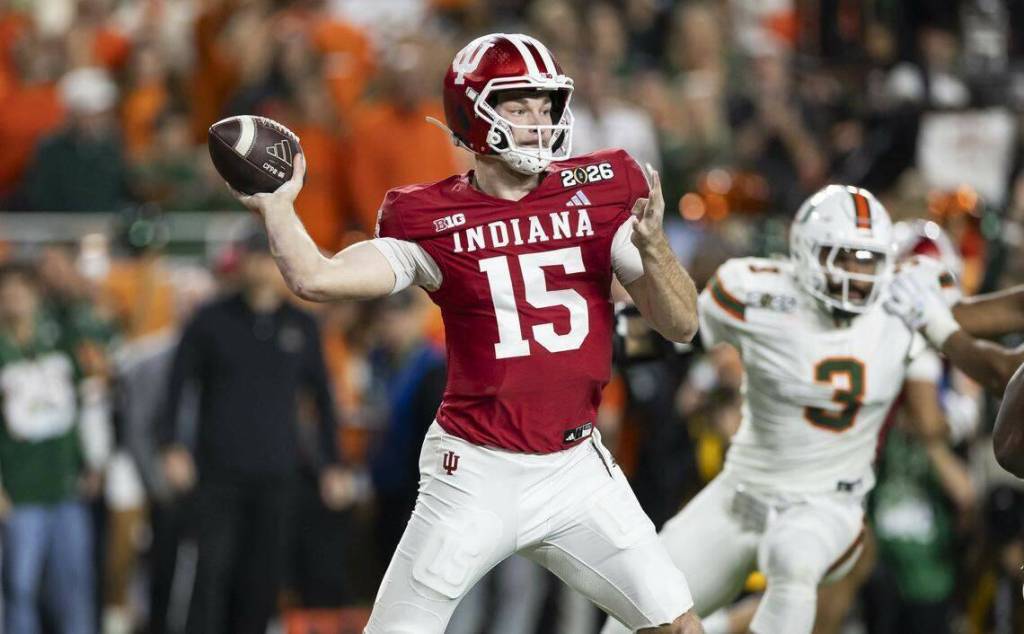
That ending seems far-fetched, and may take time, yet will have to yield time to the play sure to last the closest to forever. That’s the big little carnival that happened when Indiana clung to a 17-14 lead but faced fourth and four at the Miami 12-yard line with 9 minutes 27 seconds left — yeah, fourth down, as it would be in fine fiction. Indiana sent out the field goal team, called a timeout, removed the field goal team, called a quarterback draw.
Fernando Mendoza hadn’t seemed primed to snare a moment here even if he had won the Heisman Trophy. He seemed roughed up, a Miami native struggling in Miami. Miami’s horrifying defensive line had subjected him to uncommon hurries and harassment, to three sacks and to two late hits uncalled. Miami’s cornerbacks had throttled Indiana’s timing passes. Mendoza’s incompletions (11 in 27 attempts) would bloat to more than double the combined total (five) in the 38-3 Rose Bowl mangling of Alabama and the 56-22 Peach Bowl decking of Oregon.
Well, he caught the snap. He backed up, right foot on the 20, left on the 19. He started forward. Onlookers started gasping. He surpassed a worthy gap just left of center. He needed to get to the 8. He got past the 15 to the 14 and skirted a bit to the right, where center Pat Coogan blocked Miami lineman Justin Scott. He went by Miami defensive back Zechariah Poyser and passed the 10. He stomped to the 5, where he lurched into a thicket where a defensive back flew by and Mendoza banged into linebacker Wesley Bissainthe. It spun Mendoza rightward. He soon faced away from the end zone. His left hand grazed the ground. He turned around with lineman Ahmad Moten chasing just behind. He reached the 3, maybe the 2. He lunged with his 6-foot-5 frame and extended the football over the goal line as linebacker Mohamed Toure slammed into his back.
“I’ll just remember that Fernando is an absolute beast,” wide receiver Charlie Becker said in a Mardi Gras of a locker room. “I thought he was going to be down 10 yards ago. It’s a tribute to his character.”
“I saw him get stalled,” left tackle Carter Smith said, “and my next thought was, ‘Go push that pile.’ And I don’t think I made it to the pile because he did it himself.”
“Let me tell you: Fernando, I know he’s great in interviews and comes off as the all-American guy,” Cignetti said, “but he has the heart of a lion when it comes to competition.”
“And we were all putting our bodies on the line,” Mendoza said of his exceptionally close team, “so it was the least I could do for my brothers.”
That, too, seemed implausible, the gutsy runner scoring a deathless touchdown to make things 24-14 with 9:18 left. And then Miami went ahead and helped make the story storybook. It had narrowed things to 10-7 when Mark Fletcher Jr. swept right, saw a gap and charged 57 yards to the end zone, and to 17-14 as Beck directed an 81-yard drive to counter a whooshing blocked-punt Indiana touchdown wreaked by a brilliant Mikail Kamara. Miami, the last team in the 12-team playoff and then a hardened survivor of playoff wins over Texas A&M, Ohio State and Mississippi, would get it to 24-21 with 6:37 left by losing freshman blur Malachi Toney on a pass through the middle for 41 yards and a shovel up ahead for 22 and a speeding, spinning touchdown.
“This one hurt,” Fletcher would say, “and it’s supposed to hurt. … If you’re worth a damn as a competitor, it’s going to hurt.”
Yet Indiana outlasted even that hellacious team playing on its home field, if not before a home crowd, given the roaring half composed of Hoosiers. Overmatched for so long in history, Cignetti’s Hoosiers had taken a roster rich in overlooked strivers and had mastered the sport to such a pinpointing degree that it led the nation in turnover margin and finished second in lowest penalty yardage. It did not lose a fumble after the first quarter of the first game. It got the one turnover to clinch the ending Monday night — plus-22 for the season — and it kept its penalty yardage to 38 (next to Miami’s 60) even if a late false start and a late roughing-the-passer did jangle nerves. Calmly and competently, it converted just enough fourth downs, including a 19-yarder to Becker’s remarkable hands before Mendoza’s run, and just enough third downs (6 for 16), two on a late march that yielded a field goal for the final score. It “made one more play,” Cignetti said.
It had the flair, the ruggedness and the heart to rout Illinois, 63-10, to win a tussle at Iowa on wide receiver Elijah Sarratt’s late run with a slant, to win against Oregon in Eugene after being tied in the fourth quarter, to go from second and 17 at its own 13 to win when down 24-20 at Penn State, to wrestle with Ohio State in a 13-10 brawl, to blast through Alabama and Oregon, to withstand Miami.
That’s a lot to try to believe.