This postcard from 1911 wishes its recipient ‘A Merry Halloween’
Published 1:30 am Wednesday, October 25, 2023
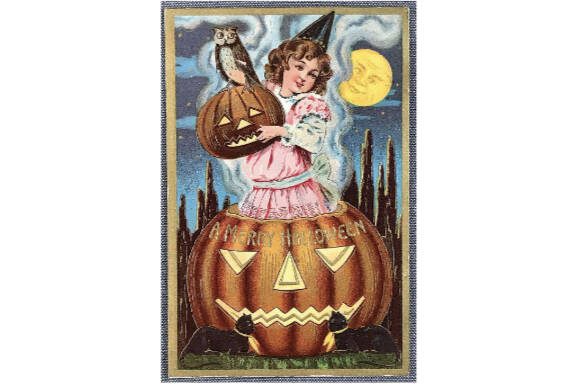
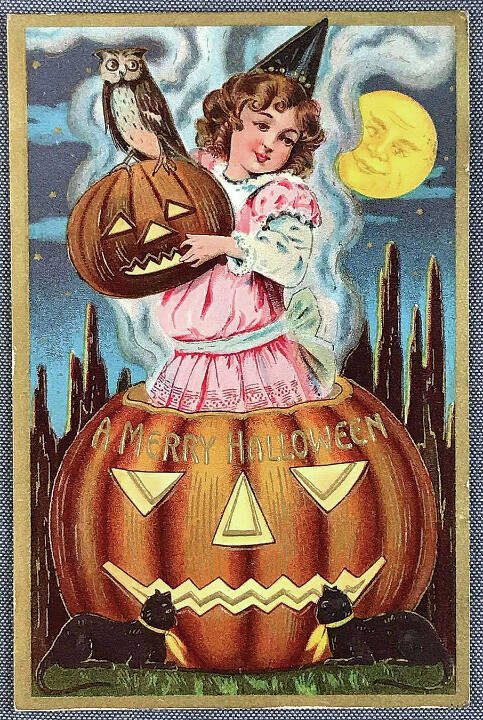


Happy Halloween from the Kovels! Or, in the words of this postcard, “A Merry Halloween.” Despite the antiquated greeting and old-fashioned art style, this card has familiar Halloween icons you might see on today’s decorations: a child in costume, jack-o’-lanterns, an owl, black cats and a full moon — complete with a face, of course.
The art style is characteristic of the early 1900s, and the postmark on the reverse dates it to 1911. So does its one-cent stamp. You would have to spend considerably more on a postcard like this today: It sold for $100 at a Matthew Bullock auction.
Q: Working on settling my mother’s estate, I found the attached piece of jewelry and newspaper article in her things. I’m trying to find its value and sell it so I can pay the estate bills. Any help would be appreciated.
A: Bakelite is a type of plastic that was invented in 1907 and used until the 1960s. It was used for costume jewelry in the mid-20th century. Colorful figural pins or brooches were popular. In the 1980s, collectors became interested in vintage Bakelite jewelry. Its popularity increased over the next decade or so, with prices reaching new heights in the late 1990s. The article you included that lists a similar pin as $610 is from 2003, not long after vintage Bakelite jewelry was at its peak. Unfortunately, prices have dropped since then. Bakelite pins have sold for anywhere from $30 to $500 at recent auctions. Pins with human faces or figures like yours tend to sell for about $100 to $200. A dealer in vintage jewelry may help you get a more accurate estimate.
Q: We have a unique payroll tally machine by the Denominator company in Brooklyn, New York, (number 1295) that was used to tally up different dollar and change amounts from $20 down to $0.01 with a $0.03 counter so you could take out the correct number of bills and coins out of the bank. The housing is made of metal and glass on a wooden base that is felt covered. On the top of the metal housing, it says “Denominator Patents Pending.” From what we could find out, it is from the early 1920s and all counters work. It also has a small shelf that contains the remnants of some kind of notepad. Considering its age, it’s in good condition. What do you think it’s worth?
A: The Denominator Adding Machine Company opened in 1914 in Brooklyn, but the patent for its payroll tally machine wasn’t granted until 1923. In the 1930s, the company changed its name to The Denominator Company and moved to Woodbury, Connecticut, where it is still making manual counters today. In the 1950s, they started making their counters with plastic cases instead of metal. The National Museum of American History at the Smithsonian Institution has a Denominator payroll tally machine like yours in its collection. Counters and adding machines from the early to mid-20th century tend to sell for about $20 to $100 at auctions. Pieces in excellent condition that can do more complex operations (such as multiplication and division) tend to get the highest prices.
Q: I have 16 Dunbar Sweet Ada line bar glasses hand-painted with two men that say what I just said on them. I can find similar items, but cannot find these anywhere. I would appreciate knowing what they might be worth.
A: Dunbar Glass operated in Dunbar, West Virginia, from 1913 to 1953. They are known for their drinking glasses, pitchers and cocktail shakers. We have seen some sellers attribute the same Sweet Ada-Line design to the Wheeling Decorating Company, another West Virginia company that was in operation about the same time. Wheeling decorated glass that was made and marked by other factories. Your set of glasses is probably worth about $100. Large sets of decorated glassware do not often sell for high prices.
TIP: Put a piece of plastic jewelry under hot water and, when warm, smell it. Bakelite smells like formaldehyde, celluloid smells like camphor (mothballs) and Galalith, a 1920s plastic, smells like burnt milk. Lucite does not smell.
On the block
Current prices are recorded from antiques shows, flea markets, sales and auctions throughout the United States. Prices vary in different locations because of local economic conditions.
Haeger, planter, Halloween, figural, pumpkin, jack-o’-lantern, smiling face, eyelashes, orange ground, ribbed, 6 by 6 by 4 inches, $50.
Scale, balance, brass, marked, W & T Avery Ltd., Birmingham, countertop, 22 by 18 ½ by 11 ½ inches, $70.
Halloween, figurine, Happy Ghost, shaded orange ground, smiling face, raised arms, Happy Halloween, black cat sitting on jack-o’-lantern, painted, art glass, signed, dated, Kim Barley, Fenton, 2015, 6 inches, $190.
Halloween, costume, orange jumpsuit, allover black print, jack-o’-lanterns, bats, crescent moons, cap, ruffle around neck and cuffs, matching hat, black eye mask, child’s, 44 inches, $205.
Weller, Woodcraft, vase, bud, double, two trunk shaped flutes, flowering branches in between, owl perched on top, repaired, 1920s, 14 inches, $230.
Coca-Cola, lamp, hanging, four milk glass panels, “Take Some Home,” “Things Go Better with Coke,” red and green lettering, 12 ½ by 11 inches, $245.
Advertising, shelf, Luther Grinder Mfg. Co., iron sides, cutout lettering and vise, early 20th century, 14 ½ by 30 ½ inches, $475.
Stand, IBM dictating machine, walnut plywood, lacquered Masonite, chrome-plated steel, aluminum, four legs, caster feet, Eliot Noyes and Associates, circa 1960, 24 by 14 by 15 inches, $1,385.
Tea caddy, gilt bronze, figural, pumpkin, ribbed, cartouches on panels, raised figures alternate with blue and red enamel, 4 by 5 inches, $2,305.
Halloween, toy, mechanical, fiddle player, jack-o’-lantern face, painted, papier-mache, fabric clothes, 8 inches, $3,565.