Mental illness survivors find healing and purpose at NAMI
Published 1:30 am Friday, December 15, 2023




EVERETT — Kathy Chiles was leading a stressful work project in 2008 when she experienced her first episode of psychosis.
She represents one of 1,000 people who develop the condition every year, according to estimates from the National Institute of Mental Health.
As Chiles navigated the onset of her illness, she said people viewed her condition differently than other medical problems. Her family kept their challenges private.
“There was a lot of stigma,” Chiles said. “We didn’t have the support that often comes with other kinds of illnesses.”
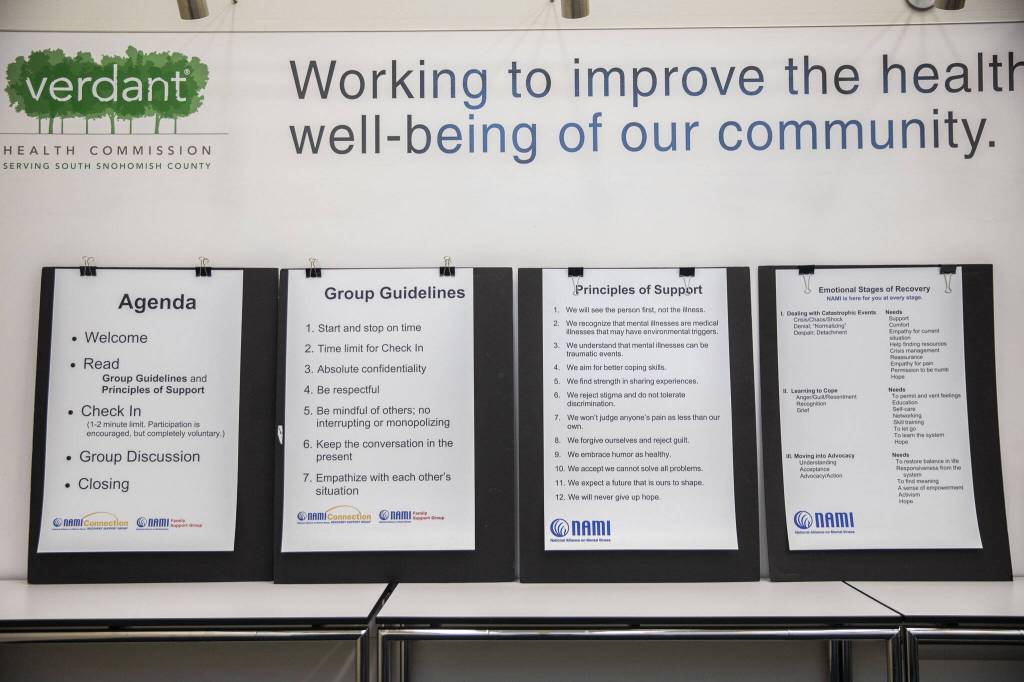
Chiles felt alone until she found a support group through the National Alliance on Mental Illness. The nonprofit provides free classes, groups and advocacy for people with mental health conditions, as well as their family members and friends. Chiles joined Connections, a group for adults hosted by the Verdant Health Commission in Lynnwood.
“Having people to talk to who understand what you’re going through is life-saving,” Chiles said.
The nonprofit started in 1979 when two mothers diagnosed with schizophrenia in Wisconsin were frustrated with misconceptions and shame surrounding mental health care. What began as a small parental support group is now the largest nonprofit for mental health resources in the country.
In 1989, volunteers established the Washington affiliate. There are now 19 offices statewide, including one serving Snohomish and Island Counties.
“The mental and behavioral health system in Washington was built in stages, and it’s not well-connected,” said Cammy Hart-Anderson, behavioral health and veteran services manager for Snohomish County. “NAMI helps fill that void.”
In addition to support groups, the nonprofit connects people with treatment options, housing, health insurance and legal representation in case of arrest. Volunteers who have experienced mental illness present seminars to help families understand what their loved ones need.
Twenty-five years ago, Snohomish residents Jim and Lynn Bloss learned their son was diagnosed with a serious mental illness. “Devastated, saddened, but mostly lost,” Jim Bloss said his family decided to call the local nonprofit.
“We found someone who knew what we were going through,” Jim Bloss said. “They told us, ‘You are not alone. We have been where you are now, and we can help you.’”
Mental health care is a significant need for Snohomish County residents, especially youth, according to an annual health report.
In 2021, nearly 40% of Snohomish County students in eighth through 12th grade reported feeling sad or hopeless every day for at least two weeks. Just over 37% of students reported feeling anxious.
From 2015 to 2020, the number of Snohomish County adults with a serious mental illness doubled. The county had a greater percentage of people with serious mental illness in 2020 compared to the state average.
Sen. Marko Liias, D-Lynnwood, has worked with the nonprofit on legislation to help youth and young adults access mental health care. Liias applauded the nonprofit’s inclusivity toward LGBTQ+ individuals, who are at a higher risk for mental health conditions.
“Marginalization of folks who need mental health support is real,” he said. “NAMI works to bring visibility, dignity, respect and self-advocacy.”
About 20 nonprofit volunteers serve Snohomish and Island County residents.
“There’s really no one who does what we do,” said Karen Schilde, co-chair on the local nonprofit’s board since 2007. “We’re helping save people’s lives.”
Recruiting volunteers is difficult, Chiles said, because of the lack of pay and unpredictable nature of mental illness. Fundraising has also been a challenge.
“For our last event, most of the funds came from money raised for families of suicide victims,” Schilde said. “It shouldn’t have to be that way.”
Schilde, whose son has a long-term mental health condition, said working for the nonprofit gives her a chance to help families like hers.
“It gives me hope,” she said. “A big part of recovery is having a sense of purpose.”
Chiles, now co-chair on the board with Schilde, is working to break mental illness stigma. She now leads the Connections group, and shares her story with police to improve crisis response.
“What people experience, to them, is very real,” she said. “Don’t discredit them. They need comfort and to know they are not alone.”
NAMI Sno-Isle seminar options include a general four-hour class, a six-week class for families of adults and an eight-week class for families of youth. Educational materials are available in nine languages. The next four-hour seminar is set 9 a.m. to 1 p.m. on Dec. 16 via Zoom.
Support groups include:
• Connection group for adults with mental health conditions at Verdant Health Commission in Lynnwood;
• Basics support group for family and friends of youth with mental health conditions at First Presbyterian Church in Everett; and
• South Whidbey family support group at Trinity Lutheran Church in Freeland.
People who need mental health resources can call the state’s 988 Suicide and Crisis Lifeline, the National Alliance on Mental Illness HelpLine (800-950-6264) and the Teen and Young Adult HelpLine (800-950-6264).
Sydney Jackson: 425-339-3430; sydney.jackson@heraldnet.com; Twitter: @_sydneyajackson.