‘The market has spoken’: Jet buyers see a grim Boeing future
Published 6:15 am Tuesday, October 27, 2020



By Dominic Gates / The Seattle Times
SEATTLE — The world’s biggest buyers of commercial jets believe the Boeing Co., which is to report more heavy financial losses on Wednesday, has fallen significantly below parity with rival Airbus — with limited options for recovery as it bleeds cash during the pandemic-driven aviation crisis.
In interviews, executives of the top aircraft-leasing companies said the country’s commercial aviation leader faces immense challenges, with its 737 Max, built in Renton, yet to resume commercial flights and prospects for its large new 777X jet, built in Everett, crushed by the dramatic contraction of international air travel.
In the market for smaller, single-aisle jets, sales of the Airbus A320neo family — especially the large, long-range A321neo model — have far outstripped those of the 737 Max.
“The market has spoken. Airbus truly has a commanding lead at the upper-end size of the single-aisle marketplace,” said John Plueger, chief executive of Los Angeles-based Air Lease Corporation (ALC), which owns or has on order a fleet of almost 800 Boeing and Airbus jets. “For sure, Boeing has lost position against Airbus during the Max crisis.”
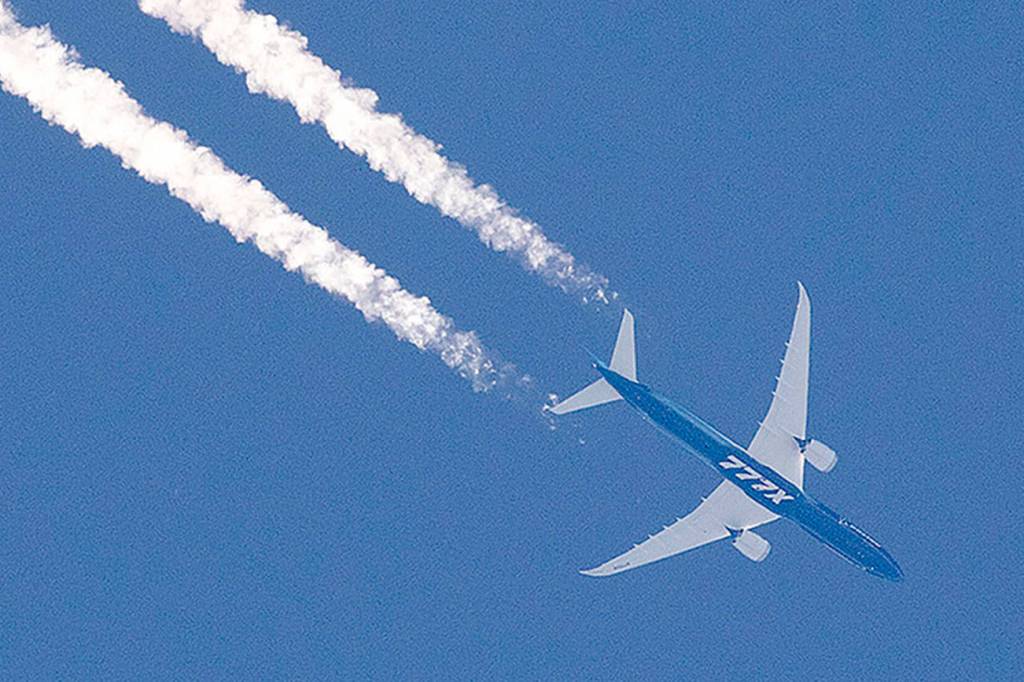
At the other end of the jet scale, Boeing has traditionally dominated the larger wide-body airplane sector. Yet the new 777X, which seats more than 400 passengers, is in trouble. The big international long-haul airlines that launched the giant jet cannot hope to fill it in the wake of the global pandemic.
Those airlines “will want to push deliveries out quite a few years,” said Gus Kelly, chief executive of Ireland-based AerCap, the world’s largest airplane lessor, with a fleet of more than 1,000 large commercial jets and more than 300 on order.
“The 777X will have its day, but it will be in the future,” Kelly said.
In an email, ALC chairman and eminent aviation entrepreneur Steve Udvar-Hazy said of the 777X that the jetmaker needs to “slow down production rates and focus on what airlines need rather than what Boeing would like to sell.”
‘Demand has vanished’
Engulfed in a historically unprecedented aviation downturn, and still awaiting approval for its 737 Max to fly again, the U.S. industrial giant and cornerstone of Washington’s manufacturing economy is shrinking — laying off thousands of employees, cutting production and selling assets, including significant real estate.
In addition to the approximately 450 Max planes parked and awaiting Federal Aviation Administration (FAA) clearance for delivery, Boeing has a growing number of finished 787 Dreamliners in storage at a desert airport in Victorville, California.
Those 787s were built for airlines — including China Southern, Hainan and Juneyao of China; Norwegian; Qatar; and Qantas of Australia — that cannot take them at this time, and in the case of Hainan and Norwegian, may never take them.
Bank of America aviation research analyst Ron Epstein estimated last week that the Max and 787 excess inventory represents about $20 billion worth of airplanes parked and undelivered.
Company leadership this month announced it will consolidate 787 production in South Carolina, abandoning by next summer the original production line in Everett.
Boeing has indefinitely shuttered its lavish Leadership Center in St. Louis, Missouri, inherited from McDonnell Douglas, and the program there for grooming future executives developed during years of expansive corporate power.
Earlier this month, Boeing Commercial Airplanes CEO Stan Deal told employees the company may sell its local headquarters campus at Longacres, part of a far-reaching review of company properties.
All of this reflects a cash crisis that was already severe from the grounding of the Max and intensified when the coronavirus seized the previously rocketing engine of global air traffic.
Wall Street analysts estimate that Boeing over the past three months has burned through more than $5 billion of a $32 billion cash hoard.
Under this extreme financial pressure, Boeing is virtually paralyzed competitively against Airbus.
Though the Wall Street Journal reported last week that Boeing is beginning to look at an all-new airplane design that would challenge the runaway success of the Airbus A321neo, aviation experts are very skeptical.
Bernstein Research analyst Doug Harned called the notion “absurd.”
“Boeing is burning cash at levels never seen before, at a time when demand has vanished,” Harned told investors. “Major new investments at this time would make no sense.”
Rob Spingarn, a Credit Suisse analyst, added that with the job cuts in Washington, including the retirements of many older, more experienced workers, Boeing may now lack “the requisite talent to successfully launch a commercially viable clean sheet aircraft.”
The Airbus A320neo family has amassed a backlog of almost 6,000 orders, including more than 3,000 for the A321neo and two longer-range variants, the LR and XLR. Boeing’s 737 Max family firm backlog has shrunk due to cancellations to just over 3,300 orders.
Plueger said Airbus has revalidated all its orders, and though some may fall away in the year ahead, he has “a high degree of confidence” that most of them will stay solid.
He added that if Boeing were to launch a new airplane, Airbus already has a likely response lined up: putting a new light composite wing on the A321neo to improve its aerodynamics, which could be accomplished much quicker than Boeing’s development of an all-new jet.
Boeing faces other barriers, Kelly noted: Engine makers, who have just spent billions of dollars developing the new generation LEAP and GTF engines for Boeing’s Max and Airbus’s neo, would have little interest in investing in a new engine to supplant those models.
And that same reluctance to cannibalize existing products would apply equally to Boeing.
“If Boeing launched such an airplane, what would happen to the Max?” Kelly said. “People aren’t going to buy it and Boeing needs that cash flow from the Max.”
Kelly echoed the assessment of Plueger, who said: “I’ve got to imagine it’s a tough sell in the boardroom in Chicago.”
The large jet problem
Plueger and Kelly, among the most powerful players in the airline world, lease planes to airlines in every corner of the globe and have a finger on the pulse of the market. When considering development of a new jet, both Airbus and Boeing consult directly with them about what the market wants.
Lessors account for north of 40% of all commercial jet sales, and due to the pandemic, that figure is likely to grow closer to half of all sales, increasing their influence.
Kelly said that when a recovery comes, airlines will emerge financially weaker, focused on repaying government debt.
“They will not be buying airplanes from Boeing and Airbus, sending billions of dollars to Seattle and Toulouse,” he said. Instead, short of cash, many more airlines will avoid the upfront capital cost of a direct purchase and lease their planes from companies like AerCap and ALC.
Plueger and Kelly remain confident that the airline industry — and Boeing — will recover eventually.
“Fundamentally, commercial air transport improves the human condition. People need to get places, they need to see family, they need to conduct business,” said Plueger. “There’s a pent-up demand for air travel.”
But in the short-term, the 777X and the Max present challenges that threaten to slow production rates in Everett and Renton, respectively.
The 777X, which had its first test flight in January, was originally supposed to enter service this year.
Boeing has pushed out the first delivery into 2022, but the pandemic may keep 777X demand very low through mid-decade. Cathay Pacific, one of the 777X’s launch customers, revealed last week that it has deferred its first deliveries to 2025.
The trend away from large wide-body jets was already apparent before the pandemic and has now greatly accelerated.
Boeing sees the 777X as the natural successor to its jumbo 747 and the Airbus superjumbo A380. But in the pandemic, airlines have prematurely retired both those aircraft and aren’t looking for replacements any time soon.
“If you fly a huge airplane, there are massive associated costs,” said Kelly. “Airlines just cannot afford to fly airplanes that they don’t think they can fill.”
Max return is crucial
The bread-and-butter market for smaller jets that fly mostly domestic routes should recover from the pandemic much more quickly.
For Boeing to take advantage, the Max must emerge from the crisis that grounded the jet in March 2019 after two fatal crashes.
Plueger said Boeing’s immediate problem is getting airlines to take the hundreds of Maxs already built that have been mothballed for many months. He expects big discounts on those planes.
“To try to push them out, frankly, will require price concessions that are compelling,” said Plueger. “Boeing needs to take aggressive action. It’s more important for Boeing to get them flying, even at additional economic cost.”
Kelly agreed but said that once those excess planes are moved out, Boeing can rely on robust sales of the main Max model — the 737 Max 8. He said that jet offers almost identical operating economics to its direct competitor, the A320neo.
“The Max 8 is an excellent airplane. The Max 8 will sell,” said Kelly.
Boeing’s harder task will be selling the larger Max models.
“The Max 9 hasn’t worked out. That’s being replaced by the Max 10,” said Kelly. And the Max 10 must compete against the longer range A321neo, as well as the even longer-range A321neoLR and A321neoXLR models.
This match-up will require discounts from Boeing, Kelly believes.
“The Max 10 will be able to fly the vast majority of the missions the A321 can do. It just cannot do it as efficiently,” he said. “Can they drop the price enough so people can live with the capability of that airplane? … Yes, there is a number where that works.”
“But will the Max family have parity with the Airbus neo family?” he said. “It doesn’t appear likely.”
The FAA is expected next month to approve the Max to fly passengers again, and the jet will likely return to U.S. and European skies early next year.
For Boeing, that begins what promises to be a long, slow climb out of crisis.