These drought-defying plants will survive our dry summers
Published 1:30 am Saturday, May 26, 2018


It seems odd to be writing about drought tolerance. We get literally feet of rain every year, and we generally have an adequate supply of water for the summer months.
But, as we all know, our rainfall isn’t distributed evenly throughout the season, and so our summers can be quite dry. So here I write.
Gardeners have options when it comes to selecting plants that are low-water users and, once established, many of these shrubs, trees and perennials can manage quite well with occasional deep watering. Just remember, it can take three or more years for a plant to truly establish itself and, during that time, it will need close attention if you want it to survive.
Here are a few of my picks for drought-tolerant plants that also have great visual interest.
Acer griseum, or paperbark maple: If you are looking for a smallish growing tree that reaches 18 to 20 feet tall and wide, then look no more. In the spring it sports soft green three-lobed leaves that turn a dark green on top and silvery underneath in the summer. In late fall the leaves change to yellow, orange, vibrant red and even scarlet, crimson or pink. These leaves hang on the tree well into winter.
Once they have fallen, we are left with a fantastic winter show of exfoliating bark in tones of copper, orange, cinnamon and reddish-brown. The bark peels in curly, translucent, papery strips that remain attached to the trunk and branches until naturally worn away. It is a real eye-catcher, and if you want to see two nice specimens, drive down State Avenue and 10th Street in Marysville to the Union Bank on the east side of the street.
Trachycarpus fortunei, or windmill palm: OK, I know, palm trees seem sort of out of place in the Evergreen State, but this variety will actually grow for us and, oh my gosh, it is the personification of drought tolerance. Once established, you can throw your garden hose away on this guy. Its single hairy trunk, less than a foot in diameter, can eventually reach 15 to 20 feet tall with a head of fan-shaped fronds reaching 10 to 12 feet across. (They are slow growing so have patience.)
I prefer to see them planted in clusters of three, but a single specimen can also be effective. The male puts out a yellow flower in spring, which is mostly a curiosity. There is a lot of seedling variation, with the frond tip being either thin and drooping or short and stiff. You can decide which you prefer.
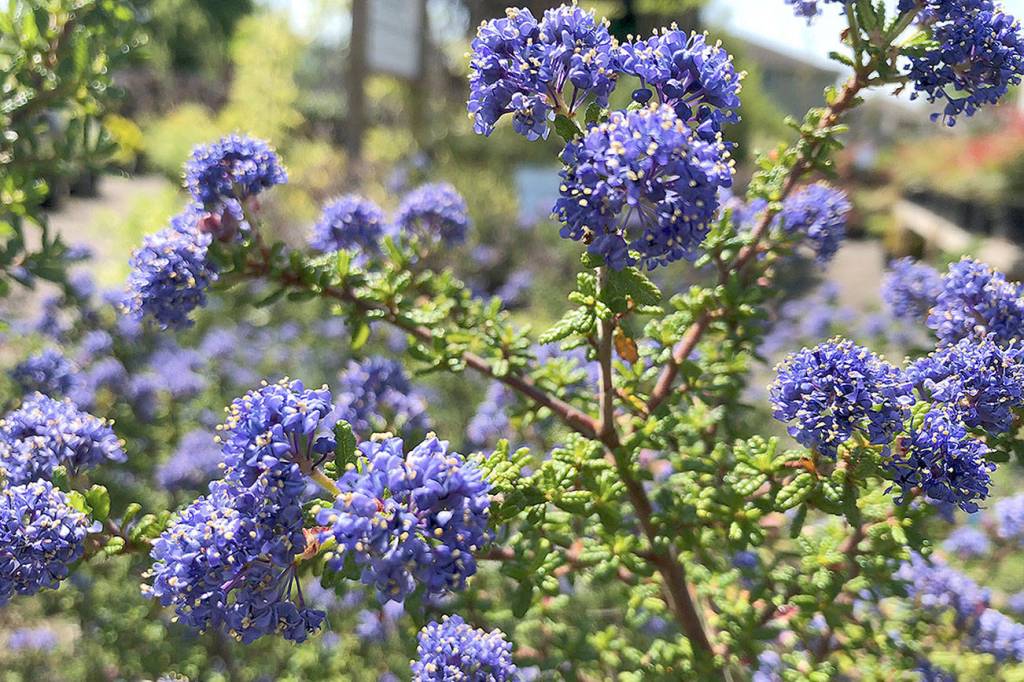
Ceanothus, or California lilac: This broadleaf evergreen is not a lilac, so don’t be confused. A native to the California foothills, it has bright indigo blue flowers that will knock your socks off and thrill the honeybees. The flowers are a stunning contrast to the glossy, dark-green foliage that looks fabulous all year-round.
The variety “Victoria” grows 8 to 10 feet tall and blooms in late May, while “Dark Star” blooms a month sooner and only reaches 4 to 5 feet tall. “El Dorado” sports attractive green leaves with a yellow margin. Plant Ceanothus in the hottest and driest spot in your garden, then sit back and enjoy.
Miscanthus sinensis “Morning Light”: This is one of my favorite varieties of maiden grasses on the market. It has a narrow blade of only a quarter-inch wide with a silver band running length wise. It grows in a very stiff and upright clump that does not spread (none of the maiden grasses are runners). Best of all, it doesn’t flop over if we get a rainstorm in late August, like we often do. It is a tidy grower topping out at only 4 to 5 feet tall, and only needs to be cut to the ground once a year in February to keep it looking good.
Epimedium or bishop’s hat: This is the consummate ground cover for a dry and partially shaded bed. The evergreen foliage looks good all winter long, but it is best to shear it back in February before the sulfur-colored flowers emerge with their clusters of dainty little bishop hats. The new foliage is often mottled with a tinge of red that matures to a pleasant medium green. There are actually several varieties on the market with different leaf and flower coloration. This plant spreads slowly, so it won’t take over your garden.
For more plants suitable for our dry summers, I suggest you consult “The Plant List,” a publication developed by City of Seattle Public Utilities and reproduced with permission by Snohomish County. This brochure is an excellent reference for all types of plants that will thrive in our gardens, whether they are wet or dry.
Steve Smith is the owner of Sunnyside Nursery in Marysville and can be reached at info@sunnysidenursery.net.
Carnivorous plants & mini gardens
Attend two free classes at Sunnyside Nursery next weekend: One on carnivorous bog gardening is 10 a.m. June 2 and another on mini gardens is 11 a.m. June 3. The garden center is at 3915 Sunnyside Blvd., Marysville. For more information or to sign up, visit www.sunnysidenursery.net.