Snohomish School District transportation supervisors John Kwesele, left, and Karl Hereth, right, stand with Transportation Director Veronica Schmidt behind the open hood of the district’s first electric school bus Thursday, March 7, 2024, at the district bus depot in Snohomish, Washington. (Ryan Berry / The Herald)

Snohomish School District transportation supervisors John Kwesele, left, and Karl Hereth, right, stand with Transportation Director Veronica Schmidt behind the open hood of the district’s first electric school bus Thursday, March 7, 2024, at the district bus depot in Snohomish, Washington. (Ryan Berry / The Herald)

Snohomish, Everett electrifying school bus fleets, ahead of new law

State lawmakers proposed electrifying all school buses by 2035. But that may be a stretch for many school districts, like Snohomish.

SNOHOMISH — In the Snohomish School District, bus mileage is critical.

The school district covers 128 square miles, while a nearby district like Everett covers 39.

Current electric buses can travel a maximum of 85 miles before needing a charge, making things tricky for longer routes.

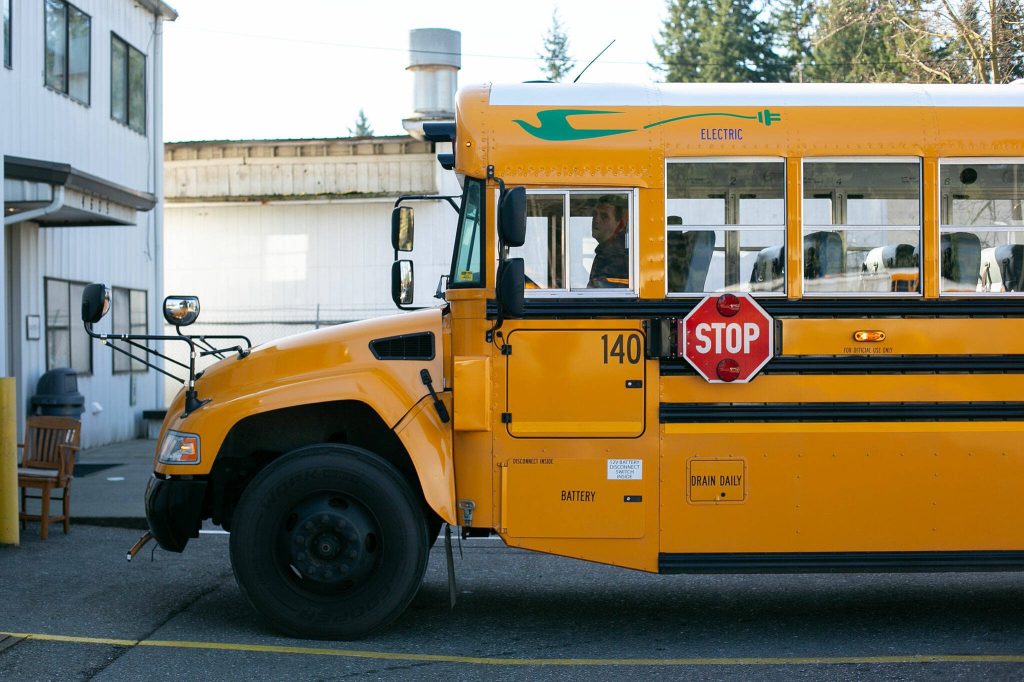
The district purchased one electric bus in 2022 for about $391,000, helped by a $304,000 grant from the state Department of Ecology. Transportation leaders had to carefully calculate the bus’ route. Driving over hills and turning on the heat can sap the battery.

Going all-electric wouldn’t work right away, said Veronica Schmidt, the Snohomish School District’s transportation director. But the school district welcomes the chance to phase out diesel- and gasoline-fueled buses.

Snohomish School District Transportation Supervisor Karl Hereth backs up the district’s electric school bus Thursday, March 7, 2024, at the district bus depot in Snohomish, Washington. (Ryan Berry / The Herald)

Snohomish School District Transportation Supervisor Karl Hereth backs up the district’s electric school bus Thursday, March 7, 2024, at the district bus depot in Snohomish, Washington. (Ryan Berry / The Herald)

“If we can get some,” she said, “we’ll try it.”

This month, state legislators passed House Bill 1368 to help districts pay for electric school buses, affirming that the long-term benefits outweigh the short-term costs and other speed bumps. Originally, state representatives proposed that the state require all new school bus purchases be electric beginning Sept. 1, 2035, in line with deadlines set in California and New York — a goal critics described as “too much, too soon.”

The Washington version delivered to Gov. Jay Inslee did not include a hard deadline.

Instead, the bill expands the state’s current electric bus program, requiring state officials to prioritize grants for populations vulnerable to air pollution, especially communities of color and low-income residents. The measure was still awaiting the governor’s signature as of this week.

School districts can also use grants to build charging stations and facilities to store electric buses.

Rep. Tana Senn, the bill’s lead sponsor, wants school districts to be excited about the initiative.

“This is a tangible, impactful way to improve air quality and children’s health,” said Senn, a Democrat from Mercer Island.

Diesel exhaust is “carcinogenic to humans,” according to the International Agency for Research on Cancer. Children are more susceptible to the negative health effects of diesel exhaust when bus drivers idle the vehicles. Diesel exhaust pollutants also contribute to ozone pollution and acid rain.

Snohomish School District’s Clayton Lovell plugs in the district’s electric bus after morning routes on Thursday, March 7, 2024, at the district bus depot in Snohomish, Washington. (Ryan Berry / The Herald)

Snohomish School District’s Clayton Lovell plugs in the district’s electric bus after morning routes on Thursday, March 7, 2024, at the district bus depot in Snohomish, Washington. (Ryan Berry / The Herald)

In Snohomish, the driver for the electric bus has about five hours in between the morning and afternoon routes to charge the vehicle at the school district’s charging station. Staff also plug the bus in overnight, but it can take up to eight hours to fully recharge.

Electric buses also can’t hold as many students, Schmidt said. The district’s electric bus can take 71 passengers. Other buses in the fleet can handle 77. Batteries in electric buses are heavy, so drivers have to take fewer students to meet weight distribution standards.

One perk of the electric bus is drivers can hear kids better, Schmidt said, because the vehicles are quieter.

This year, the Environmental Protection Agency awarded the Snohomish School District another grant for three smaller Type A electric buses. They can hold just over 20 passengers. These buses typically cost $320,000.

Schmidt isn’t sure when the district will get those vehicles.

In September, Everett Public Schools deployed three electric buses, funded by an Ecology grant, school district spokesperson Kathy Reeves said.

The Everett school district contracts with Durham School Services for student transportation. And the company received a grant from the Environmental Protection Agency for three more electric buses and charging stations, beginning in the 2024-2025 school year.

By 2025-2026, the school district’s fleet could grow to nine electric buses if Durham gets another grant from Ecology.

Also this year, the Environmental Protection Agency is helping Snohomish schools buy 11 propane-fueled buses — an alternative Everett is exploring, too.

Propane fuel has lower carbon content compared to gasoline and diesel fuel, according to the U.S. Department of Energy.

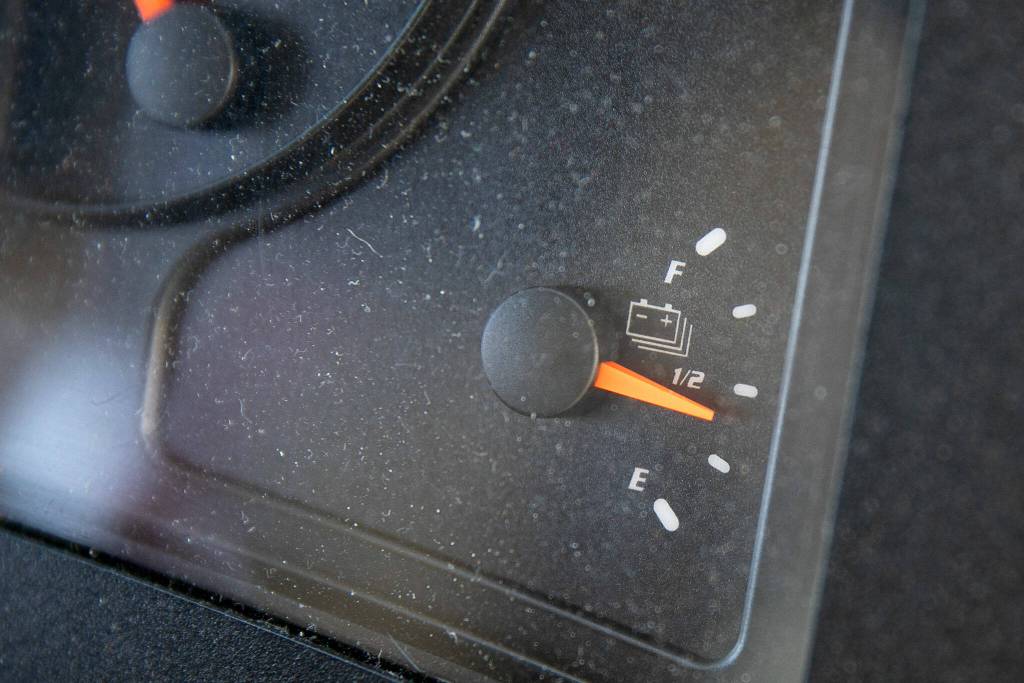
The battery gauge on Snohomish School District’s lone electric school bus replaces the typical fuel gauge of most buses Thursday, March 7, 2024, at the district bus depot in Snohomish, Washington. (Ryan Berry / The Herald)

The battery gauge on Snohomish School District’s lone electric school bus replaces the typical fuel gauge of most buses Thursday, March 7, 2024, at the district bus depot in Snohomish, Washington. (Ryan Berry / The Herald)

On a full tank, a propane bus can travel about 300 miles. Propane buses are also more cost-effective. Diesel fuel currently costs 64 to 80 cents per mile, while propane costs 19 to 30 cents a mile, Schmidt said.

Durham School Services recently acquired 25 propane buses for Everett to use next school year.

The Everett school district anticipates saving over $200,000 annually by using propane instead of diesel or unleaded gasoline, Reeves said.

School district officials have to trade in one diesel or gasoline-powered bus every time they’re awarded a grant for a propane or an electric one. Staff take the bus to an auto yard, where any salvageable parts are recycled.

Ta’Leah Van Sistine: 425-339-3460; taleah.vansistine@heraldnet.com; Twitter: @TaLeahRoseV.

Talk to us

> Give us your news tips.

> Send us a letter to the editor.

> More Herald contact information.

More in Local News

A sign notifying people of the new buffer zone around 41st Street in Everett on Wednesday, Jan. 7. (Will Geschke / The Herald)
Everett adds fifth ‘no sit, no lie’ buffer zone at 41st Street

The city implemented the zone in mid-December, soon after the city council extended a law allowing it to create the zones.

Logo for news use featuring the Tulalip Indian Reservation in Snohomish County, Washington. 220118
Teens accused of brutal attack on Tulalip man Monday

The man’s family says they are in disbelief after two teenagers allegedly assaulted the 63-year-old while he was starting work.

A view of the Eastview development looking south along 79th Avenue where mud and water runoff flowed due to rain on Oct. 16, 2025 in Snohomish, Washington. (Olivia Vanni / The Herald)
Eastview Village critics seek appeal to overturn county’s decision

Petitioners, including two former county employees, are concerned the 144-acre project will cause unexamined consequences for unincorporated Snohomish County.

Snohomish County commuters: Get ready for more I-5 construction

Lanes will be reduced along northbound I-5 in Seattle throughout most of 2026 as WSDOT continues work on needed repairs to an aging bridge.

Logo for news use featuring the municipality of Snohomish in Snohomish County, Washington. 220118
Snohomish man held on bail for email threat against Gov. Ferguson, AG Brown

A district court pro tem judge, Kim McClay, set bail at $200,000 Monday after finding “substantial danger” that the suspect would act violently if released.

Kathy Johnson walks through vegetation growing along a CERCLA road in the Mt. Baker-Snoqualmie National Forest on Thursday, July 10, 2025 in Granite Falls, Washington. (Olivia Vanni / The Herald)
Activism groups to host forest defense meeting in Bothell

The League of Women Voters of Snohomish County and the Pacific Northwest Forest Climate Alliance will discuss efforts to protect public lands in Washington.

Debris shows the highest level the Snohomish River has reached on a flood level marker located along the base of the Todo Mexico building on First Street on Friday, Dec. 12, 2025 in Snohomish, Washington. (Olivia Vanni / The Herald)
SnoCo offers programs to assist in flood mitigation and recovery

Property owners in Snohomish County living in places affected by… Continue reading

x
Delay on Critical Areas Ordinance update draws criticism from groups

Edmonds is considering delaying updates to a section of the ordinance that would restrict stormwater wells near its drinking water aquifer.

Logo for news use featuring Snohomish County, Washington. 220118
Providence Swedish welcomes first babies of 2026 in Everett, Edmonds

Leinel Enrique Aguirre was the first baby born in the county on Thursday in Everett at 5:17 a.m. He weighed 7.3 pounds and measured 20 inches long.

Marysville house fire on New Year’s Day displaces family of five

Early Thursday morning, fire crews responded to reports of flames engulfing the home. One firefighter sustained minor injuries.

Floodwater from the Snohomish River partially covers a flood water sign along Lincoln Avenue on Thursday, Dec. 11, 2025 in Snohomish, Washington. (Olivia Vanni / The Herald)
Images from the flooding in Snohomish County.

Our photographers have spent this week documenting the flooding in… Continue reading

Lynnwood
Lynnwood man sentenced over placing spy cameras in Expedia bathrooms

This comes after Marcelo Vargas-Fernandez pleaded guilty in December to 14 counts of voyeurism and two counts of violating a sexual assault protection order.

Support local journalism

If you value local news, make a gift now to support the trusted journalism you get in The Daily Herald. Donations processed in this system are not tax deductible.