Investigators consider whether train engineer was distracted
Published 1:30 am Tuesday, December 19, 2017




By Michael Balsamo and Haven Daley / Associated Press
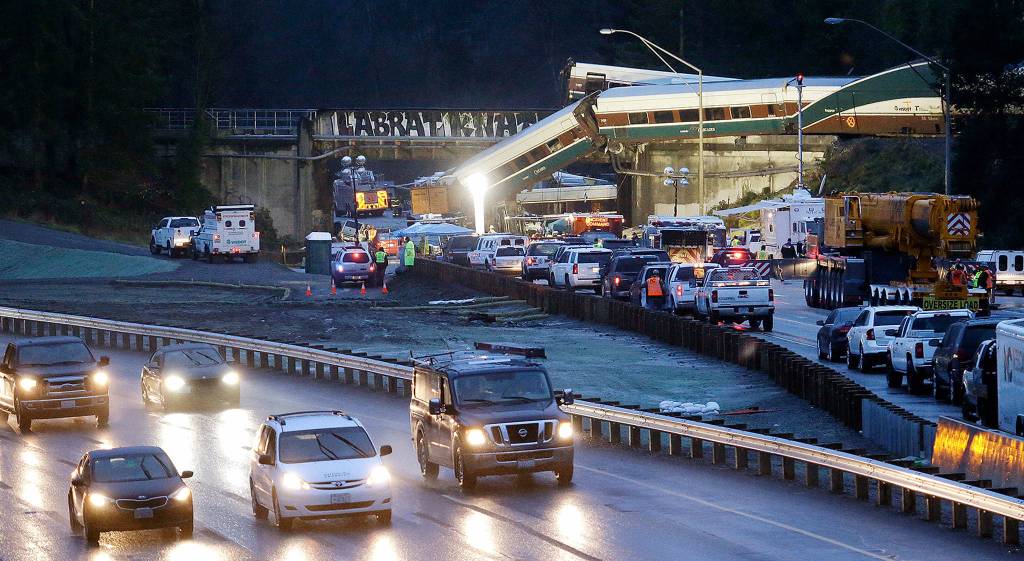
DUPONT — Investigators are looking into whether the Amtrak engineer whose speeding train plunged off an overpass, killing at least three people, was distracted by the presence of an employee-in-training next to him in the locomotive, a federal official said Tuesday.
The official, who was not authorized to discuss the matter publicly and spoke on condition of anonymity, said investigators want to know whether the engineer lost “situational awareness” because of the second person in the cab.
Preliminary information indicated that the emergency brake on the Amtrak train that derailed in Washington state went off automatically and was not manually activated by the engineer, National Transportation Safety Board member Bella Dinh-Zarr said.
The train was hurtling at 80 mph (129 kph) in a 30 mph (48 kph) zone Monday morning when it ran off the rails along a curve south of Seattle, sending some of its cars plummeting onto an interstate highway below, Dinh-Zarr said, citing data from the locomotive’s event recorder.
Skid marks — so-called “witness marks” — from the train’s wheels show where it left the track, she added.
Dinh-Zarr said it is not yet known what caused the train to derail and that it was too early in the investigation to conclude why it was going so fast.
Investigators will talk to the engineer and other crew members and review the event data record from the lead locomotive as well as an identical device from the rear engine, which has already been studied. Investigators are also trying to get images from two on-board cameras that were damaged in the crash, she said.
There were two people in the cab of the train at the time of the crash, the engineer and an in-training conductor who familiarizing himself with the route, Dinh-Zarr said. A second conductor was in the passenger cabin at the time of the crash, which is also part of the job responsibility, she said.
In previous wrecks, investigators looked at whether the engineer was distracted or incapacitated. It is standard procedure in a crash investigation to test the engineer for alcohol or drugs and check to determine whether he or she was using a cellphone, something that is prohibited while the train is running.
The engineer, whose name was not released, was bleeding from the head after the crash and his eyes were swollen shut, according to radio transmissions from a crew member.
The train, with 85 passengers and crew members, was making the inaugural run along a fast new bypass route that was created by refurbishing freight tracks alongside Interstate 5. The 15-mile, $180.7 million project was aimed at speeding up service by bypassing a route with a number of curves, single-track tunnels and freight traffic.
Investigators were also looking into what training was required of the engineer and other crew members to operate on the new route, said Ted Turpin, the lead NTSB investigator of the crash. That includes assessing the training process and how much time the workers were required to spend on the trains before they shuttled passengers, he said.
“Under Amtrak policy he couldn’t run this train without being qualified and running this train previously,” Turpin said of the engineer.
At least some of the crew had been doing runs on the route for two weeks prior to the crash, including a Friday ride-along for local dignitaries, Dinh-Zarr added.
The bypass underwent testing by Sound Transit and Amtrak beginning in January and at least until July, according to documents on the Washington Department of Transportation website.
Positive train control — technology that can automatically slow or stop a speeding train — was not in use on that stretch of track. Track sensors and other PTC components have been installed, but the system is not expected to be completed until the spring, transit officials said.
Regulators have been pressing railroads for years to install such technology, and some have done so, but the deadline has been extended repeatedly at the industry’s request and is now set for the end of 2018.
Dinh-Zarr said it was too early in the investigation to say whether positive train control would have prevented Monday’s tragedy.
Meanwhile, two of the dead were identified as train enthusiasts who belonged to the rail advocacy group All Aboard Washington and were excited to be aboard for the inaugural run: Jim Hamre, a retired civil engineer with the state Transportation Department, and Zack Willhoite, a customer service employee at Pierce Transit.
“It’s pretty devastating. We’re having a tough time,” said All Aboard Washington executive director Lloyd Flem.
In addition to those killed, more than 70 people were injured. As of Tuesday, 35 were still hospitalized, including 21 in critical or serious condition.
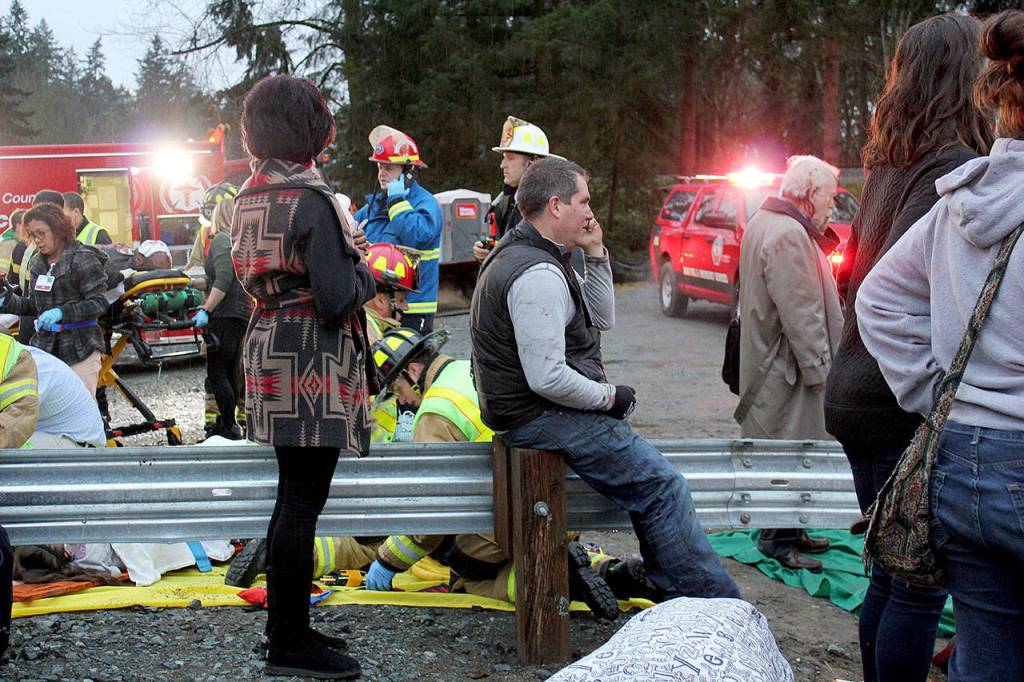
The 7:34 a.m. accident left mangled train cars up on top of each other, with one hanging precariously over the freeway. The screech and clang of metal were followed by silence, then screams, as the injured cried out to rescuers and motorists pulled over and rushed to help.
var _informq = _informq || []; _informq.push([’embed’]);
In 2015, an Amtrak train traveling at twice the 50 mph speed limit ran off the rails along a sharp curve in Philadelphia, killing eight people. Investigators concluded the engineer was distracted by reports over the radio of another train getting hit by a rock.
In September, a judge threw out charges of involuntary manslaughter and reckless endangerment against the engineer, saying the wreck did not appear to rise to a crime. Prosecutors are trying to get the case reinstated.
In the Washington state crash, speed signs were posted 2 miles (3 kilometers) before the speed zone changed, according to Kimberly Reason of Sound Transit, the Seattle-area transit agency that owns the tracks.
After the Philadelphia wreck, Amtrak agreed to pay $265 million to settle claims filed by victims and their families. It has also installed positive train control on all of its track between Boston and Washington.
The NTSB’s Dinh-Zarr said it is too soon to say whether positive train control would have prevented Monday’s tragedy.
Balsamo reported from Los Angeles. Associated Press staffers Phuong Le and Sally Ho in Seattle, Michael Sisak in Philadelphia and Manuel Valdes in Dupont contributed.