Emile Galle infused furniture with elements of his better-known glass work
Published 1:30 am Wednesday, November 22, 2023


One of the most recent, most popular and often most expensive categories of collecting is known as design. Sometimes called modern or industrial design, the term refers to the work of 20th and 21st century manufacturers who brought their distinctive style to various types of furnishings and housewares, from furniture to lamps to decorative sculptures to functional appliances.
Industrial design took off in the mid-century modern era shortly after World War II (think of Charles and Ray Eames, Isamu Noguchi, Alvar Aalto, etc.), but artisans were working in multiple media before then.
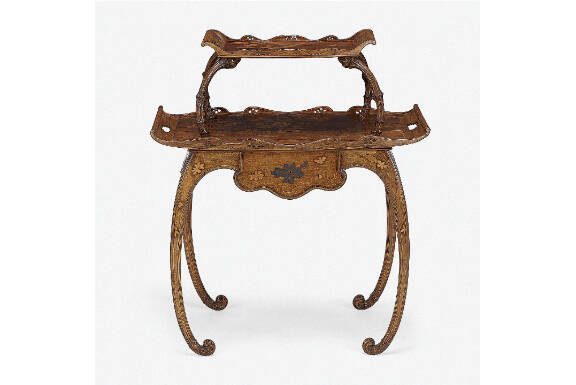
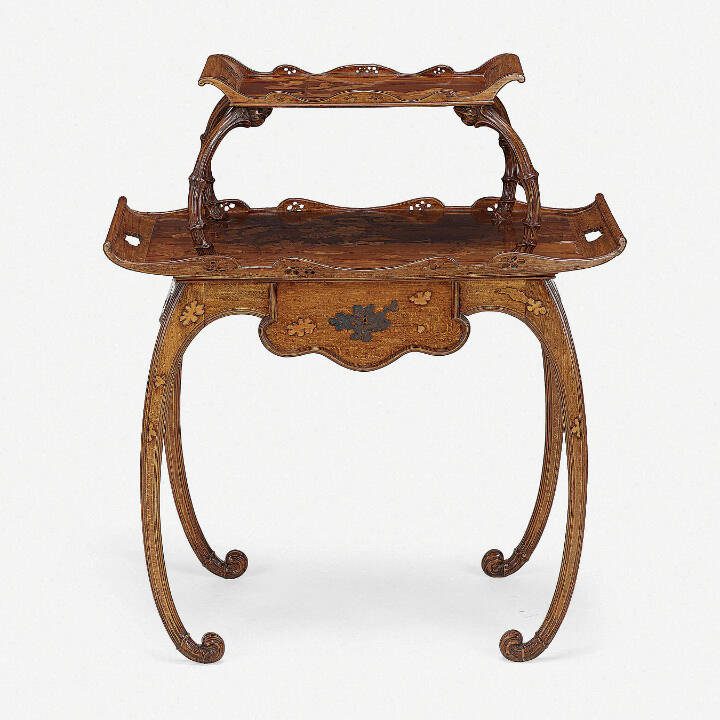
Emile Galle, a pioneer of the art nouveau movement that started in the 19th century, is famous for his glass, ceramics and furniture. He is best known for the cameo glass made by the studio he founded in Nancy, France, in 1873. His glass had the graceful curving shapes, Japanese influence and natural elements like flowers and plants that characterize art nouveau. So did his furniture. This tea table by Galle, with scrolling legs, scalloped edges and inlaid cherry blossoms, sold for $2,800 at a Rago auction.
Q: I have a piece of pottery 8 inches tall and 9 inches in diameter with no maker’s mark. The pattern is similar to Weller Knifewood pottery with a carved squirrel, owl and raven in leafy tree branches. Can you help me find the manufacturer or value?
A: Weller pottery is not always marked. Weller started making art pottery in the early 1900s. Designer Rudolph Lorber created several art pottery lines for the company, including Knifewood, which was introduced by the 1920s. A 1921 catalog described Knifewood as having “the effect of which is suggested by the name. The various pieces have all the appearances of being carved out of wood by a sharp knife.” Designs have matte or high-gloss glazes and feature woodland scenes with animals like dogs, squirrels and birds. Unmarked Weller vases like yours tend to sell for about $200 to $300. Generally, the more three-dimensional elements, the higher the price.
Q: Attached are three pictures of the oil painting I received years ago from my grandparents in Germany. I was wondering if the painting is worth anything. I would appreciate greatly if you could give me some feedback.
A: Your painting is by Carl Schultze, sometimes spelled Karl Schultze or Carl Schultz, a painter who lived in Dusseldorf, Germany, from 1856 to 1926. He graduated from the Dusseldorf Academy about 1880 and soon established his own studio. Most of his paintings are of German landscapes. In recent years, his paintings have sold for about $150 to $1,500. They sell most often in Europe, especially Germany. If you can identify the precise location, such as a town or landmark, in your painting, it increases the value. If you plan to sell your painting, get a professional appraisal first. Some art museums and galleries offer appraisals or can help you get more information.
Q: I have an antique collectable Russian porcelain figurine “Dancer” that was in my family at least 70 years. It was designed by Boris Kustodiev c. 1923. Size is 21 by 11 by 10 centimeters. It was made by the Leningrad Porcelain Factory. It has the shaper’s mark “IK” for molder I. Kuznetsov. In 1923, Boris Kustodiev created models of figurines “Accordionist” and “Dancer” for the State Porcelain Factory. His figures have become symbols of the era of 1920-30 in the USSR. I am trying to find a price for this unique figurine and places where I can sell it.
A: Boris Kustodiev (1878-1927) was a painter, illustrator and stage designer born in Russia. His most famous paintings are portraits and genre scenes of provincial life. Later in his career, he created models for figurines based on his paintings. The Harmonist (or Accordionist) and Dancer figures are from his painting of a winter carnival. The models were originally ordered by the Volkhov porcelain plant. Later, other factories made the figures, including the Leningrad Porcelain Factory (the Imperial Porcelain Factory in St. Petersburg). Today, the figures can sell for high prices. Earlier this year, a Harmonist figure sold for about $500 at auction. A few years ago, a Harmonist and Dancer made in different years sold as a pair for $5,700. If you decide to sell your figurine to an antiques dealer or at an auction, be sure to get a signed contract with the terms of stale, any fees or commission charged and whether it is insured. Another option is to sell your figurine online through a resale site like eBay or Etsy, or one that specializes in antiques like Ruby Lane or TIAS (The Internet Antique Shop).
TIP: Don’t try to clean an oil painting unless you are an expert.
On the block
Current prices are recorded from antiques shows, flea markets, sales and auctions throughout the United States. Prices vary in different locations because of local economic conditions.
Glass-midcentury, tumbler set, Silver Fade, eight glasses, ice bucket, caddy, $35.
Animation art, cel, Bugs Bunny, wearing tuxedo jacket, holding carrot, mouth open, frame, Warner Bros., 1989, 9 ½ by 11 ½ inches, $75.
Stoneware, pitcher, brown and cream swirl, baluster shape, etched bands and zigzag, applied handle, marked, BB Craig, 8 inches, $95.
Plastic, tray, Bakelite, Pavement, rows of pink circles, transfer printed, George Nelson, Bolt-A-Best, circa 1956, 13 ½ by 10 ½ inches, three pieces, $195.
Rug, Navajo, chinle, alternating bands, brown, tan, red, serrated double diamond motif, 60 by 37 inches, $200.
Toy, car, racing, Super Hot Rod, open top, driver, red, yellow, light blue, flashing lights, battery operated, friction, box, Marx, 1950s, 11 ½ by 4 by 5 inches, $250.
Advertising, display, Smile Soda, bottle, painted green, black script lettering, waffled texture, mounted as lamp, mid 1920s, 23 inches, $470.
Tole, tea cannister, black, parcel gilt, armorial, shield flanked by griffins, red and white details, rectangular base, mounted as lamp, 21 by 10 by 10 inches, pair, $1,280.
Silver-sterling, tea service, pear shape, animal head spout, artichoke finial, server, bone handle, stand, coffeepot, teapot, sugar and creamer, oval tray, six pieces, $1,320.
Furniture, table, tilt top, Chinese Export, black lacquer, parcel gilt, city scene, wreath border, turned stand, triangular base, three paw feet, 27 by 25 inches, $3,070.