Starwatch: At Christmas, the heavens gove us a little tree
Published 1:30 am Sunday, December 25, 2016
Our Earth, in its orbit around the sun, has reached the point of winter solstice. From now until late June, days will get longer and nights will get shorter.
For now, Everett nights are plenty still plenty long, allowing us lots of time to see all of the bright stars, provided we get some clear nights to see them, of course.
That can be a real challenge, as this is one of the cloudiest times of the year.
But on clear nights, there’s much to behold with all of the great winter constellations like Orion the Hunter and Gemini the Twins.
The brightest Christmas stars in 2016 are actually planets, one lighting up the sky in early evening sky and the other in the early morning. Shortly after sunset, the very bright planet Venus lights up the low southwest skies. In the early morning twilight, Jupiter dominates the southeastern sky.
While there really aren’t any constellations or constellation stories that have much to do with Christmas, there is a miniature but distinct symbol of the holiday season in the eastern sky.It’s called the Christmas Tree Cluster because that’s exactly what it looks like.
You’ll need binoculars or a small telescope to see the miniature celestial Tannenbaum , and you’ll need to wait until after 8:30 p.m. to see it. That’s when it will be high enough above the eastern horizon to get a good look at it.
The Christmas Tree Cluster resides in an obscure constellation called Monoceros the Unicorn.
Forget about trying to see this constellation. It’s just too faint and undefined.
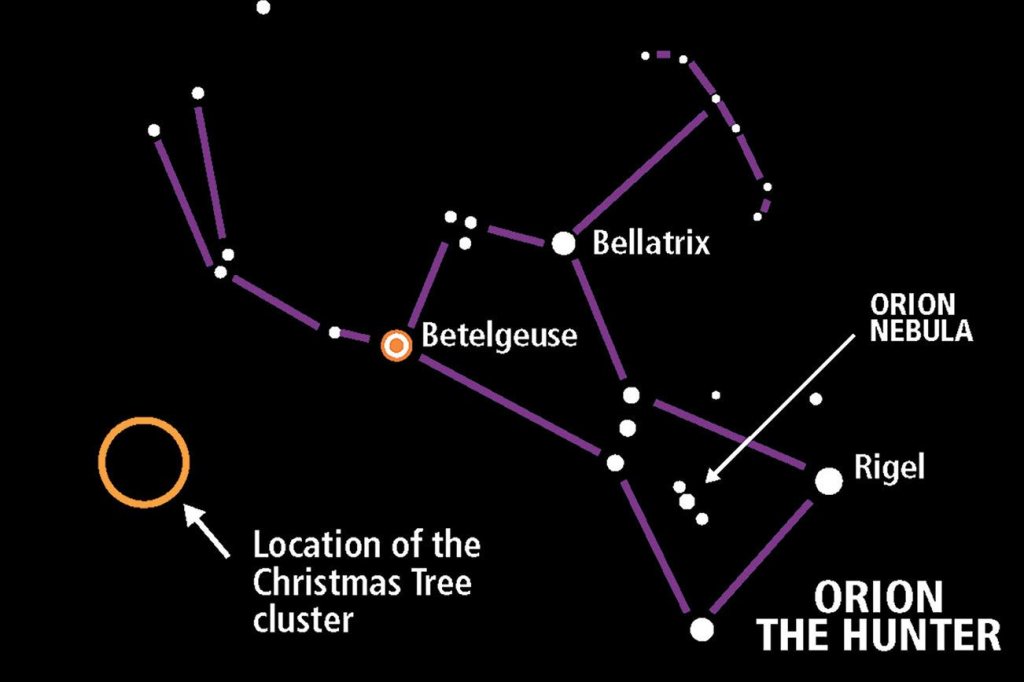
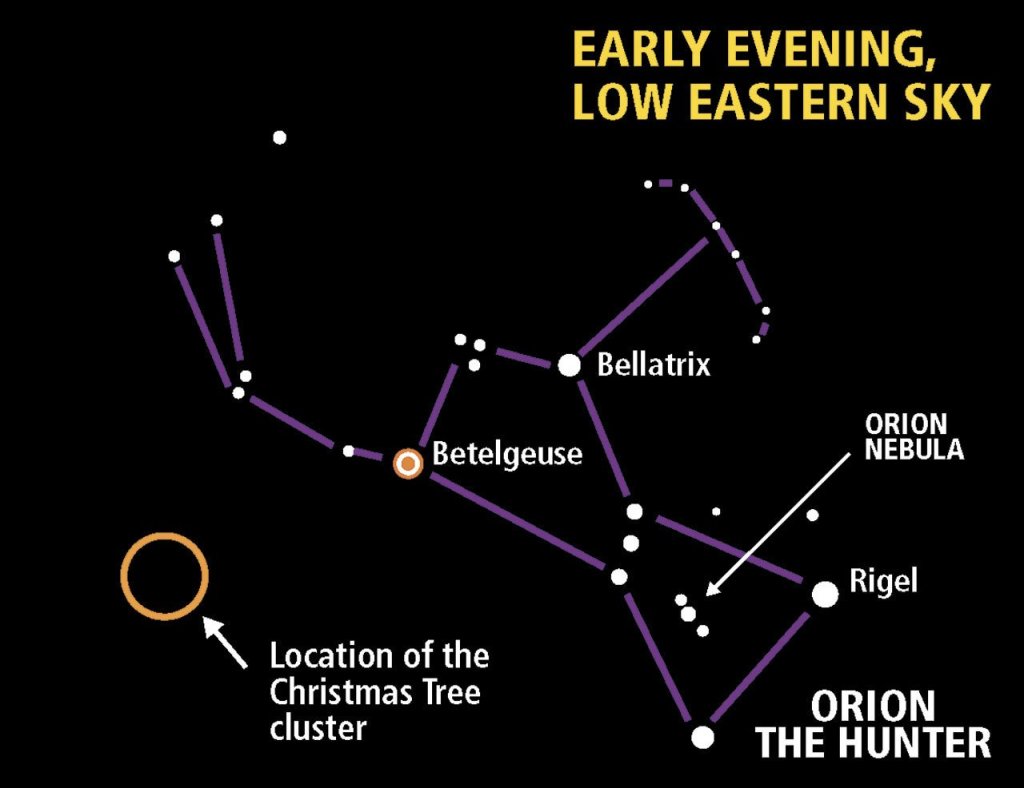
The best way to find the Christmas Tree Cluster it is to use the bright and famous constellation Orion the Hunter, perched diagonally in the southeastern sky.
Orion is the dominant constellation of winter with its three bright stars in a nearly perfect row that make up the belt of the mighty hunter.
On the upper left corner of Orion is Betelgeuse, a bright reddish star that marks the armpit of the hunter. On the upper right corner of Orion is Bellatrix, a star not quite as bright as Betelgeuse. Draw a line from Bellatrix to Betelgeuse and continue that line to the lower left about 10 degrees from Betelgeuse. (Ten degrees is about the width of your fist at arm’s length.)
Scan that area with your binoculars or a telescope and you should find the Christmas Tree Cluster. This is a great week to find it because there isn’t much moonlight in the sky.
Once you find the cluster you’ll see that the 20 or so stars in it are arranged in the shape of a Christmas tree, but its bright star is actually at the base of the tree.
I truly hope this adds to your holiday spirit. If you look through binoculars, the starry little tree will appear on its side pointing to the right.
In most telescopes, however, it will appear on its side pointing to the left. That’s because the optics in most telescopes give you an inverted view of the heavens.
The Christmas tree shape of the cluster is arguably a pleasant coincidence. The stars just happen to be arranged that way from our view of them from Earth. Like most open clusters this group of young stars formed out of a large nebula of hydrogen gas, much like our sun did over 5 billion years ago. These clusters of young stars hang out together for several hundred million years until gravity from other surrounding stars break them up.
This Christmas tree is wishing us a Merry Christmas from over 2,600 light years away. Just one light year equals almost 6 trillion miles. The light we see from it tonight left that cluster in 606 B.C. The famous British astronomer William Herschel discovered this cluster in 1783 near Bath, England, and over 200 years later its starry ornaments are still lighting up the tree. Clark Griswold would be proud.
Celestial hugging this week: Venus and Mars are getting closer and closer to each other in the very early evening low south-southwest sky. On Saturday, Dec. 31, they will only be 10 degrees apart. Also on the 31st the very faint planet Neptune will be just to the upper left of Mars. You’ll need at least a small telescope to see it. Neptune is 2.8 billion miles away. A very thin crescent moon is also shining in the low southwest sky to the lower right of the three planets.