
Lynnwood reconsiders Flock, discusses immigration resolution
Published 1:30 am Wednesday, February 18, 2026
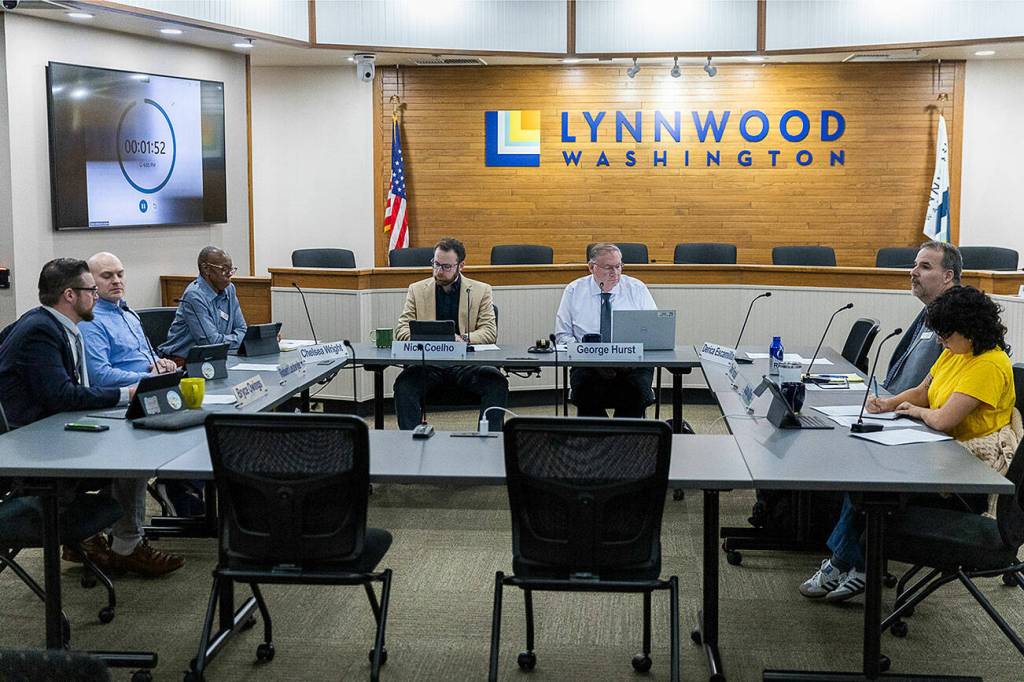
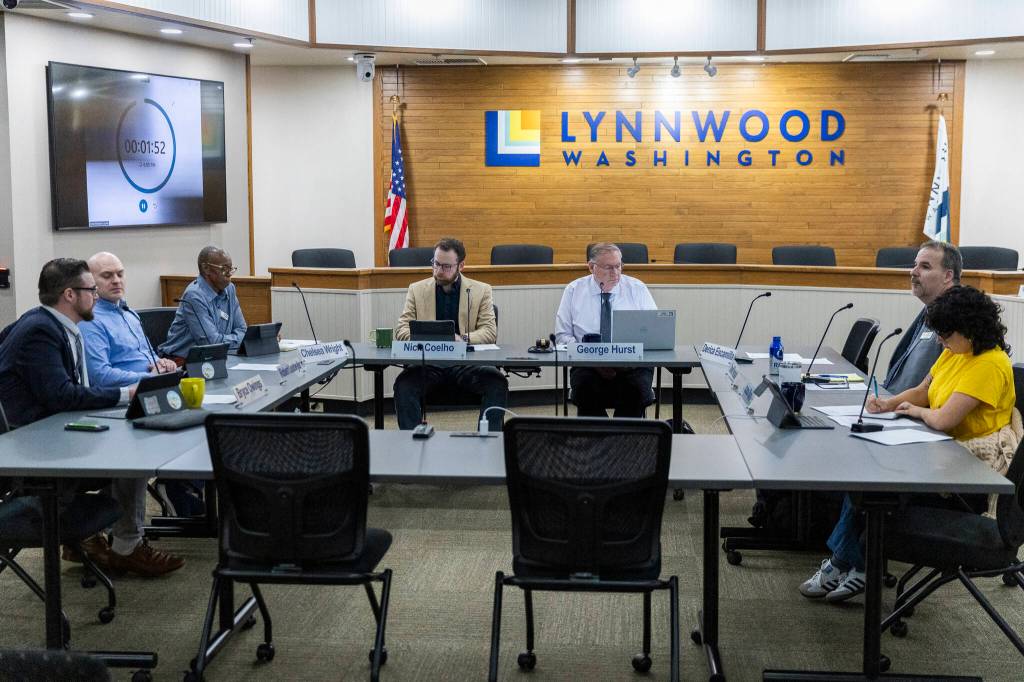
LYNNWOOD — Amid community concern about federal immigration enforcement, the Lynnwood City Council discussed its contract with Flock Safety and a resolution affirming immigrant rights at its work session Monday.
In January 2025, the council unanimously approved a contract for 25 Flock cameras. Flock Safety cameras are automated license plate readers that use artificial intelligence to analyze vehicle footage. Many law enforcement agencies across the country have implemented the technology as an investigative tool to help locate stolen vehicles and missing persons.
In late October and early November, reports from the University of Washington and The Daily Herald found that out-of-state agencies accessed Lynnwood’s network — along with several others in Snohomish County — seemingly for the purpose of civil immigration enforcement. Around that time, Lynnwood Police Chief Cole Langdon paused the network entirely. The City Council formalized the pause in November.
Shortly after the cameras went live in June, Langdon learned that out-of-state agencies were accessing the network. Many agencies, sometimes unknowingly, had enabled Flock’s “nationwide lookup” tool, which allows any participating agency in the U.S. to search their network. In return, the feature allows them to search any participating network in the country.
The nationwide lookup feature was on for nine days in Lynnwood before Langdon turned it off. In that time, out-of-state agencies made more than 100,000 searches into Lynnwood’s network, including at least 16 directly related to immigration enforcement from two agencies.
“Disappointingly, as our staff worked with the vendor on this issue, their customer service representatives, and even their sales representatives, were not sure how this was happening,” Langdon said. “It was only through our staff working with the system and really troubleshooting this on their own that they figured it out.”
Community members have spoken at numerous council meetings since November, urging the council to cancel its contract with Flock.
“This violates community trust in a time when community trust in law enforcement is low,” Lynnwood resident Quinn Van Order said at the council’s Feb. 9 meeting. “Law enforcement is important; they’re a critical function for a healthy society, but you can’t operate on that mandate when you lose the trust of the populace. We need to get back to community policing and not mass surveillance.”
Records show that Lynnwood police officers sometimes made searches in the system with a fake case number or vague reasons for their searches. Langdon said that about 6% of Lynnwood’s searches contained insufficient information, compared to 33% from agencies statewide.
State lawmakers are working on Washington’s first-ever legislation regulating automated license plate readers. Senate Bill 6002 — which passed the Senate on Feb. 4 — would shorten the data retention period from 30 to 21 days, explicitly prohibit ALPRs from being used for federal immigration enforcement or tracking protests, and prohibit vendors, like Flock, from upgrading systems without the informed consent of local agencies, among other protections. The House held a public hearing on the bill Wednesday.
Langdon said that a standardized framework across the state would make him more comfortable with turning the Flock cameras back on.
Several council members said that while they trust the police department, they don’t trust Flock as a company and would support ending the contract.
“My concern is what the Flock network is capable of, and I’m concerned that I don’t think state law will really hold up, potentially, to what this surveillance network can be used for on a national scale,” council member Robert Leutwyler said.
Vehicle theft in Lynnwood decreased by 59% in 2025 through October, Langdon said. In the four months the cameras were active, the department used the technology to recover 10 stolen vehicles, including some that had firearms, and arrest suspects in several crimes, including assault with a firearm, identity theft and child rape, Langdon said.
Late last year, the police department was investigating a vehicle versus pedestrian collision where the vehicle fled the scene. If the Flock cameras were active, the department could have searched for the vehicle description and possibly located the suspect, Langdon said.
“This tool could have been a key component in the investigation,” he said. “I’m not saying it would have solved it, but it would have helped us develop some leads based on a vehicle description that we did have from a witness.”
Council President Nick Coelho asked about alternatives to Flock that could provide automated license plate readers. Axon, a public safety technology company that supplies the department’s body cameras, also makes ALPRs. Axon has more robust safeguards, Langdon said, but is about four times the cost of Flock.
Lynnwood’s Flock cameras are largely funded through a $132,000 grant from the Washington Auto Theft Prevention Authority. An additional $38,000 from the police department budget funds the contract.
Lynnwood wouldn’t be the first Snohomish County city to cut ties with Flock. Mountlake Terrace canceled its contract with Flock before its cameras were installed. The city still had to pay Flock $27,000 for the first year of the two-year contract.
“When a very powerful tool can be misconfigured in a way that has real-world consequences for immigrant families and for a lot of people, I don’t think that’s a tool we should be using when (Flock) has violated our trust, violated our core promises and safeguards, especially at a time when public trust is so deeply important,” council member Isabel Mata said.
The council will likely vote on whether to cancel the contract at Monday’s meeting.
The council also discussed on Tuesday a proposed resolution affirming the rights of immigrants in Lynnwood. Edmonds and Mountlake Terrace passed resolutions earlier this month in the wake of increased federal immigration enforcement in Minneapolis and the killings of Renee Good and Alex Pretti.
Much of Tuesday’s discussion centered around whether Lynnwood police would intervene in the event of unlawful actions by federal immigration officials, a question that community members have brought up in several public comments.
In a joint statement on Feb. 9, Langdon and Mayor George Hurst said the city will comply with the Keep Washington Working Act, which restricts local agencies from assisting with federal immigration enforcement.
On Tuesday, Langdon expressed concern with a section of the resolution that directed officers to intervene “when witnessing excessive force or unlawful conduct by any law enforcement agency operating within the City.”
“These discussions and these remedies should take place in the courtroom,” Langdon said. “They should take place at the ballot box. To place armed police officers against armed federal agents, we are exposing our officers to potential federal criminal liability. They can be very much committing a federal crime by intervening in a federal operation.”
Langdon said that the city has received reports of people impersonating federal immigration officers in Lynnwood. In the event someone calls the police about federal immigration enforcement, officers would keep this in mind, he said.
“Our ability to actually go out and intervene is extremely limited,” Langdon said. “We’re not going to respond to intervene against ICE or go to ICE reports, what we’re going out to do is make sure that this is a legitimate law enforcement operation.”
The council asked Langdon to edit the language of the resolution to include actionable steps police officers can take to protect the community.
“The ultimate goal with this is to communicate to the public what your limitations are and what you are willing to do, rather than just what you’re not willing to do,” Mata said. “How will you protect our community in ways that you’re comfortable with?”
Other parts of the resolution include increasing the visibility of immigrant rights resources for the public and having the mayor meet with city departments to clarify immigration policy. The resolution also affirms that law enforcement activity in Lynnwood would be consistent with constitutional protections and restates a portion of the Keep Washington Working Act that restricts public funds and property from being used for federal immigration enforcement.
Hurst said he is working to form a community group that would support families affected by federal immigration operations in Lynnwood. Local organizations — including the Washington West African Center, Latino Educational Training Institute, and Refugee and Immigration Services Northwest — have agreed to be part of the group, Hurst said. He is working on securing funding, he said.
The council will continue to discuss the resolution at a work session in March.
Jenna Peterson: 425-339-3486; jenna.peterson@heraldnet.com; X: @jennarpetersonn.
