
How do these 13-3 ‘Death Zone’ Seahawks compare to the 2013 ‘LOB’?
Published 9:30 am Wednesday, December 31, 2025

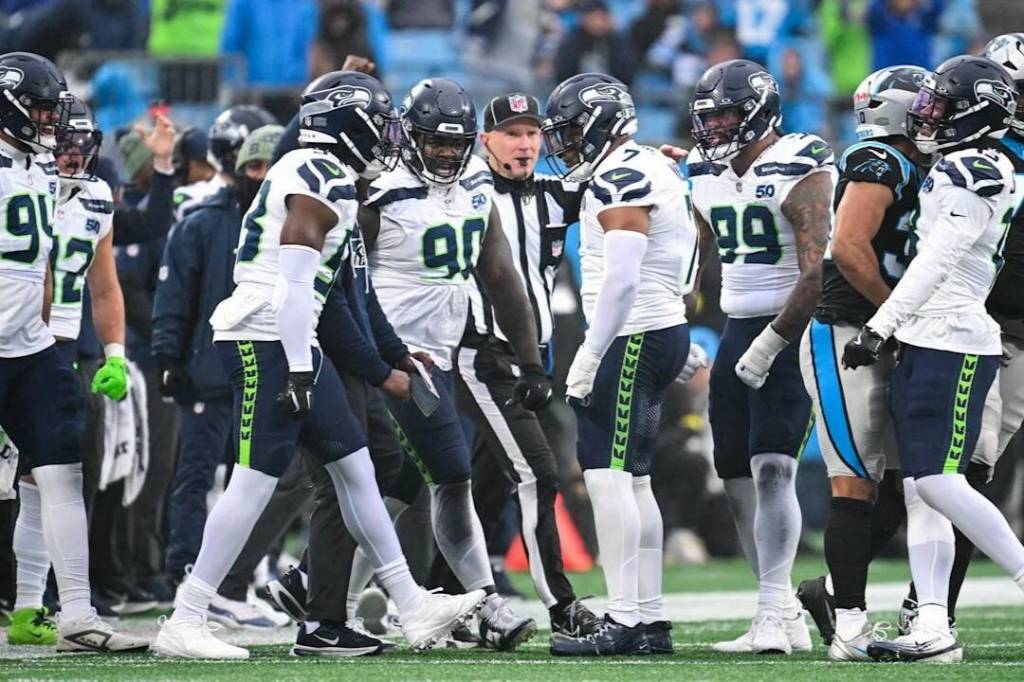
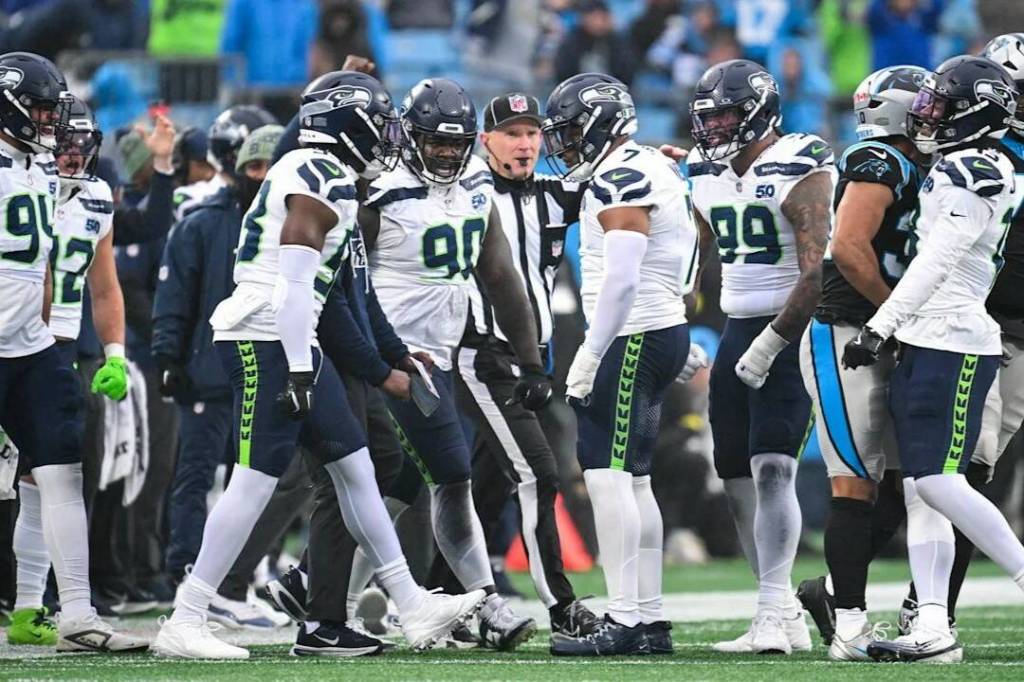


Jarran Reed sat on a folding chair in the visiting locker room in Atlanta. The big defensive tackle had the small grin of someone who just thought of a favorite memory.
“This is the best defense I’ve been a part of since I’ve been here,” the only current Seahawk that played with Seattle’s legendary “Legion of Boom” unit of a decade-plus ago told The News Tribune this month.
“Besides when I first got here, with the guys.”
The 33-year-old defensive tackle is the spiritual leader of this year’s first-place Seahawks. His “guys” when Seattle drafted him in 2016 were Richard Sherman, Earl Thomas, Kam Chancellor, Bobby Wagner. He’s the only one around now who played with Seattle’s immortals.
“Pay respect to them,” Reed said.
Reed said that minutes after the 2025 Seahawks and their top-of-the-league defense, which calls itself the “Death Zone Defense,” dominated the Falcons in a 37-9 win this month.
“I think the intent, man,” Reed said. “With the whole ‘L.O.B.’ it was the intent that we had in practice, that we had in games.
“And I’m feeling that right now.”
These Seahawks are 13-3 entering their showdown at the San Francisco 49ers (12-4) Saturday night in Santa Clara, California. The winner is the NFC West champion and will have the top seed in the conference playoffs.
This year’s Seattle team has tied the record for most wins in a season in the 50-year history of the franchise. This is the third 13-win Seahawks team. The other two, the 2005 and ‘13 teams, each went to the Super Bowl.
Seattle has been a No. 1 seed with home field throughout the playoffs three times in its history, ‘05, ‘13 and ‘14. Those are the only three times the franchise has reached the Super Bowl.
The last Seahawks team to go 13-3 earned the division title and top NFC seed over the 49ers, who were also 12-4 that 2013 season. Seattle beat San Francisco in the conference title game in January 2014. Sherman famously tipped Colin Kaepernick’s pass away from Michael Crabtree in the end zone in the final seconds to Seattle teammate Malcolm Smith for the interception that sent the Seahawks to the Super Bowl.
Let’s take Reed’s comparison further.
How do these 13-3 Seahawks compare to the last time Seattle was 13-3, that 2013 team?
Seahawks’ dominant defenses
Any discussion of the 2013 Seahawks begins, and ends, with that “Legion of Boom” defense. Reed came onto it at the end of its reign when the team drafted him in 2016.
In 2013, Seattle had one of the best defenses in NFL history, run by a defensive guru head coach, Pete Carroll. Those Seahawks ranked first in the NFL in points allowed (14.4 per game), total defense (273.6 yards against per game), passing defense (172.0 yards/game), takeaways (39) and interceptions (28).
The 2025 Seahawks have one of the league’s best defenses, also run by a defensive guru head coach, Mike Macdonald. These Seahawks rank second in the NFL in points allowed (16.6), fifth in total defense (292.6). This unit is far below the 2013 “L.O.B.” in overall pass defense at 12th in the league (198.6).
But this year’s defense has the same number of sacks in 16 games as that ‘13 unit (44). And this season’s Seahawks have a better run defense: third in the NFL allowing 94.4 yards per game. The 2013 team was eighth at 101.6 yards per game on the ground.
Seattle’s schemes in 2025 vs. 2013
This year’s Seahawks defensive backfield has a brash, attacking, Pro Bowl cornerback in his third NFL season — just as Sherman was in 2013.
He’s Devon Witherspoon, who last week made the Pro Bowl for the third consecutive year to begin his career.
Carroll kept Sherman as an outside cornerback shutting down a full third of the field. That was while Carroll kept Seattle in a 4-3 system with the L.O.B.’s Cover-3 scheme, press coverage by cornerbacks outside with Thomas back as an incomparable, single deep safety. Thomas covered the entire width of the field like no other safety, maybe before or since. “Safety” Chancellor came down “in the box,” nearer the line of scrimmage as a thudding tackler against the run and against running backs and tight ends in coverage, like a linebacker.
Macdonald moves the shorter, faster, aggressive tackling Witherspoon around his defense that is based in 3-4, not 4-3, principles. Witherspoon begins games outside at corner. He plays inside as a nickel, slot corner on many passing downs. He blitzes more than Sherman did.
Macdonald plays a mix of man-to-man and zone coverages, including Cover 2 (safeties Julian Love and currently injured Coby Bryant deep), Cover 3 and quarters (”Cover 4”).
Carroll didn’t care that offenses knew Seattle would be in 4-3, Cover 3. The coach wanted his Seahawks to mainly play one base scheme and know it so well they could play instinctively and, thus, lightning-fast. He knew his “Jimmys and Joes” were better than anybody else’s “Xs and Os.” Macdonald has one “Joe” Carroll didn’t have. No Seahawks coach ever has had a Nick Emmanwori. Macdonald has played the do-it-all rookie at deep safety, in the box like Chancellor, at outside linebacker, inside linebacker — even, recently while shutting out Minnesota, at defensive end. The second-round draft pick Seattle traded up 17 spots to get this past spring is the dynamic wild card that most makes this Seattle defense unique, even compared to the L.O.B.
“Man, this defense (is) special,” the 21-year-old Emmanwori said. “This defense is super special … I don’t think no defense can top this.
“I think this defense is, like, historic almost. People want to shy away from saying it, but I really do think this defense is — it’s a special defense.”
Macdonald is a self-described X’s and O’s nerd. His goal is to out-scheme you. He changes looks, coverages, blitzes and fronts at the snap. He takes schemes to offenses, instead of sitting back and telling offenses, as Carroll, Sherman, Chancellor and pals did in the L.O.B.: “Bring it on!”
Macdonald’s trick in his first two seasons as he’s gone to 23-10 replacing Carroll has been to get his players to know his intricate, changing schemes so well they still play fast and attack, like the “L.O.B.”
Hence the “feel” and “intent” in practices Reed is talking about.
The defensive signal callers
Wagner, as middle linebacker and defensive signal-caller, directed everyone and made it all begin each play as the pre-snap maestro of the 2013 Seahawks. He was so good at it, and largely still is at age 35 in his 14th NFL season playing for Washington, Wagner will eventually be inducted into the Pro Football Hall of Fame.
His Commanders coach the last two seasons was his defensive coordinator on the 2013 Seahawks, Dan Quinn.
Ernest Jones is the current Seahawks’ Wagner, in responsibility, communication and importance. Like Wagner in 2013, Jones is in his second season as Seattle’s middle linebacker and signal-caller. Jones, who turned 26 last month, excels in thumping, sideline-to-sideline tackling that is Wagner-like. He is a more dynamic pass defender. The Los Angeles Rams Super Bowl champion in 2021 has a career-high five interceptions this season, of the nine picks in his career.
Jones and this year’s Seahawks don’t have the skilled, ultra-dependable outside linebacker Wagner had as his partner for a decade in Seattle. K.J. Wright surpassed current outside backers Derick Hall, Boye Mafe, and inside, weakside linebacker Drake Thomas. These Seahawks don’t have a rangy, pass-rushing outside edge rusher Bruce Irvin was for the ‘13 team — unless you count Pro Bowler DeMarcus Lawrence as an outside linebacker, as this year’s Seahawks do on their roster. Lawrence plays more as an end on the edge of the line of scrimmage.
Lawrence may be Seattle’s best player right now. He changed last weekend’s win at Carolina from a 3-3 slog in the third quarter into a Seahawks runaway by forcing and recovering a Panthers fumble deep in Carolina’s end. Seattle scored the next 14 points and won 27-10 to get to 13-3.
Defensive line comps
A huge, underrated strength of the 2013 Seahawks was its uniquely deep defensive line. Their starters were Red Bryant, Tony McDaniel, Brandon Mebane and Chris Clemons. But those Seahawks rotated as many as 11 tackles and ends into the games by the first quarter. By the fourth quarter, offensive lines with the same five blockers were exhausted trying to block the Seahawks’ fresh front. That’s a large reason those LOB Seahawks scored 202 points and allowed only 101 in the second half of games that 2013 season.
These Seahawks don’t have that depth on the defensive line. But their starters are better and more versatile playing more positions. Lawrence and Leonard Williams are Pro Bowlers whom Macdonald moves around inside and outside, often by the play.
First-round draft choice Byron Murphy in his second season should have made the Pro Bowl. He shared the team lead in sacks with Williams at seven, third-most in the league for an interior tackle. This week Macdonald called Murphy the “best in the world” taking on double-team blocks on running plays inside, with his rare skill at dropping to one knee and chest- and shoulder-pressing through both blockers to blow up plays throughout games.
The offenses
Both the 2013 and ‘25 Seahawks had offensive coordinators who called the plays for a defense-first head coach. That’s unlike the current NFL trend of head coaches (Sean McVay, Kyle Shanahan, Kevin O’Connell, Liam Coen, etc.) being offensive play-calling savants.
And both the Seahawks’ last two 13-3 teams sought to run the ball first.
The 2013 team did it better. It had a better and more consistent offensive line. Those Seahawks with Darrell Bevell calling the plays ran it more than all but one other team in 2013, 509 times in 16 games, fourth in the league in rushing offense (136.8 yards per game).
Marshawn Lynch was the plowing lead back and soul of the team. He was sixth in the league with 1,257 yards. His 12 rushing touchdowns tied for most in the NFL.
This year’s Seahawks with Klint Kubiak calling plays for the first time run more often than any NFL team, 48% of the time. And with something the 2013 team didn’t use: a full-time fullback (rookie Robbie Ouzts, on 27% of offensive snaps). In 2013, Robert Turbin was more of a third-down back.
Yet this season the Seahawks are only 25th in the league at 4.1 yards per rush. They have a job-share as lead backs. Kenneth Walker is in his fourth season as Seattle’s supposed No. 1 back, as Lynch was unequivocably a dozen years ago. Walker has 930 yards and an average of 4.3 yards per rush. Lately he’s often had multiple defenders waiting for him when he gets handoffs. Where Lynch would just run through those guys — “Beast Mode” famously said, as only he could, his goal every play was to “run through a m***** *******’ face” — Walker makes them miss. Walker this season has had some of the most impressive 1-yard runs in Seahawks history.
Zach Charbonnet is coming off what Macdonald called the third-year back’s best game as a Seahawk. His second career 100-yard rushing day led the offense to pull away late last weekend at Carolina. He has 656 yards rushing. Charbonnet’s 11 rushing touchdowns make him the first Seahawks with double-digit TDs in a season since Lynch, in 2014, Seattle’s last Super Bowl season.
Passing games
We saved the most important position for last.
In 2013 Russell Wilson was in his second NFL season entering his prime. At age 25 he threw less often and not as far down the field as Sam Darnold does. Wilson threw for 3,357 yards with 26 touchdowns against nine interceptions for those 13-3 Seahawks. He was also elusive and the team’s second-leading rusher with 539 yards that season. He made the Pro Bowl for the second straight season for 2013.
Darnold makes bigger pass plays, with higher risk of turning the ball over. The 28-year-old QB Seattle signed from Minnesota before this season has thrown 451 times through 16 games, to Wilson’s 407 in 2013. Darnold has thrown for 500 more yards, 3,850. He has 25 touchdown passes against 14 interceptions. His 20 turnovers are the most in the NFL and threaten to short-circuit Seattle’s run to a possible Super Bowl. Darnold’s best in games has been brilliant, often enough to overcome his turnovers. This year’s offense scores more than the 2013 Seahawks, at 29.4 points per game (second in the NFL) to 26.1 (ninth) back then. Darnold has the Seahawks throwing for 231 yards per game, eighth in the league. Wilson threw for 202.3 yards per game, 26th.
Like Wilson did a dozen years ago, Darnold last week made the Pro Bowl for the second straight season.
Darnold’s offense is more heavily tilted to one prolific receiver than Wilson’s was. Jaxon Smith-Njigba leads the NFL in receiving yards with 1,709. He has a franchise-record 114 catches on 155 targets from Darnold, with 10 touchdowns.
Last weekend the 23-year-old wide receiver became the third player in NFL history under age 24 with at least 1,700 receiving yards in a season. Seattle’s first-round pick in 2023 out of Ohio State, Smith-Njigba joined Minnesota’s Justin Jefferson (1,809 receiving yards in 2022), and Pro Football Hall of Famer Isaac Bruce (1,781 with the 1995 St. Louis Rams). Veteran former Rams Super Bowl MVP Cooper Kupp is second in targets, way behind Smith-Njigba at 67. Kupp has 45 catches. Second-year tight end A.J. Barner has 50 receptions with seven touchdowns. Macdonald says Kubiak wants to throw to Barner more.
The 2013 Seahawks were more of a receiving co-op. Golden Tate led them with 64 receptions on a team-high 99 targets, for 989 yards. Doug Baldwin had 50 catches. Tight end Zach Miller had 33. Tate and Baldwin co-led that offense with five TD receptions.
Kicking game
A true strength of this year’s team, one of the league’s best special-teams and kicking units, compares favorably to Seattle in 2013.
Jason Myers leads the league with 39 field goals in 44 tries. He’s made 25 of his last 26 kicks. He is 9 for 12 from beyond 50 yards, meaning as soon as Seattle crosses midfield it is close to points. Michael Dickson is a magician punting the ball directionally. He averages more than 49 yards per punt and for his career has one of the highest punting averages in league history. And Rashid Shaheed’s arrival in a trade from New Orleans in early November turned the return games into a weapon for Seattle — though he is iffy to play Saturday at San Francisco because of a concussion.
The 2013 Seahawks had Steven Hauschka, who made 33 of 35 field goals, though he only tried three field goals beyond 50 yards (he made all three). Folk hero Jon Ryan averaged 42.7 yards per punt (Dickson eventually replaced him when the team drafted the Aussie in 2018). Tate was the primary punt returner. Jermaine Kearse was the kickoff returner.
Neither produced the touchdowns and field-tilting plays Shaheed has.
The bottom line
Seattle’s last 13-3 team of 2013 had multiple future Hall of Famers: Sherman, Wagner and perhaps someday Thomas and Chancellor. It remains one of the most brash, dominant defenses the NFL has seen the last half century.
This season’s defense is not that. None likely ever will be. But these Seahawks are better against the run. And that, as this year’s players keep saying, travels in the playoffs.
The 2013 team had a better offensive line and a more powerful, consistent running game. Yet the ceiling is higher in this season’s Seattle passing attack — albeit with that higher risk.
The current squad has better kicking and special-teams units. That’s something else that’s a huge plus in tight playoff games.
It will come to what it always does in the postseason: Matchups. Who the Seahawks play, where and when.
Saturday night at San Francisco will determine that.
“It’s funny. I just think we’ve grown as a defense and coaches, included of how we prepare our guys,” Macdonald said of the 2025 Seahawks, particularly of his defense, since they last played the 49ers in Week 1. “We have a better feeling for what our guys are good at and what they can handle on a game plan basis.
“We just have a better understanding of who we are, who can do what, and how much we can carry. We have more clarity at this point — which I’m actually glad that’s the case.
“Otherwise that wouldn’t be a very good job on our part.”
