Editorial: Find respectful policy on tariffs, trade with Canada
Published 1:30 am Saturday, February 21, 2026


By The Herald Editorial Board
The not-unexpected decision by the U.S. Supreme Court that President Donald Trump had exceeded his authority by imposing broad-based and significant tariffs against U.S. trading partners was celebrated in Washington state, long one of the nation’s most trade-dependent states and a leading exporter of goods and services.
Along with statements of agreement with the court decision from voices such as Gov. Bob Ferguson, state Treasurer Mike Pellicciotti and U.S. Reps. Rick Larsen and Suzan DelBene, was that of Lori Otto Punke, president of the Washington Council on International Trade, a policy advocate on Northwest trade issues. Punke, in a statement, called the court decision an important step forward for the state and region’s workers, farmers, businesses and consumers.
“For more than a year, these tariffs have caused serious harm; triggering retaliatory duties on key agricultural exports, eroding markets for goods and services, increasing construction and production costs, disrupting cross-border supply chains, and reducing price competitiveness,” Punke said. “From apples to wine, from advanced manufacturing to wood products to technology and innovation, the Supreme Court has now affirmed that trade policy of this magnitude must rest on proper legal authority.”
What’s been gained; what’s at stake: Continuation of the International Emergency Economics Powers Act (IEEPA) tariffs, Punke said, threatened to impose billions of dollars of additional costs on importers and exporters; discourage markets for key producers in the state, including agriculture and manufacturing; and strain long-standing trade relationships with the state’s largest export and import partners, including Canada, Mexico and China, among many others.
Yet, that relief is tempered. While these particular tariffs were deep and costly to American businesses and consumers — extracting as much as $30 billion each month from companies importing goods, with those costs largely passed on to consumers over the past year — the Supreme Court’s final word on these particular tariffs doesn’t deny the White House the ability to use other tariff authority to replace that denied by the court.
Nor does it resolve negotiations regarding prospective and existing trade deals between the United States and other countries.
Among the most concerning for Washington state are talks regarding reauthorization of the United States-Mexico-Canada Agreement, particularly considering the current state of relations between Canada and its Prime Minister Mark Carney and the United States and President Trump.
Tantrums and trade: Those relations have been prickly for months, complicating talks. Among the irritations, reported by The New York Times:
In October, in response to hardball U.S. negotiation tactics and the tariffs imposed against Canada, the Province of Ontario aired a commercial during a broadcast of an MLB playoff game that quoted President Reagan’s anti-tariff stance. Provincial governments also have pulled U.S. liquor, wine and beer off shelves in Canadian stores.
Likewise, in response to a trade deal Carney struck with China, Trump threatened 100 percent tariffs against Canadian goods and warned that China — somehow — would ban hockey and “eliminate” the Stanley Cup, the NHL’s premier trophy; while at the same time Trump threatened to stop the opening of a new freight bridge between Windsor, Ont., and Detroit, Mich., unless “the United States is fully compensated for everything we have given (Canada).”
Nor did Trump react well to Carney’s address at the World Economic Forum, during which he declared the U.S.-led global order was over and that Canada and European countries should band together to protect their interests.
Trump’s truculent response: “Canada lives because of the United States. Remember that, Mark, the next time you make your statements.”
Scuttle the USMCA? Now, Trump and his trade officials have indicated they may scrap the three-nation agreement altogether, a move that would throw more uncertainty at businesses and imperil trillions of dollars of trade among the three nations.
This is why the North American trade deal matters: The USMCA exempts trade that otherwise could be subject to unilateral tariffs.
Between January and July of 2025, under the USMCA, Washington state exported $4.1 billion of goods to Canada and another $2.6 billion to Mexico, accounting for 20 percent of the state’s total exports. Prior to imposition of Trump’s tariffs, during the same seven-month period in 2024, state exports to Canada totaled $5.2 billion and $2.5 billion to Mexico.
“Washington’s trade flows with Canada and Mexico demonstrate both the magnitude of its dependence and the critical protections provided by the USMCA,” the WCIT said in an October report. “USMCA saved Washington businesses $90 million in direct tariff costs and much more in waived IEEPA tariffs. Given these deep trading relationships, the USMCA remains essential for shielding businesses, workers, and consumers from escalating trade barriers and for sustaining the state’s economic resilience.”
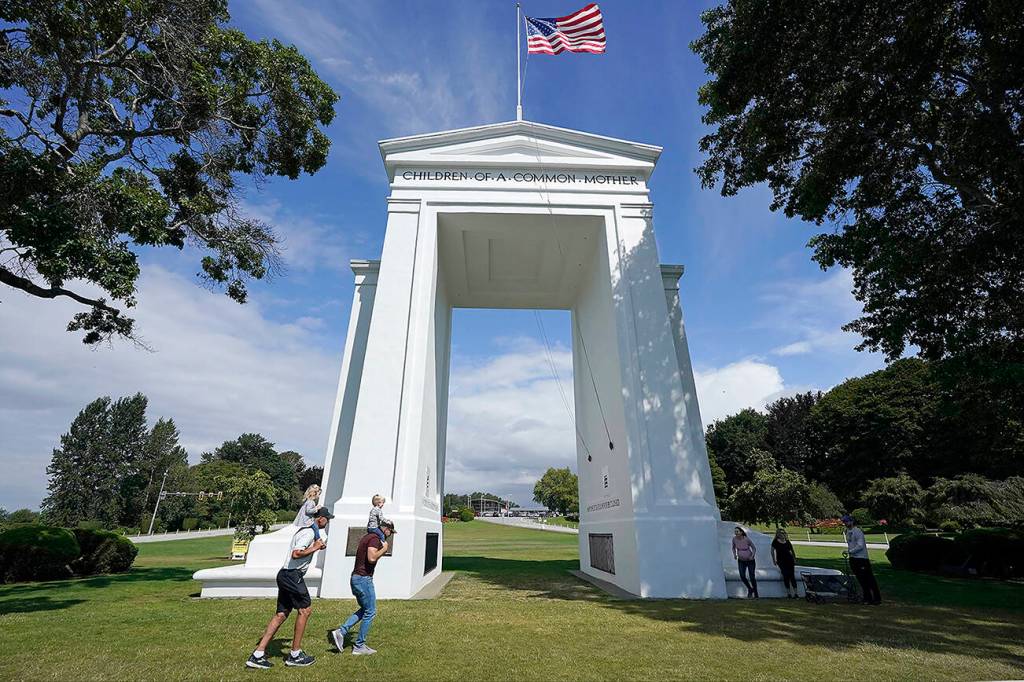
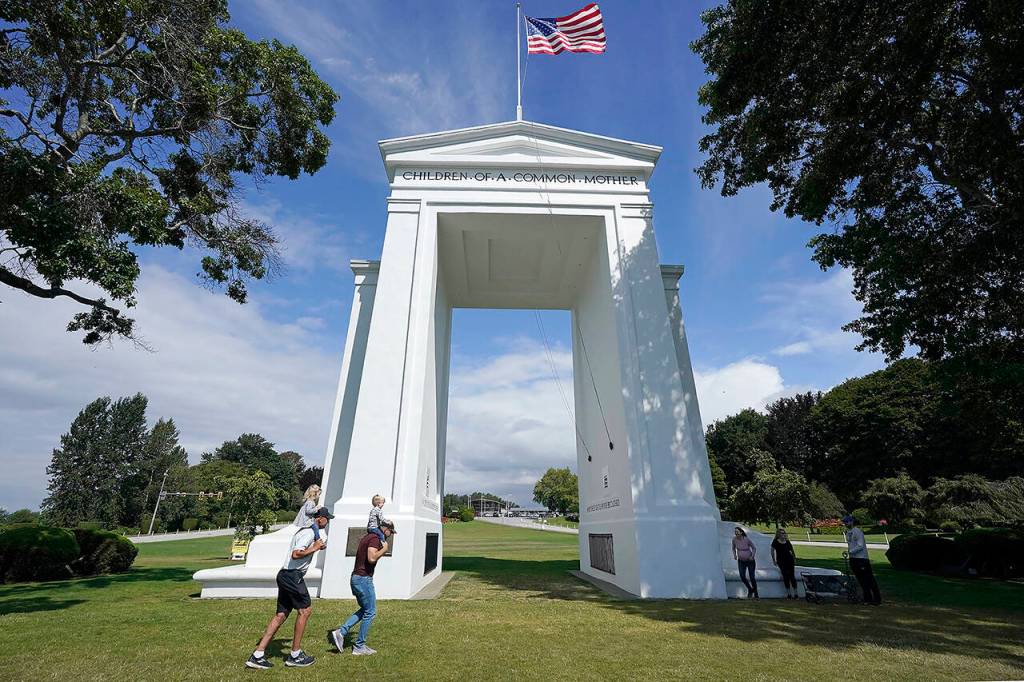
Meanwhile, in the other Washington: While the tariff and trade scuffles play out elsewhere, state officials are attempting to encourage rational discussions and strengthen economic ties on both sides of the Peace Arch.
Lt. Gov Denny Heck, speaking to newspaper editors and reporters Thursday in Olympia, defended trade and relations between the “Children of a common mother,” as an inscription reads on the U.S. side of the Peace Arch.
Asked about the previous day’s news that the Trump administration might seek to leave Canada out of talks to renew the United States’ trade agreement with Canada and Mexico, Heck called the question “paradoxical.”
“Talk about a North American trade deal without Canada? It’s not a North American trade deal if there is no Canada. By definition, it’s a U.S.-Mexico trade deal,” said Heck, a former member of the U.S. House.
In the face of the tariffs against Canada and other nations, belligerence against the nation’s northern neighbor and Trump’s threats to make Canada the “51st state,” Heck has spent much of the last five years in office working to rebuild ties with British Columbia and Canada, a split marked by a 20 percent drop in Canadian tourism to Washington state and the rest of the U.S.
In January, Heck went to Vancouver, B.C., to sign an inter-parliamentary agreement with British Columbia’s legislative assembly speaker, pledging joint efforts between the province and the state to address shared challenges, such as the housing affordability crisis. The cross-border group’s first meeting is scheduled for later this year.
That work on the part of the Trump administration should include a renewal of the USMCA, which was negotiated during Trump’s first term and praised by him at the time, because it has benefited all three countries; and still can.
Freezing Canada out of a trade deal — especially over Trump’s apparent personal pique — violates a historic relationship between the two countries, one that has long benefited both.
“This cannot stand,” Heck said Thursday. “This is our oldest ally. This is the nation with which we have a 5,525-mile border, the longest international border in the world. There hasn’t been a war in well over 100 years where the sons and daughters of Canadians have not died in the trenches alongside the sons and daughter of Americans.”
Hands across the border: Canada is, Heck continued, more than the United States’ largest trading partner.
“They are our friends because we share values,” he said.
Heck recalled the advice, often attributed to an African proverb: If you want to go fast, go alone. If you want to go far, go together.
“The international order since World War II has served the world very well, and our relationship with other nations matters to us, matters to them. And it matters to the fate of the whole planet, as a matter of fact.”
The Supreme Court has provided — as the Founders intended — a necessary check against executive overreach. The court’s 6-3 decision should give the Trump administration pause to better consider how and when best to use its tariff authority, while at the same time considering the best outcomes for all countries in its trade deals.
That leaves state and provincial officials and the citizens on both side of the border to work together — as the Peace Arch inscription reads on the Canadian side — as “Brethren dwelling together in unity.”