
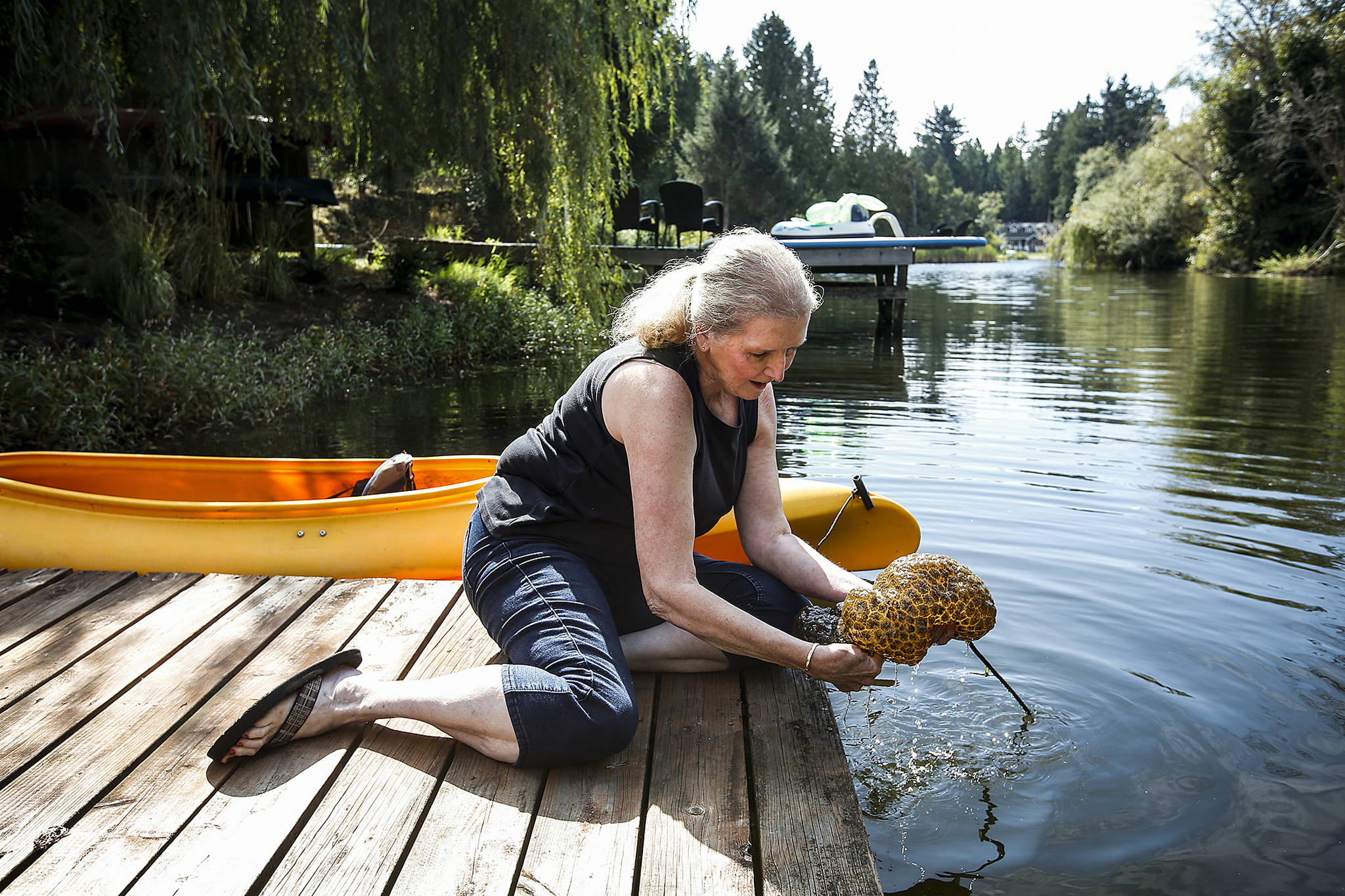
STANWOOD — When Miriam Lancaster checked a crayfish pot off her dock at Lake Ketchum last month, she was surprised to pull up a dense, quivering blob wrapped around a rope below the water’s surface.
Others might have been grossed out by the slimy find. Not Lancaster. Some internet sleuthing and a call to Snohomish County surface water staff told the retired public health nurse that she had discovered a colony of bryozoans — tiny invertebrates that live in jelly-like masses.
“At first, I thought it was some kind of egg sack,” Lancaster said. “I didn’t understand what it was. I put it down in the water. I just found it fascinating.”
Harmless to humans and pets, bryozoans have an otherworldly appearance that brings to mind an alien brain from a sci-fi film. In the sunlight, the furled, translucent colonies appear to glow. Some call them “dragon boogers.”
However weird they might look, there’s nothing abnormal about finding bryozoans in local lakes. They attach to submerged ropes, branches and dock pilings. Their presence off Lancaster’s dock and elsewhere in Lake Ketchum is one suggestion that water quality there has rebounded from toxic conditions of just a few years ago.
Polluted past
As recently as 2014, Lake Ketchum, north of Stanwood, was fouled with toxic blue-green algae. By one measure, it was the most polluted lake in the county — a sad turn for what was once the drinking water supply for the city of Stanwood. A survey conducted in 2010 by a state Department of Ecology biologist found only a single rooted aquatic plant in the entire lake.
“It was like green soup out here in the cove, like green paint on the surface,” said Marisa Burghdoff, a county water-quality specialist who helps oversee lake restoration efforts.
Lake Ketchum’s water quality has been a concern since the early 1990s. Testing pointed to a dairy farm south of the lake as the likely culprit contributing an excess of phosphorus, a nutrient used in agricultural fertilizer. At one point, phosphorus amounts reached 13 times the acceptable standard for the Puget Sound lowlands.
Treatments with the chemical alum in 2014 and 2015 neutralized the phosphorus, causing it to settle to the lake bottom.
Today, the lake has lost its rank smell and pond-scum patina. It’s now considered safe for swimming. Bryozoans might be a sign of that positive turn.
“It’s exciting to come out here and see the changes since the treatments took effect,” Burghdoff said.
Cleanly critters
The name bryozoa is Greek for “moss animal.” Individual critters measure just a few millimeters long. Filter feeders, they live by the hundreds inside gelatinous masses, extending tentacles into the water to pull out food, according to the U.S. Fish & Wildlife Service.
County staff have documented bryozoans in more than a half-dozen other lakes: Lake Loma, Lake Serene, Lake Wagner, Chain Lake, Blackmans Lake, Little Lake Martha and Lake Roesiger.
There are thousands of bryozoan species throughout the world, the vast majority in marine waters.
The U.S. Fish & Wildlife Service reports that non-native magnificent bryozoans — the species Lancaster found— historically lived only east of the Mississippi River. They appear to be on the rise in the Pacific Northwest.
“Everyone I know who talks about them says they’re a good thing, even though they’re creepy-looking,” Lancaster said.
Bad to better
Lancaster, who used to work for the U.S. Public Health Service, moved in 2000 to one of the homes surrounding Lake Ketchum. The 25-acre lake has a public boat launch and is stocked with rainbow trout. It drains toward Skagit Bay, where there are commercial shellfish beds.
In 2008, officials posted signs warning people not to swim or water ski in the lake because of an outbreak of blue-green algae. The risk comes from microcystin, a liver toxin that can cause allergic reactions, skin rashes, hives, itchy eyes and an itchy throat, among other problems.
Lancaster believes the pollution contributed to an auto-immune condition that afflicts her. A neighbor suspected that her two dogs died after drinking polluted lake water. Algae outbreaks can kill fish.
With the help of lakefront homeowners and grants, the county has tried to confront the problem. The work is showing results.
The county has been treating the lake with the alum, or aluminum sulfate, which bonds with phosphorus to neutralize it. It’s commonly used in drinking water plants.
The two large treatments in 2014 and 2015 cost $250,000. Smaller applications continue at a cost of up to $70,000 per year.
“Ongoing maintenance is what we’re working on now,” Burghdoff said.
The yearly costs are being covered by county surface water fees and by homeowners in the Lake Ketchum area. The Stillaguamish Clean Water District and the state Department of Ecology contributed grants toward the large initial treatments.
Lancaster said fish populations appear to be recovering, including the largemouth bass that used to attract fishermen.
“By working cooperatively with the county, we were able to do it,” she said.
The state Department of Fish & Wildlife has no data to corroborate that trend, but fish populations are likely to benefit over the long term.
“We do expect those treatments to positively change the habitat — namely, the dissolved oxygen environment,” said Justin Spinelli, a fisheries biologist with the department.
And presumably for bryozoans, the organic globs that look like they might have come from a Halloween-themed Jell-O mold.
Noah Haglund: 425-339-3465; nhaglund@heraldnet.com. Twitter: @NWhaglund.
LakeWise
Snohomish County’s LakeWise program advises homeowners living near lakes on ways to improve septic systems, lawns and shorelines for better water quality. Learn more at www.lakewise.org.
Talk to us
> Give us your news tips.
> Send us a letter to the editor.
> More Herald contact information.
Gallery

























