
Fighting opioid epidemic: Drop boxes for unused medications

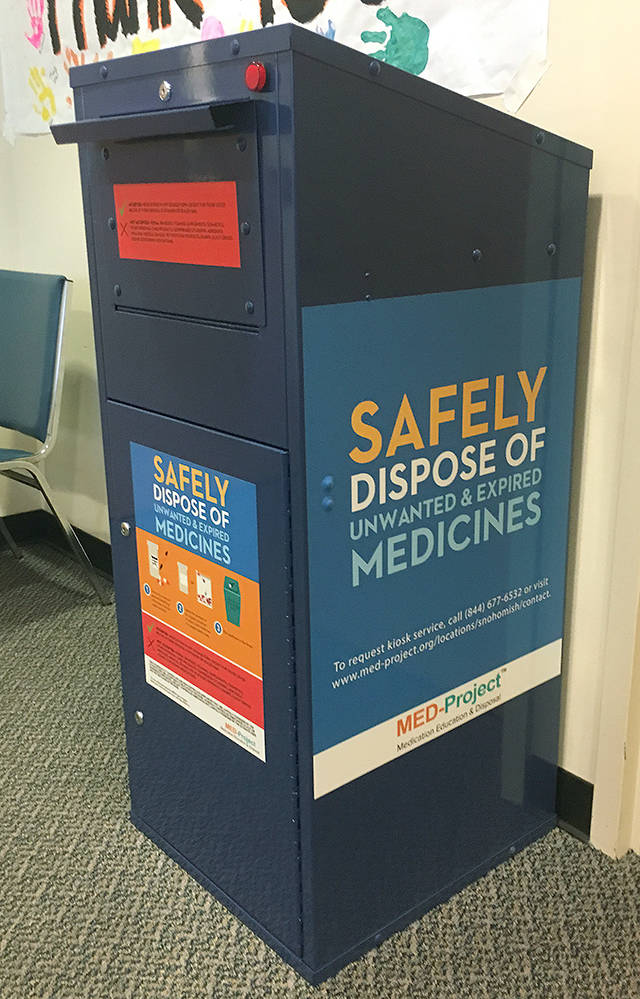
This drop box in Edmonds is one of three in Snohomish County where consumers can dispose of prescription and over-the-counter medications they no longer use. The program will be expanded. (Snohomish Health District)

This drop box in Edmonds is one of three in Snohomish County where consumers can dispose of prescription and over-the-counter medications they no longer use. The program will be expanded. (Snohomish Health District)

EDMONDS — The first three sites in a countywide program to give people a safe and convenient way to dispose of unused prescription and over-the-counter medications are scheduled to open this week.

The three drop off sites, all in Edmonds, are at the Edmonds Police Department, 250 5th Ave. N; Family Pharmacy, 7315 212th St. SW, and at QFC, 22828 100th Ave. W.

Three to five drop boxes will be added every day with 25 of the kiosks expected to be operating throughout the county by mid-August at pharmacies and police stations, said Heather Thomas, a spokeswoman for the Snohomish Health District.

Drop boxes will be set up in every city, except rural areas, such as Index, which don’t have pharmacies or police stations. Postage paid mailers will be available in those areas as well as for disabled people who can’t get to a drop-off site.

Locations of the drop boxes will be posted online by MED-Project, the company which is collecting the medications. They will be shipped to Heritage Thermal Services in Ohio for disposal.

Snohomish County is the second county in the state to launch a program that requires drug manufacturers to pay for the disposal of medications, and one of only a handful nationally. It’s estimated to cost $570,000 this year. King County began a similar program in January.

The project is not only a convenience for consumers. The goal is to reduce easy access to powerful painkillers and other medications. It also will prevent them from being improperly disposed of by steps such as flushing them down the toilet.

“We’re absolutely in the middle of a public health epidemic with opioids,” said Jeff Ketchel, the health district’s interim administrator.

Snohomish County recorded the state’s second-highest number of fentanyl deaths last year.

Whatever can be done to get prescription painkillers out of the medicine cabinet and safely disposed of means less opportunity for someone to become addicted to opioids, he said.

State Rep. Strom Peterson, D-Edmonds, introduced a bill to start a statewide medication collection system, similar to the state’s electronic recycling system. The bill didn’t pass during this year’s legislative session, but he said he would try again in 2018.

Public health agencies, law enforcement, and drug counselors “are all realizing this is an important part of the puzzle in dealing with the opioid crisis,” Peterson said.

One of the most common ways for young teens to first try unprescribed opioids is getting them from a medicine cabinet, he said.

“It’s one of the things we as a community can do on the prevention side,” he said.

King County now has 99 sites to dispose of unneeded medications.

“We’ve gotten tremendous response from the public,” said Taylor Watson, program manager for the Secure Medicine Return program.

Pickup schedules at many sites have shifted from once every two weeks to once a week if not more frequently, she said. And more drop off locations continue to be added.

Proper disposal of unused medications also decreases the amount that are thrown into the trash or dumped into the toilet, which ultimately can end up in streams and groundwater.

A study by the National Oceanic and Administration and University of Washington scientists found 81 compounds, including Prozac and the diabetes medication metformin, in wastewater flowing into Puget Sound estuaries.

A take-back program in Snohomish County began in 2010, with drop off sites at local law enforcement agencies. But they typically accepted medications only during business hours Monday through Friday.

A health district employee was deputized to do pick ups and drive them to a disposal site in Spokane or Oregon, a program costing about $80,000 a year.

Sharon Salyer: 425-339-3486; salyer@heraldnet.com.

Talk to us

> Give us your news tips.

> Send us a letter to the editor.

> More Herald contact information.

More in Local News

Gage Wolfe, left, a senior at Arlington High School and Logan Gardner, right, a senior at Marysville Pilchuck High School work with their team to construct wooden framed walls, copper plumbing, electrical circuits and a brick facade on Tuesday, Feb. 10, 2026 in Marysville, Washington. (Olivia Vanni / The Herald)
High schoolers construct, compete and get career-ready

In Marysville, career technical education students showed off all they’d learned at the SkillsUSA Teamworks Competition.

The Edmonds City Council on Tuesday, Jan. 6 in Edmonds, Washington. (Will Geschke / The Herald)
Edmonds issues moratorium on development in Deer Creek aquifer

The ordinance passed unanimously Tuesday, giving the city time to complete a study on PFAS in the area.

Taylor Scott Richmond / The Herald
Getchell High School students protest ICE during their walkout demonstration on Wednesday in Marysville.
Marysville students peacefully protest ICE

Around 150 Getchell High School students walked out of school to line 67th Avenue Northeast as cars drove by on Wednesday morning.

Logo for news use featuring Snohomish County, Washington. 220118
Snohomish County voters continue to approve most school levies, bonds

The Monroe School District operations levy, which was failing after initial results, was passing Thursday with 50.4% of the vote.

People fish from the pier, hold hands on the beach and steer a swamped canoe in the water as the sun sets on another day at Kayak Point on Monday, June 12, 2023, in Stanwood, Washington. (Ryan Berry / The Herald)
Kayak Point Park construction to resume

Improvements began in 2023, with phase one completed in 2024. Phase two will begin on Feb. 17.

Everett
Everett to pilot new districtwide neighborhood meetings

Neighborhoods will still hold regular meetings, but regular visits from the mayor, city council members and police chief will take place at larger districtwide events.

A truck drives west along Casino Road past a new speed camera set up near Horizon Elementary on Wednesday, May 8, 2024 in Everett, Washington. (Olivia Vanni / The Herald)
Crashes, speeding down near Everett traffic cameras

Data shared by the city showed that crashes have declined near its red light cameras and speeds have decreased near its speeding cameras.

Community Transit is considering buying the Goodwill Outlet on Casino Road, shown here on Tuesday, Jan. 6, 2026 in Everett, Washington. (Will Geschke / The Herald)
Community Transit to pay $25.4M for Everett Goodwill property

The south Everett Goodwill outlet will remain open for three more years per a proposed lease agreement.

Logo for news use featuring Snohomish County, Washington. 220118
Parent support collaborative worries money will run out

If funding runs out, Homeward House won’t be able to support parents facing drug use disorders and poverty.

Carlos Cerrato, owner of Taqueria El Coyote, outside of his food truck on Thursday, Jan. 29, 2026 in Lynnwood. (Olivia Vanni / The Herald)
Everett proposes law to help close unpermitted food carts

The ordinance would make it a misdemeanor to operate food stands without a permit, in an attempt to curb the spread of the stands officials say can be dangerous.

Megan Wolfe, the executive director of the Snohomish County’s Girls on the Run, at her office on Thursday, Feb. 12, 2026 in Mountlake Terrace, Washington. (Olivia Vanni / The Herald)
SnoCo nonprofit teaches running and life skills simultaneously

Girls on the Run hopes to teach students confidence and people skills while getting them to be active.

Arlington
Man convicted of manslaughter after stabbing death of his friend on a camping trip

The third trial for Alexander Vanags, of Arlington, came to a close Thursday after five weeks in Whatcom County Superior Court.

Support local journalism

If you value local news, make a gift now to support the trusted journalism you get in The Daily Herald. Donations processed in this system are not tax deductible.



















