
By The Herald Editorial Board
Reach 100 years of age and you can count on people asking your secret to longevity.
The responses can be varied and sometimes contradictory: A glass of wine at dinner vs. tee-totaling, for example. But there are common factors: good genes, no tobacco, staying fit and active, and a loving family.
The same holds for companies that reach their centennial. Every company is different, but the ones that do last share some common contributions to their longevity.
The Boeing Co, which marks its 100th year today, found its own prescription.
Last Friday, The Herald published The Boeing Century, a 48-page special section with stories by Herald reporters Dan Catchpole, Jerry Cornfield, Chris Winters and Herald Business Journal Editor Jim Davis and photos by Herald photographers Andy Bronson, Ian Terry and others, as well as photos from historical archives. The Boeing Century explored the company’s history and its future in Everett, Washington state, throughout the U.S. and across the globe.
You can read those stories and follow further coverage of the centennial online at www.heraldnet.com/news/daily-herald-special-report-boeings-100-years/.
Ingenuity and an entrepreneurial spirit were there at the start when founder Bill Boeing established the Pacific Aero Products Co., on July 15, 1916, after Boeing and friend George Westervelt designed and built a floatplane, the B&W, on the shores of Seattle’s Lake Union. The Model C, a floatplane trainer built for the U.S. Navy, followed a year later and launched the company’s long relationship with the federal government.
That relationship, while often beneficial to Boeing, saw downturns, especially at the ends of World War I and World War II, when the pace of military aircraft production slowed.
During those lean years, resourcefulness carried Boeing. After World War I, Boeing kept the doors open by taking any work it could get, making furniture, boats and even fixtures for a corset shop.
Primed for the arrival of the jet age and the growth of commercial air travel in the early 1950s, the company developed and launched the Dash-80, the prototype for the Boeing 707 and the military’s KC-135 Stratotanker, which begat the 727, the 737 and 747, and later the 757, 767, 777 and the 787.
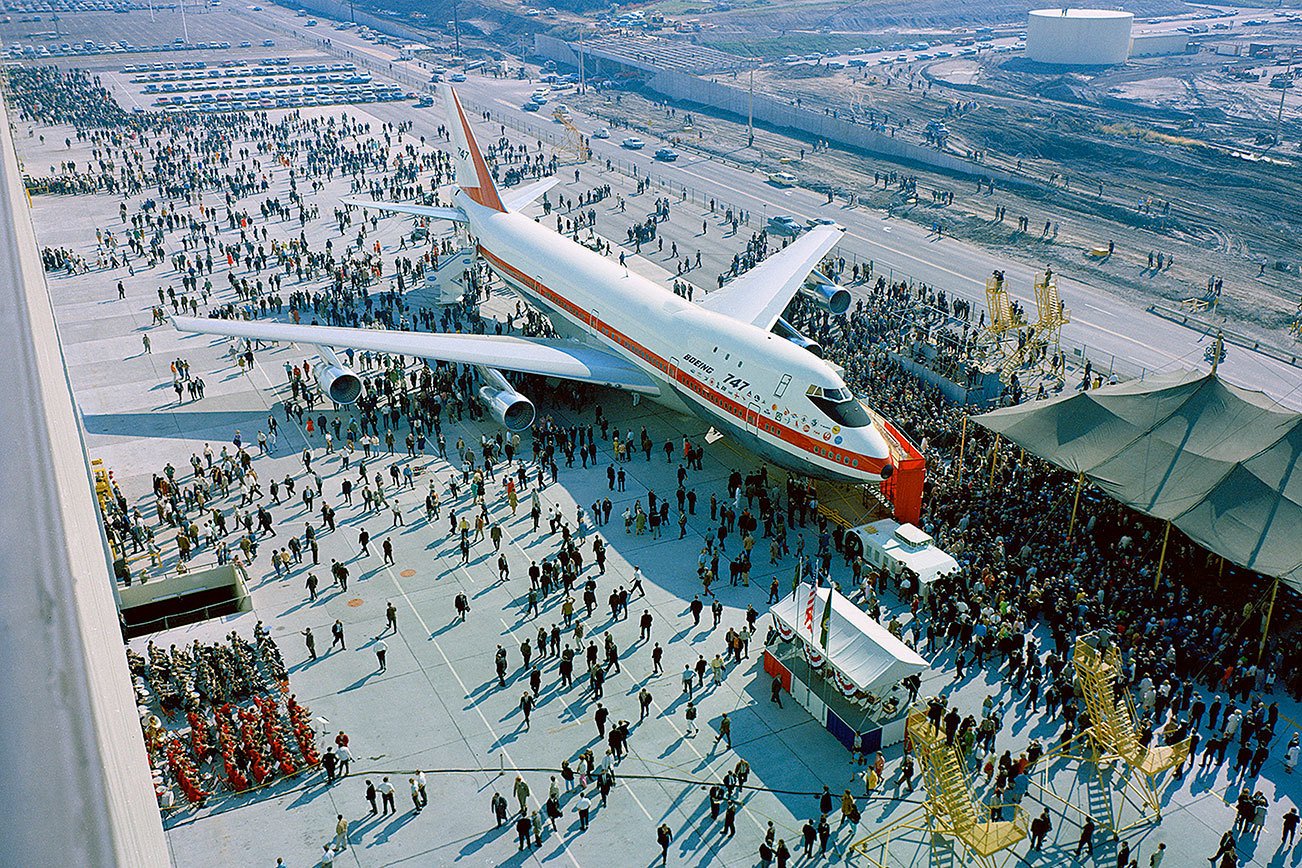
Boeing’s relationship with Everett began when it was making B-17s and B-29s here during World War II, but boomed when it choose Everett in 1966 — with some prompting from then-Everett Herald Publisher Robert Best — to build the world’s largest building by volume to produce the 747.
Even as production of Boeing’s landmark jumbo jet has tailed off, Boeing has renewed that relationship over the years, choosing Everett for final assembly of the all-composite 787, and most recently for wing production and assembly of the next generation of the 777, the 777X.
Boeing, of course, hasn’t done this on its own. It has benefited from publicly financed infrastructure such as inexpensive electricity from Washington’s dams. It has benefited from a transportation system that connected Puget Sound communities and ports and airports that linked it to suppliers and customers. Public secondary and higher education systems provided Boeing with innovative engineers and dedicated machinists.
And, not without controversy, it has benefited from taxpayer-supported tax incentives.
But all those resources have helped secure hundreds of thousands of jobs over the decades, provided tax revenue of their own and encouraged further development of education and infrastructure that made Everett, Snohomish County and Washington state the economic engines they are today.
We helped build Boeing, and Boeing helped build our communities.
That’s how you get to 100.
Talk to us
> Give us your news tips.
> Send us a letter to the editor.
> More Herald contact information.
























