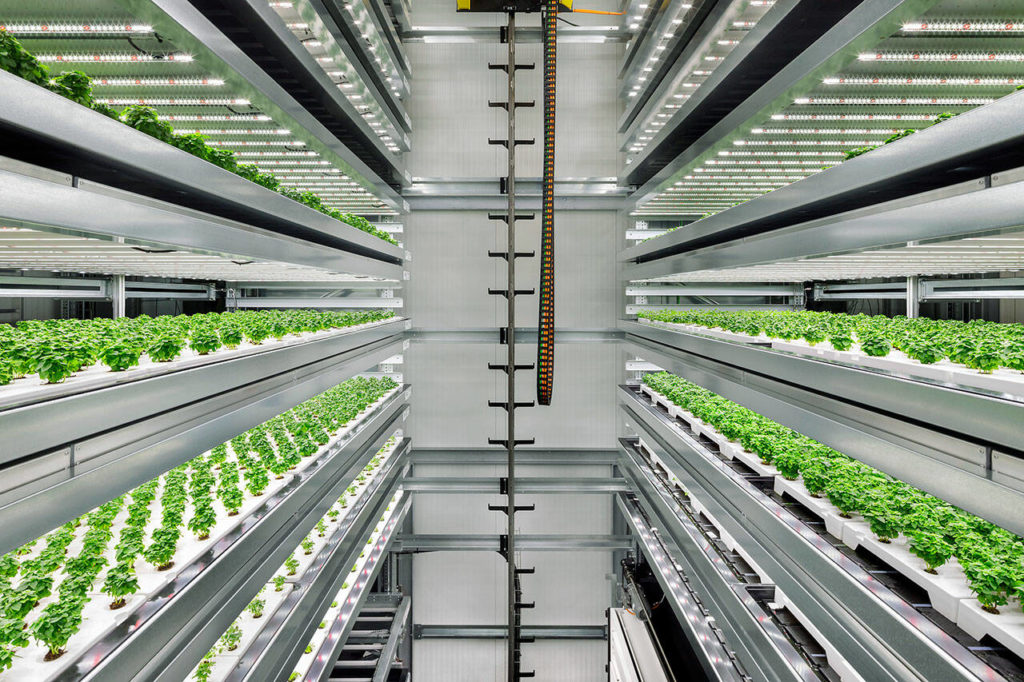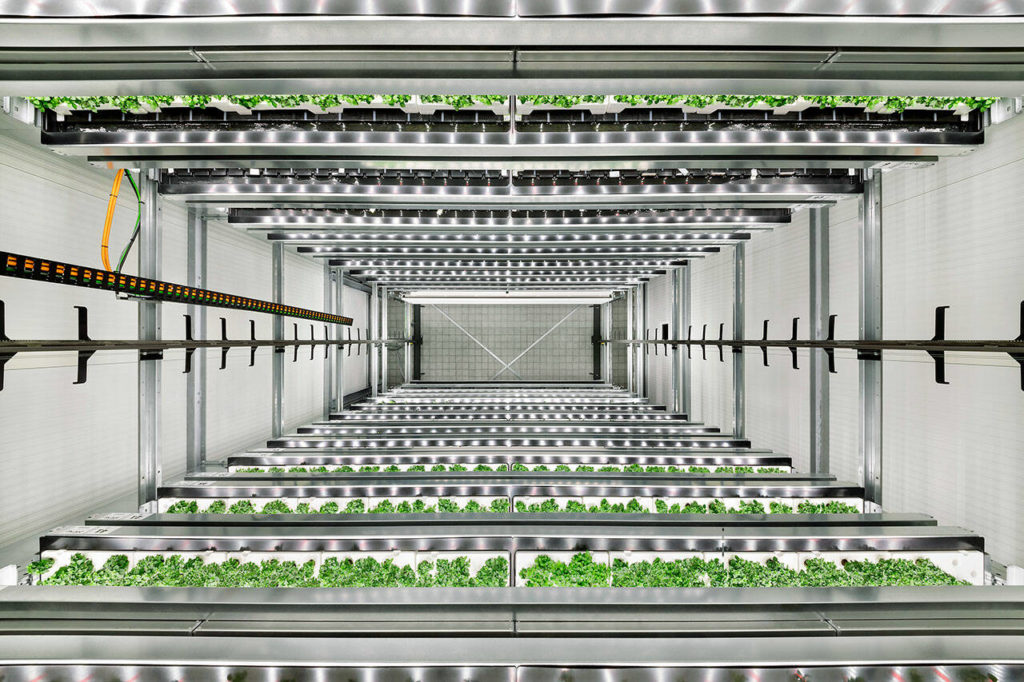
MARYSVILLE — The future of farming is looking up … at the ceiling of a warehouse.
Growing food crops indoors, in tiers under LED lights, is making inroads in Snohomish County.
Vertical farming, also known as controlled environment agriculture, can transform a business park warehouse into a high-tech farm.
Cannabis producers have cultivated indoors and under the lights, illegally and legally, since the 1980s and the advent of hydroponic systems.
Now, those methods are gaining traction as a means to produce food.
At least two companies that employ vertical farming to grow greens have taken space in the county.
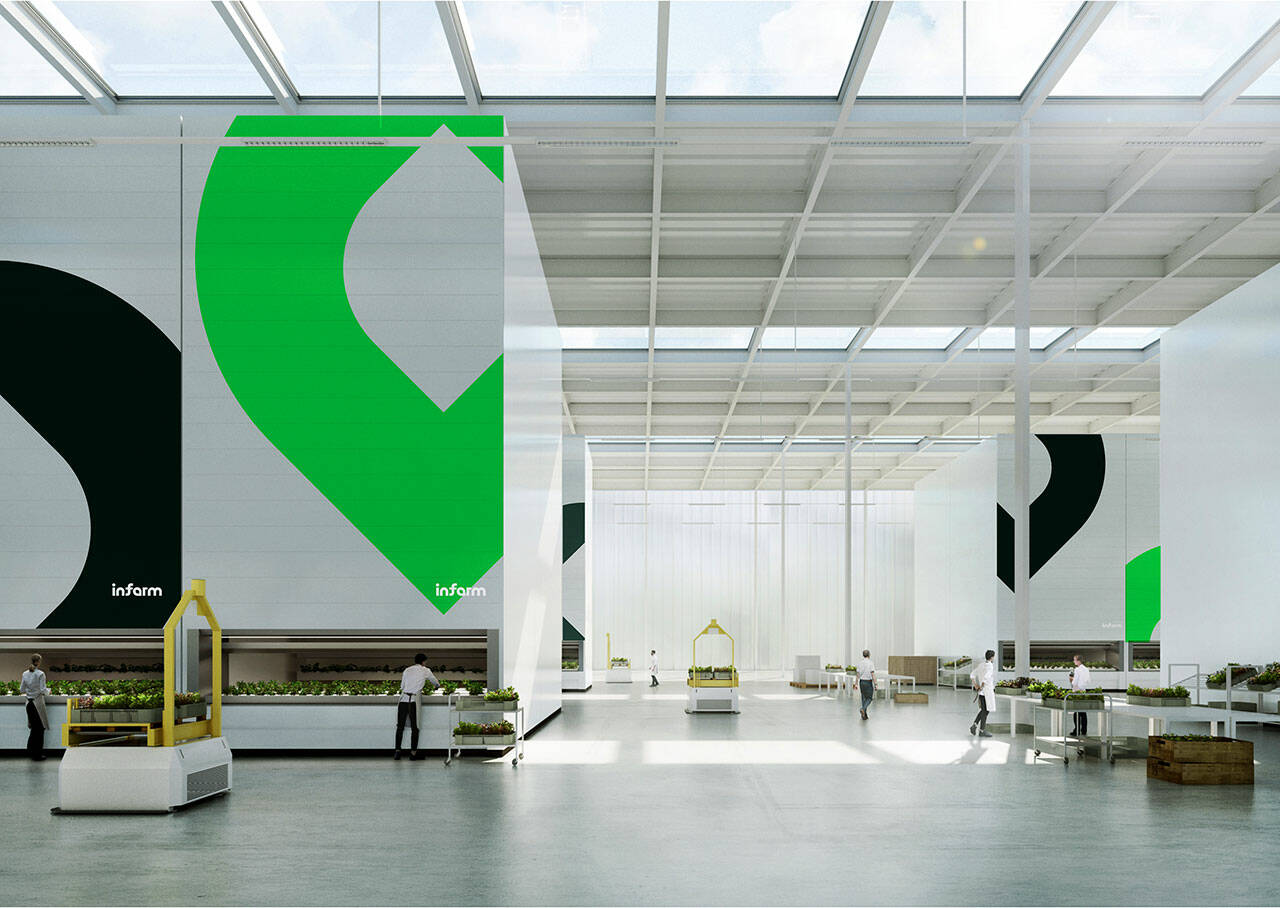
Infarm, a German company, established an indoor growing center at an Everett business park three years ago.
And next year Soli Organic, based in Virginia, plans to open a vertical farm in a warehouse at the Cascade Industrial Center in Marysville.
Both companies produce fresh herbs and salad greens for grocery stores, restaurants and food distributors.
Like a greenhouse, vertical farms can protect plants from field pests and fickle turns of the weather. Unlike a greenhouse, they “can stack many plants on top of each other, allowing farmers to plant more seeds per acre,” according to Eden Green technology, which produces vertical farm equipment.
Infarm employs about 30 people at the Everett location. It mainly supplies QFC and Kroger stores with fresh produce, Infarm spokeswoman Philine von Hardenberg, recently told an online gathering sponsored by Economic Alliance Snohomish County.
Both say their vertical farming methods produce higher yields and use less water and fertilizer than traditional outdoor farms.
Infarm relies on a water-based, hydroponic system to grow its crops. Soli Organic uses a soil-based system to put the bloom on its plants. Both nurture their crops using LED lights.
But how do these indoor, high-tech farms fit into the region’s conventional agricultural community?
Linda Neunzig, Snohomish County’s agriculture coordinator, believes vertical farms fit nicely into the mix.
“They’re an important part of the agricultural sector. They diversify it. If you look at this spring, it was impossible to grow outside,” Neunzig said, referring to the unseasonable cold and wet weather that delayed or quashed the planting season at some local farms.
“Chances are they won’t interfere with traditional farms,” she said.
In fact, Neunzig said, consumers will have more local choices.
“We have a massive number of people moving to Snohomish County, so it’s one more opportunity to buy locally grown produce at the grocery store, especially in the winter months when there aren’t any Farmers Markets,” she said.
Plus, indoor farms aren’t displacing valuable farmland, she noted.
“We’re not placing them on agricultural land, we’re putting them on industrial land,” Neunzig said.
The global indoor farming industry was valued at nearly $80 billion in 2021. By 2026, it is expected to nearly double and reach $156 billion, according to Pitchbook, which gathers investment data.
Everett warehouse
In 2019, Infarm set up shop inside a new warehouse at the Port of Everett’s Riverside Business Park. Its neighbors include an Amazon distribution center and Canteen, a food service company.
Inside, a hydroponic system nurtures fresh herbs and leafy salad greens under the glow of LED lights. said Steve Martin, Infarm’s regional director of operations in North America, wrote in an email.
The 24,000 square-foot facility can grow more than a million pounds of produce a year, Martin said.
There, “we are currently growing herbs and lettuces such as rosemary, Italian basil, Thai basil, dill, flat parsley, green romaine, crystal lettuce, caravel lettuce, cilantro, mint, and chives,” Martin said.
Infarm says its vertical farm is capable of growing more than a half a million plants a year in a space the size of a studio apartment.
Producing the same amount outdoors would require a tract of land the size of a football field, the company said.
Infarm’s watering method, which recycles and recaptures the water that evaporates from the plants, means it takes less than seven ounces of water to irrigate a pound of herbs over its growth cycle, Martin said.
As a result, its farms use 95% less water and 95% less land than conventional farming methods, Martin said.
Infarm did not allow The Daily Herald to visit the facility, but when a door swung open at the growing center, a reporter caught sight of green plants in trays stacked high on white shelves.
Inside its growing centers, plants grow without soil in farming towers that are stacked 30 feet tall or more, von Hardenberg told Economic Alliance.
“We use a nutrient solution that is packed with everything the plant needs,” von Hardenberg said.
Sensors monitor the temperature, carbon dioxide levels, and vitamin levels of plants. With the data, the facility can analyze how each plant responds to the light and nutrients it receives, the company said.
The company’s vertical farms produce more than 70 types of leafy greens, von Hardenberg said. “But eventually, we want to grow the full food and vegetable basket. We’re already piloting mushrooms, strawberries, tomatoes, bell peppers.”
Feeding the future
Across the globe, the food supply chain produces 31% of greenhouse gas emissions, according a United Nations study. Growing products closer to market and the consumer can reduce transportation costs and spoilage that occurs in transit.
Infarm’s methods can reduce the environmental harm that happens when forests and grasslands are cleared for agricultural use — one of the primary drivers of biodiversity loss, von Hardenberg said.
“Scientists estimate in 30 years there will be more than nine billion people on the planet, the majority of whom will live in urban areas,” von Hardenberg said.
With a growing population, some experts forecast that the planet needs to produce more food in the next four decades than humans have harvested in the past 8,000 years.
“Our ambition is not to replace agriculture but add to the solution to make sure there is enough food to feed the world,” von Hardenberg said of the company’s aim.
The Everett facility is Infarm’s first U.S. growing center. This year, the company announced plans to open two new growing centers near Austin, Texas and Baltimore, Maryland.
Infarm wants to establish another five or so growing centers around the U.S. in the next few years.
“We aim to grow the entire fruit and vegetable basket by 2030 and beyond that, produce staple crops such as wheat or rice,” according to a company report.
Despite the industry’s lofty ambitions, vertical farming can have drawbacks.
The biggest challenge? Energy consumption.
“Indoor farms are dependent on LED lighting. Energy costs can run high, threatening profitability, and using fossil-fuel powered electricity can undermine the potential environmental benefits of indoor farming,” Emerging Tech Brew reported.
Soli Organic plans to cut energy costs by programming the lights to flicker imperceptibly, on and off, without affecting plant growth. The move is expected to cut energy costs in half, the company said.
Soil-based vertical farms
In Marysville, Soli Organic plans to spend $30 million to convert most of a 170,000 square-foot warehouse into a 130,00 square-foot vertical farm capable of producing a yearly bounty of five million pounds of organic herbs and leafy greens.
The packaging and distribution portion of the business, occupying about 35,000 square feet, is set to open in August.
The company is closing a distribution center in Duvall it’s operated since the 1990s, said Philip Karp, Soli’s president.
The Duvall facility employed 102 people. Some 90% of those workers plan to relocate to the Marysville facility, Karp said.
The growing operation is expected to open early next year and support 150 “well-paying jobs, in two shifts,” Karp said.
In making the move, the company sold a 180-acre outdoor plot associated with the Duvall location.
The outdoor farm in Duvall was only viable four months out of the year, said Jeremy Schoonover, vice president of operations.
“Eight months out of the year we purchased products outside of Washington state,” Schoonover said.
“When the Marysville facility begins producing, we can go to retailers and say we can grow locally year round,” Schoonover said.
Soli uses soil instead of a water-based or hydroponic system to produce indoor crops.
Using soil and a closed-loop system that makes nitrogen naturally eliminates the need for synthetic fertilizers, meaning the produce can be certified as USDA organic.
“It’s magical what happens in soil,” Karp said. “Soil contains various beneficial bacteria that help deliver nutrients to plants and deliver flavor.”
Like other indoor growing operations, Soli’s indoor technology uses about 95% less water than a conventional, outdoor farm.
“We sub-irrigate — the soil holds the moisture. We don’t do any overhead irrigation. You don’t have to use as much water because the soil will hold the water.”
“It is not a greenhouse,” Schoonover said. “It looks like a warehouse.”
Inside, “You’ll see water and dirt and beautiful green plants,” Karp said.
This facility is expected to yield five million pounds of produce a year. By contrast, one of Soli’s 50-acre tracts in Southern California, produces about one million pounds per year.
“And here you can farm year round,” Karp added.
Vertical farms allow crops to be grown closer to market, which can cut transportation costs and reduce the risk of food-borne illness because “you’re avoiding multiple hands and handling,” Karp said.
“When food is transported from the farm by airline or truck to your processing facility, you can lose about 30% of what was harvested,” Karp said. “It’s enormously wasteful and very costly.”
“Beyond the benefits of the environment, longer shelf life and food safety, we can actually achieve lower costs,” Karp said.
Vertical farms also need less oversight, he said.
“On the conventional side of agriculture you spend a lot of time planting and harvesting,” Karp said. “You have hundreds of people bent over doing that really tough work.”
“When you go vertical, you can automate,” reducing labor needs and generating higher paying jobs, he said.
Soli plans to spend $30 million to install growing equipment, germination chamber insulation and other features at the Marysville warehouse.
“With a growing population, less arable land, this is really the way to go,” Karp said.
Janice Podsada: 425-339-3097; jpodsada@heraldnet.com;
Talk to us
> Give us your news tips.
> Send us a letter to the editor.
> More Herald contact information.
Gallery