
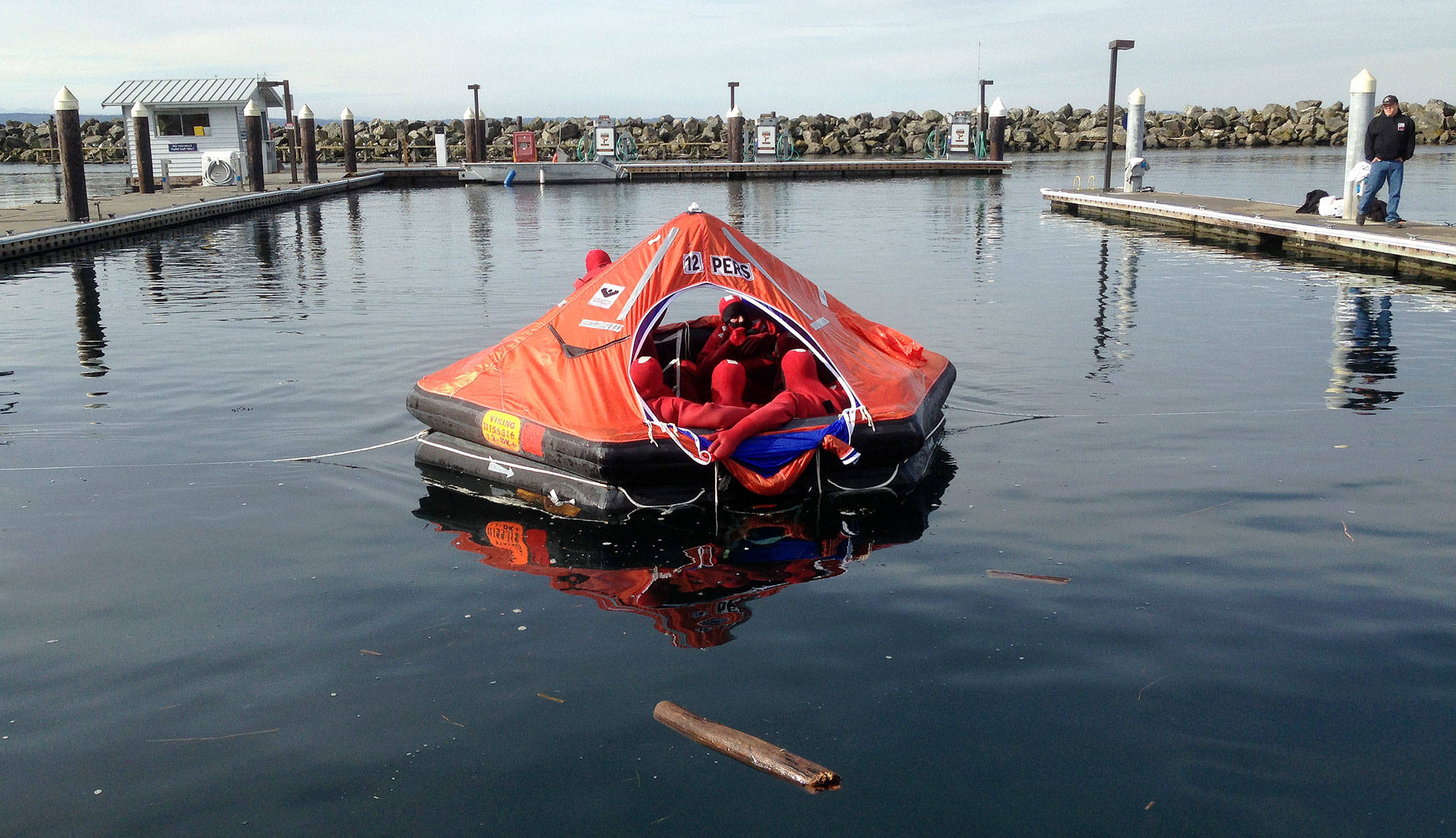
The owner of a private maritime-training school in Edmonds sees a lot of opportunity opening up in the industry for young people.
“What we’re finding in our industry is that we have too many people retiring and not enough young people getting involved,” said Julie Keim, owner of Compass Courses, located in Harbor Square on Dayton Street.
Partly it’s a matter of changing attitudes, she said, of today’s generation wanting instant gratification and not liking to be away for long — the opposite of older generations.
“I think, you know, years ago, guys would get on ships to get away from things,” she said.
It’s also a matter of educating school counselors and students who may be unaware that it’s possible to make a career of a life at sea. Gov. Jay Inslee has made it a priority to research the state’s maritime sector and “start some programs to get young people involved in maritime,” Keim said.
The average age of Washington’s maritime workforce in 2013 was “upwards of 54 years old,” according to a task-force report on the state’s maritime industry.
“As we look ahead to the needs of the industry from shipbuilding to merchant mariners,” states the report, “there will be an increasing need for a skilled workforce even beyond today’s needs.”
The state’s maritime industry is robust and growing an average of 6.4 percent a year and is responsible for 146,000 jobs, including 57,700 directly, with an economic impact of $30 billion, according to the report. The industry contributes to Inslee’s top priority: “to create an economic climate where innovation and entrepreneurship thrive and create good-paying jobs in every corner of our state,” the report says.
At an average union salary of $70,800 a year, compared to an average statewide paycheck of $52,000 across other sectors, maritime workers can earn a middle-class, living wage without a college degree.
“As our state grapples with widening income disparity,” the report says, “the sector offers above average salaries without the necessity for advanced degrees and ongoing education debt.”
A steady stream of licensing requirements for seafarers ensures there will always be a need for schools like Keim’s Compass Courses as well.
“When we started the business it was the wave of something called STCW,” Keim said. “And that stands for Standards Training, Certification and Watchkeeping. That is an umbrella term for a lot of classes. But it was a treaty that the United States signed that said we are going to offer these classes and any mariner all over the world will have those classes.”
Signed by countries around the world in 1978 and revised in 1995, that agreement was the first to establish international standards for seafarers.
Unlike drivers’ licenses, Keim said some maritime licenses can expire in as little as one year and seafarers must take classes to update them.
That’s Compass Courses’ specialty — continuing education for commercial workers in the maritime industry. Its students work on everything from cruise ships to fishing boats, to research vessels, tugboats and more. The school is GI-approved and sometimes attracts people looking to change careers.
“So through the years,” Keim said, “we’ve gotten guys that were laid off at Boeing, that may have had past military experience or fishing experience in their 20s and now they’re in their 50s, to the guy that goes, ‘Yeah, you know, I’m bored being a contractor or a construction worker, I want to go work on a tugboat.’”
Women also work in the maritime industry, though not in high numbers. Only about 10 percent of her students are women, Keim said, but she’s hoping that will change.
Historically the industry has had an image of “the old salty dog,” but attitudes are shifting, she said.
“I think it’s changing because that older generation is leaving or they’re knowing they have to shift their paradigm to allow women on board, and that they’re capable,” she said. “I mean, the conversation that we had in the class 15 years ago about social responsibilities is a different conversation today.”
Keim herself, now 53, grew up in the landlocked state of Idaho before migrating to Alaska and later working on small cruise ships for five years.
She earned her license to pilot a ship before quitting the business and teaching for two years at the Seattle Maritime Academy in Ballard, part of Seattle Central College.
While teaching, Keim recognized the need for another school in the region and, with two partners, started Compass Courses in Edmonds — a logical berth, since she was living in Kingston at the time. (One partner quit after two years and Keim bought the other one out in 2006.)
It was at sea, though, working for the now-defunct Cruise West based in Seattle, that Keim discovered her passion for safety. Her first day onboard, she was handed a clipboard and told to do engine-room rounds, which involved checking gauges and recording their numbers. She wanted to know more.
“Just because it’s supposed to be at 50,” she said, “what does that really mean? But more, you know, about the lifejackets and life rafts and if we had to abandon ship, what would be our issues?”
That need to understand works well in the classroom, where Keim pushes her students to acquire a thorough knowledge of equipment, regulations and survival techniques. Some training takes place offsite at the Port of Edmonds, the Shoreline Pool and in the case of firefighting, at Fremont Maritime Services in Ballard or the Washington State Fire Training Academy in North Bend.
One of the biggest issues in her business is finding qualified instructors, Keim said. She is always accepting applications, but is choosy about who she hires, she said. Instructors include fulltime firefighters and retired merchant mariners and Coast Guard captains.
No one works as hard as Keim at getting students to understand course materials, said Katie Knifong, vessel safety manager for Trident Seafoods, based in Seattle. Knifong worked on Trident Seafoods fishing boats for 25 years before working in safety, she said, and has both taken classes at Compass Courses and sent others there.
“Probably what sets them apart is, they stay up with technology, first of all, and with regulatory changes in the industry,” Knifong said.
Regarding women working in the maritime industry, Knifong said she sees nothing to stop them.
Still, those considering a life at sea need to thrive in close quarters, Keim said. “Let’s say a fishing vessel’s a hundred feet long,” she said. “In a couple weeks it’s 50 feet and then in another week, it’s 20 feet, you know?”
Those who do choose the sea will likely need to take classes at some point at Compass Courses, or a similar school. Compass Courses is one of about 300 private maritime-training schools in the country, Keim said.
Private schools are different from the government-run, four-year academies some aspiring mariners attend, the nearest being the California Maritime Academy in Vallejo, whose students graduate fully licensed, Keim said.
For one thing, academies are able to acquire training tools from the government that for-profit schools must buy themselves.
An example is the lifeboat gravity davit Keim acquired eight years ago, a crane-like device used onboard ships to support, raise and lower lifeboats. Compass Courses is one of only two private schools in the country to own the tool, Keim said, which is needed to teach the Able Seaman course — her most popular class.
It cost her $70,000 and a trip to Brownsville, Texas, she said. There the device was cut off a ship and delivered to her in pieces for $7,000. Shipping cost another $3,000. Then, with the help of Everett Engineering and a naval architect, she put it back together in a barn in Snohomish at a cost of $60,000.
Keim said she initially meant to anchor it in the ground, but when the permitting process grew too daunting, opted for mounting it on a flatbed truck instead. The truck is now parked in a fenced back lot near the railroad tracks in Edmonds, not far from Compass Courses in Harbor Square, and shares space with two lifeboats, one a bright-yellow covered lifeboat that Keim said came from France.
Compass Courses serves 2,000 to 2,700 students annually and is open Mondays through Fridays, with most classes starting at 8 a.m., Keim said. Basic Safety Training, which is the first class offered when Compass Courses opened in April 2001, is the only class where you can find beginners hoping to land a maritime job, she said.
Each of the remaining 25 courses require previous sea time and that’s because the certificates for completing the classes are only good for one year, so wouldn’t do any good for the unemployed , she said. Certificates are turned over to the U.S. Coast Guard to get them added to a merchant-mariner credential.
Cost of the classes varies, but the weeklong Basic Safety Training class is $1,100, which Keim said is comparable to similar schools.
Sometimes companies pay for employees to take classes at Compass Courses, especially if it’s a required class, but if it’s simply to upgrade a license, the student may be on his own. Compass Courses offers some scholarships.
Talk to us
> Give us your news tips.
> Send us a letter to the editor.
> More Herald contact information.
Gallery

























