Trump to impose tariffs on imports of steel and aluminum
Published 1:30 am Thursday, March 1, 2018


Associated Press
WASHINGTON — Ordering combative action on foreign trade, President Donald Trump declared Thursday the U.S. will impose steep tariffs on steel and aluminum imports, escalating tensions with China and other trading partners and raising the prospect of higher prices for American consumers and companies.
With “trade war” talk in the air, stocks closed sharply lower on Wall Street.
Trump said firm action was crucial to protect U.S. industry from unfair competition and to bolster national security. However, his announcement came only after an intense internal White House debate. It brought harsh criticism from some Republicans and roiled financial markets with concerns about economic ramifications.
Overseas, Trump’s words brought a stinging rebuke from the president of the European Commission. Though the president generally focuses on China in his trade complaining, it was the EU’s Jean-Claude Juncker who denounced his plan as “a blatant intervention to protect U.S. domestic industry.”
Juncker said the EU would take retaliatory action if Trump followed through.
Canada, the largest source of steel and aluminum imports in the U.S., said it would “take responsive measures” to defend its trade interests and workers if restrictions were imposed on Canadian steel and aluminum products.
Should restrictions be imposed on Canadian steel and aluminum products, Canada will take responsive measures to defend its trade interests and workers.”
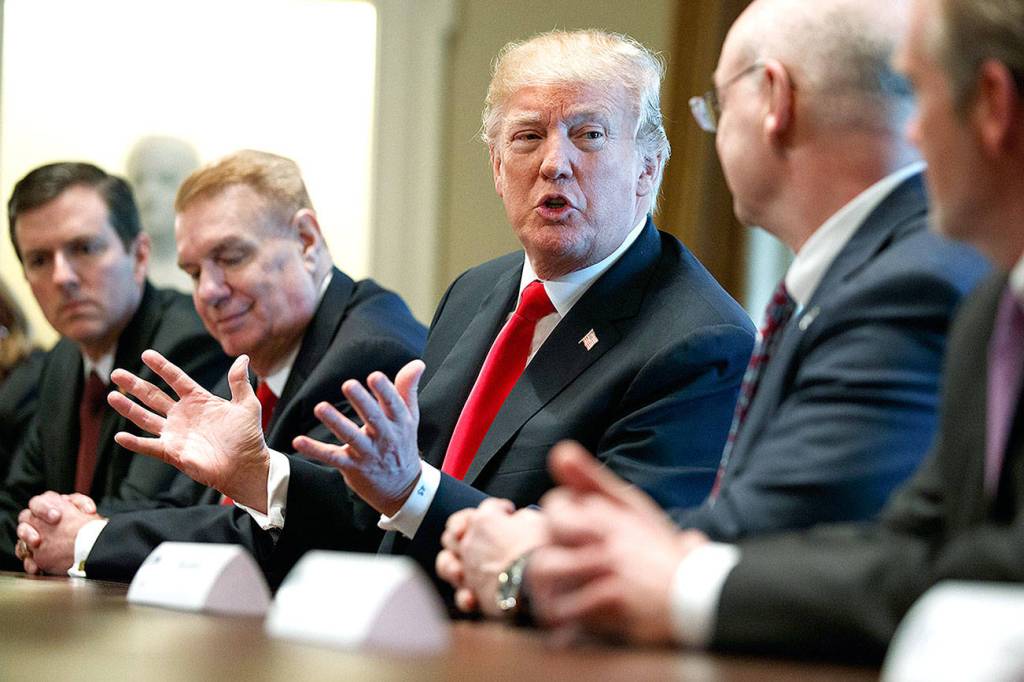
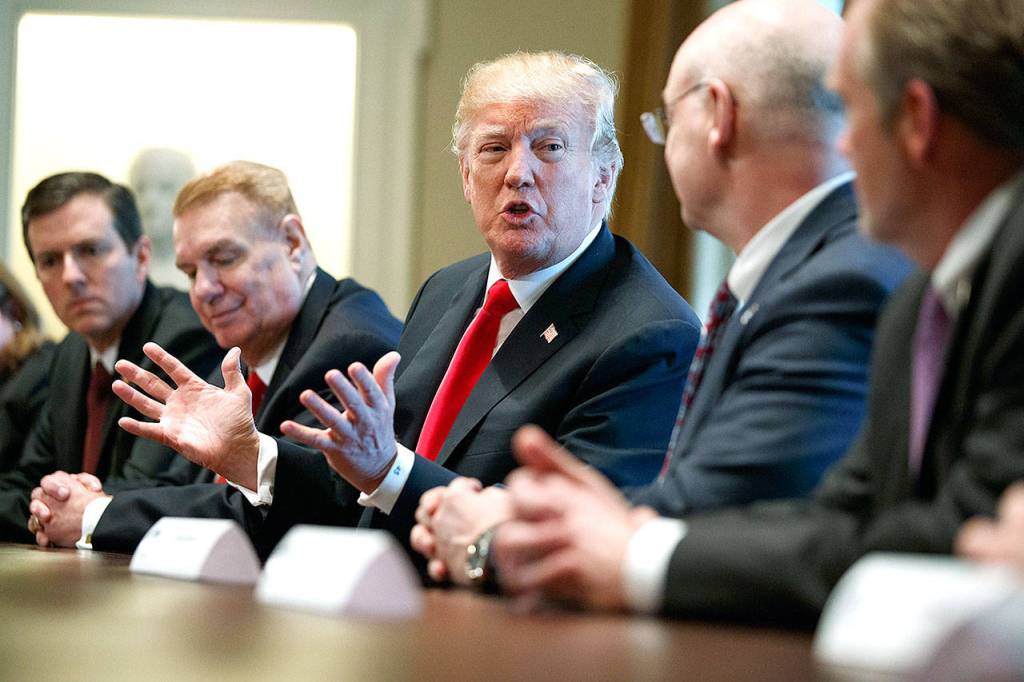
Trump, who has long railed against what he deems unfair trade practices by China and others, summoned steel and aluminum executives to the White House and said next week he would levy penalties of 25 percent on imported steel and 10 percent on aluminum imports. The tariffs, he said, would remain for “a long period of time,” but it was not immediately clear if certain trading partners would be exempt.
“What’s been allowed to go on for decades is disgraceful. It’s disgraceful,” Trump told the executives in the Cabinet Room. “When it comes to a time when our country can’t make aluminum and steel … you almost don’t have much of a country.”
The president added: “You will have protection for the first time in a long while, and you’re going to regrow your industries. That’s all I’m asking. You have to regrow your industries.”
Increased foreign production, especially by China, has driven down prices and hurt U.S. producers, creating a situation the Commerce Department has called a national security threat.
However, critics raised the specter of a trade war, suggesting other countries will retaliate or use national security as a reason to impose trade penalties of their own.
Trump’s move will likely raise steel and aluminum prices here. That’s good for U.S. manufacturers. But it’s bad for companies that use the metals, and it prompted red flags from industries ranging from tool and dye makers to beer distributors to manufacturers of air conditioners. The American International Automobile Dealers Association warned it would drive prices up “substantially.”
“This is going to have fallout on our downstream suppliers, particularly in the automotive, machinery and aircraft sectors,” said Wendy Cutler, a former U.S. trade official who is now vice president of the Asia Society Policy Institute. “What benefits one industry can hurt another. What saves one job can jeopardize another.”
Steel-consuming companies said steel tariffs imposed in 2002 by President George W. Bush ended up wiping out 200,000 U.S. jobs.
The decision had been strenuously debated within the White House, with top officials such as economic adviser Gary Cohn and Defense Secretary Jim Mattis raising concerns.
The penalties were pushed by Commerce Secretary Wilbur Ross and White House trade adviser Peter Navarro, an economist who has favored taking aggressive action.
Mattis, in a memo to Commerce, said U.S. military requirements for steel and aluminum represent about 3 percent of U.S. production and that the department was “concerned about the negative impact on our key allies” of any tariffs. He added that targeted tariffs would be preferable to global quotas or tariffs.
Plans for Trump to make an announcement were thrown into doubt for a time because of the internal divisions. The actual event caught some top White House officials off guard and left aides scrambling for details. Key Senate offices also did not receive advance notice.
White House press secretary Sarah Huckabee Sanders said the decision “shouldn’t come as a surprise to anyone,” noting that the president had been talking about it “for decades.”
But some Republicans in Congress were plainly upset.
“The president is proposing a massive tax increase on American families. Protectionism is weak, not strong,” said Sen. Ben Sasse of Nebraska. “You’d expect a policy this bad from a leftist administration, not a supposedly Republican one.”
GOP Sen. Pat Roberts of Kansas, chairman of the Senate Agriculture Committee, said, “Every time you do this, you get a retaliation and agriculture is the No. 1 target.” House Speaker Paul Ryan, R-Wis., said through a spokesman he hoped Trump would “consider the unintended consequences of this idea and look at other approaches before moving forward.”
Trump met with more than a dozen executives, including representatives from U.S. Steel Corp., Arcelor Mittal, Nucor, JW Aluminum and Century Aluminum. The industry leaders urged Trump to act, saying they had been unfairly hurt by a glut of imports.
“We are not protectionist. We want a level playing field,” said Dave Burritt, president and chief executive officer at U.S. Steel.
Trump last year ordered an investigation into whether aluminum and steel imports posed a threat to national defense. Ross said last month that the imports “threaten to impair our national security,” noting, for example, that only one U.S. company now produces a high-quality aluminum alloy needed for military aircraft.
Under section 232 of the Trade Expansion Act of 1962, the president has the authority to restrict imports and impose unlimited tariffs if a Commerce Department investigation finds a national security threat.
Commerce recommended a number of options. The president’s plan is more stringent than any of them.
It was the latest move by the president to engage in trade actions after campaigning to revitalize the “forgotten” workers of the country. Trump earlier raised duties on Chinese-made washing machines, solar modules and some aluminum and steel products to offset what he said were improper subsidies.