
By Adrian Higgins
The Washington Post
If you garden long enough, your relationship with certain plants changes. You play the role of Tudor monarch, allowing your fawning courtiers to fall in and out of favor. I used to love that dainty, lemon-yellow daisy called the coreopsis but haven’t felt a need to plant it in many years. When I first saw a perennial named brunnera, its spindly blue flowers seemed weedy. I later came to see that the gardener needs to plant it in groups for the floral effect and that moreover, brunnera is best grown as a foliage plant in partial shade, much as you would a hosta. It’s a lovely and valuable plant for the shade garden.
In the 1990s, I was smitten by the daylily, especially when I discovered that breeders could deliver forms that were so far advanced from the ditch-weed tawny daylily (Hemerocallis fulva) or even the insufferably cheerful Stella de Oro, a delicate gold rebloomer that was suddenly everywhere.
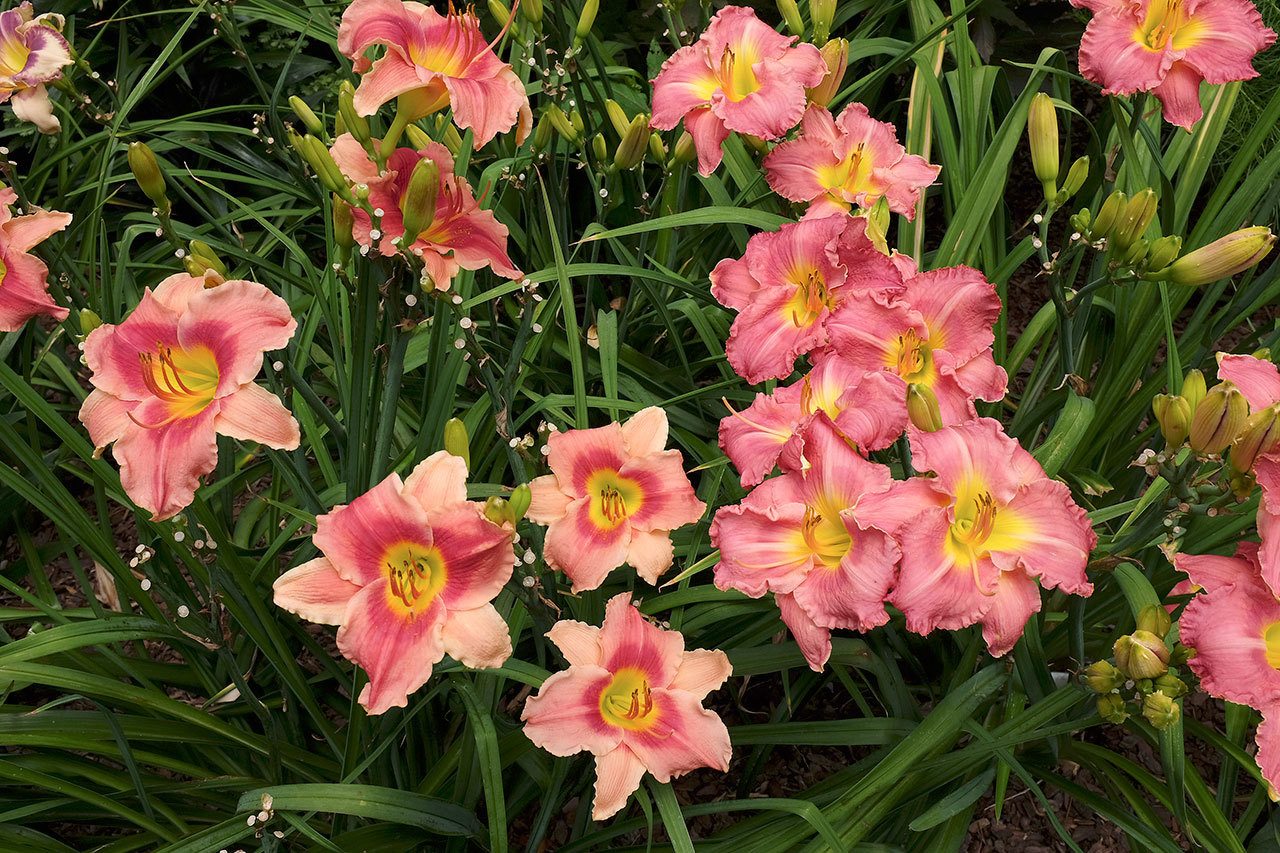
I was struck by varieties with broad, folded-back petals and palpably thick flowers, some with crystalline dustings, which had the substance a summer flower needs to stand up to the season’s solar assault. As for colors, I liked the softer yellows, pinks and oranges, many with contrasting rings, bands and an inner throat of green or yellow.
Eventually, I lost interest for various reasons. As beautiful as the varieties were, the foliage always went downhill quickly after flowering. I planted them en masse, so when they withered, a whole patch of garden turned empty and ugly. In addition, I became more interested in naturalistic planting schemes, and highly bred daylilies can be hard to place. Also, I was drawn in a big way to true lilies, whose towering spikes of trumpets are far from naturalistic, but they do perfume the air in a way that daylilies cannot.
It had been so long since I had planted a new daylily that I sensed that I was denying myself the delight of planting afresh. After a span of 20 years or so, you see a plant with fresh eyes, fresh passions, and the plant itself is bound to change because with daylilies, there’s always a new variety to savor.
There are two enduring realities with daylilies: First, the blooms last only 24 hours or so, but a single plant can produce many flowers over a three-week period, especially if grown in enriched soil and watered well in June. Second, this fertility lends itself to hybridizing by hobbyists and pros alike, and there are a ridiculous number of registered cultivars, more than 52,000 by the last decade. Many are almost identical and prove that you can have too much of a good thing.
Images of daylilies go only so far. The way to assess them is in the garden, so when Gail Gee, owner of a showcase three-acre garden in Fulton, Maryland, asked me to come and look at her daylilies, I needed little persuading.
I have tended to give red flowers in general (other than roses) a wide berth, but one becomes more adventurous with age. I warmed, so to speak, to Gee’s “hot” border where reds, oranges and strong yellows are used in considered combinations.
Instead of my clumsy mass plantings, she has used them effectively as discrete specimens, as clumps of paired varieties twinned by color and, perhaps most effectively, as a dancing thread through a stretch of border.
In the color echo category, she paired Susquehanna Echo, pink with a red eye and edge, with Carolina Cranberry, described as a bright cranberry-wine color with a deeper cranberry halo. Both are full and large, about five inches across, and they contrast and harmonize together at the same time. The beauty of daylilies is that if you have clashing colors, you can move them readily; this is best done in September, dividing time.
In another combo, she paired two solids — the strong yellow-orange Jersey Spider with rose-red Oriental Ruby — and placed them next to a heuchera clump with rose- and green-colored foliage. Most effective.
I’m partial to rich orange flowers and loved Heavenly Dragon Fire, with its elongated petals and sheer size, seven inches or so. One of its parents is a daylily named Primal Scream, which is lower growing and a slightly lighter orange.
I’m not keen on the deep burgundy-reds of some daylilies, preferring the wine-reds of such varieties as Highland Lord and Heavenly United We Stand, a tall and floriferous variety with a contrasting green throat. One of Gee’s loveliest reds is Flamenco Queen, which is full of big blooms held conspicuously above the foliage. An older red variety named Lusty Lealand is still striking in the size and presentation of its upward-looking flowers.
A number of varieties are based on daylily species that present smaller and more spidery flowers on slender, tall and upright stems that are handsome features in themselves. I particularly liked Autumn Minaret, with gentle orange colors to match its delicate blooms. It was one of the last creations of hybridizer Arlow B. Stout (1876-1957), who might be described as the patriarch of the garden daylily in the United States. Autumn Minaret remains a sterling variety. Nestled at its feet is an entirely different daylily, lovely and an unusual blend of orange and brown, named Mokan Bitone. In daylily terminology, a “bitone” means three of the six petals are a different color from the others.
Elsewhere in the garden, Gee has a six-footer named In the Clouds, which is a golden yellow, more muscular in form and color than Autumn Minaret.
Daylilies do best in full sun but will work happily in light shade. By shoehorning them into gaps in garden beds — they look particularly effective around tall grasses — it’s surprising how many of these beauties you can grow and enjoy. Deer regard them as candy, but a new deer fence in the front garden has expanded Gee’s daylily world a great deal. “I’ve got daylilies everywhere,” she said. “I got carried away.”
Talk to us
> Give us your news tips.
> Send us a letter to the editor.
> More Herald contact information.
























