
By Rick Steves / Rick Steves’ Europe
Intriguing Dresden, Germany, winds up on far fewer American itineraries than it deserves to. Don’t make that mistake. Since its horrific firebombing in World War II, the city has transitioned to a thriving cultural center that’s well worth a visit. Even with only a day to spare, Dresden is a doable side trip from bigger attractions like Berlin or Prague.
The burg surprises visitors with fanciful Baroque architecture in a delightful-to-stroll cityscape, a history that mingles tragedy with inspiration and some of Germany’s best museum-going. A generation ago, Dresden was dreary, but today it’s young and vibrant, crawling with proud locals, cheery tourists and happy-go-lucky students who have no memory of communism.
Even so, Dresden’s heritage of destruction is hard to ignore. I’ll never forget standing on Altmarkt square in the Old Town — just another square. Then, looking down at the cobblestones, I saw an inscription that read, “After the air attack on Dresden on February 13-14 1945, the corpses of 6,865 people were burned on this spot.” Carved on a piece of granite above that was a simple statement: “ Thus the horrors of war, unleashed by Germany upon the whole world, came back to be visited upon our city.”
Four eras have shaped Dresden: its golden age in the mid-18th century, the city’s devastation in World War II, the communist regime (1945-1989) and the “reconstruction after reunification.” Each city sight provides a glimpse into this timeline, so I like to weave my sightseeing into a day-long stroll for the most comprehensive and meaningful visit. The highlights are conveniently clustered along the delightful Elbe River promenade, nicknamed the Balcony of Europe.
I start at Theaterplatz, the main square and home to the statue of King John of Saxony, a mid-19th-century ruler who preserved Saxon culture in Germany. The buildings in this square — like many Dresden landmarks — are reconstructed to resemble their pre-bombing facades. At the head of the square, the sprawling Zwinger palace was once the site of lavish royal celebrations hosted by the Wettin dynasty, which ruled Saxony for eight centuries. Today, this Baroque complex is filled with fine museums, including the Old Masters Gallery, featuring works by Raphael, Titian, Rembrandt and more.
Across the street, the Royal Palace, once destroyed, was rebuilt during a years-long project. Here, I visit the Historic Green Vault. Wettin dynasty big shot Augustus the Strong began his Baroque treasury collection here in the early 1700s, and the extravagant trove is clearly designed to wow. The ivory, silver and gold knickknacks are examples of Gesamtkunstwerk — a symphony of artistic creations that take fancy to sometimes ridiculous heights. (Reserve tickets well in advance, as the daily number of visitors is limited to protect the collection.)
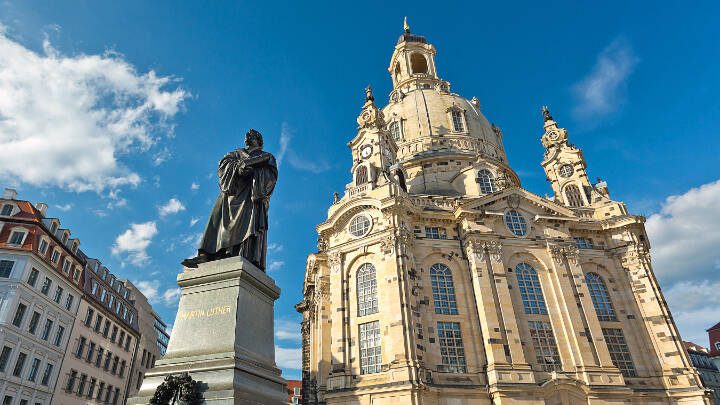
The highlight of my day is a stop at the symbol and soul of the city: the Frauenkirche (Church of our Lady). Destroyed in the firebombing, the Frauenkirche was left a pile of rubble and turned into a peace monument after World War II. Only after Germany’s 1990 reunification was the decision made to rebuild it completely and painstakingly. Over a decade and €100 million later, it reopened in 2005. Inside, the circular nave is bright, welcoming and poignant. It features a twisted old cross, once the bright golden cross atop the original church, that fell 300 feet into the bombed-out wreckage. Lost until uncovered from the debris in 1993, it stands on the place where it was found — still relatively intact. The persistence of this cross symbolizes the themes of the church: rebirth, faith and resolution.
The Frauenkirche towers over Neumarkt, a once-central square ringed by rich merchants’ homes. The districts that surround Neumarkt have been rebuilt with their facades resembling the originals, and the area is once again alive with bustling cafés. A statue of Martin Luther — holding the Bible he translated from the Latin of the elites to the German of the commoners — reminds passers-by of the Reformation that began in nearby Wittenberg.
A short walk toward the water leads me to the end of the Balcony of Europe, where the Albertinum art museum boasts a fine collection of works by Gauguin, Monet, Picasso, Rodin, and other Romantic and contemporary masters.
Dresden’s intense history and remarkable museums can be demanding. To unwind after my walking tour, I head over to the New Town (Neustadt), across the river. The bombs missed most of this area, so it retains its well-worn, prewar character. With virtually no sights, the area is a lively people zone that’s best after dark, when the bohemian-chic Outer New Town sets the tempo for Dresden’s trendy nightlife.
Today, Dresden is rebuilt, full of life and wide-open for visitors. While these streets paint a portrait of the city’s highest highs and lowest lows, in this era of cultural rebirth, Dresden is in its prime.
Edmonds resident Rick Steves (www.ricksteves.com) writes European guidebooks, hosts travel shows on public TV and radio, and organizes European tours. This column revisits some of Rick’s favorite places over the past two decades. You can email Rick at rick@ricksteves.com and follow his blog on Facebook.
Talk to us
> Give us your news tips.
> Send us a letter to the editor.
> More Herald contact information.
























