Needle phobics want COVID vaccines, but injection terrifies them
Published 1:30 am Wednesday, September 8, 2021


By Elise Young / Bloomberg News
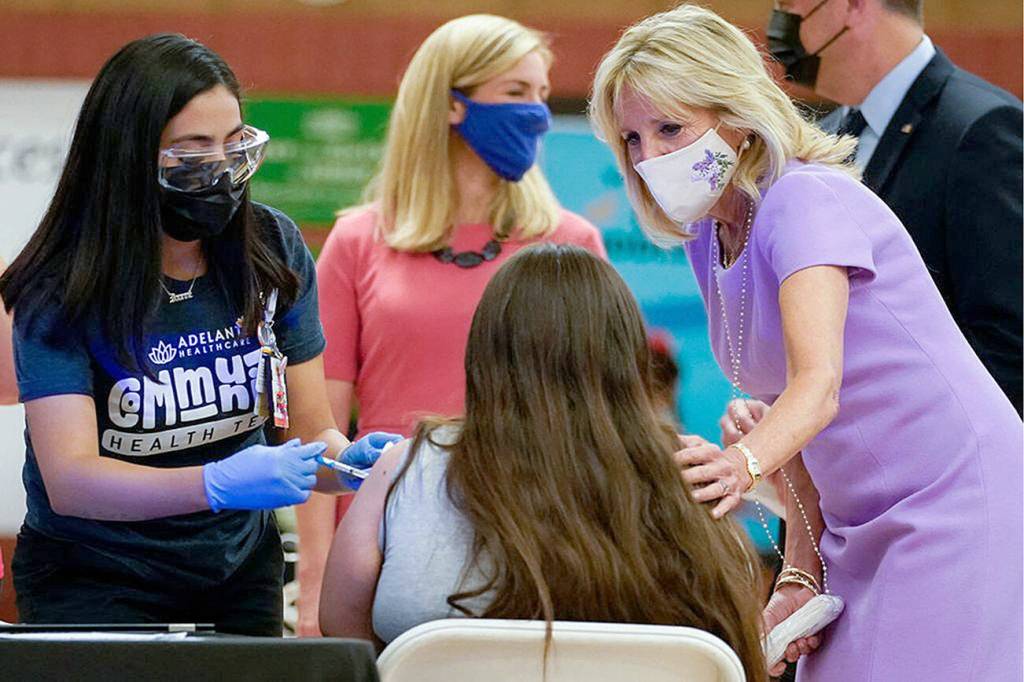
They trust the vaccine. They want the vaccine. But millions of U.S. residents who pass out or beat feet at the sight of a hypodermic needle are risking COVID rather than getting a shot in the arm.
Even while most coronavirus deaths are among the unvaccinated — and other Americans prepare for booster shots — the phobics are digging in. They’re often first to say that their deepest dread makes no sense: Shots are brief and usually minimally painful, after all. But traumatic memories trump COVID maybes.
“Irrational is the perfect word for it,” said Jocie Konoske, 29, a homemaker from Portland, Oregon, with a childhood dental drama that has led her to resist blood tests, booster shots, flu vaccines — and now, the COVID vaccine. “If I could do it, believe me, I would have done it as soon as it came out.”
More than eight months after COVID shots won emergency approval, roughly 100 million eligible Americans remain unvaccinated. Holdouts often cite medical conditions, side effects, allergic reactions, fertility, skepticism of the virus’s danger or conspiracy theories.
It’s impossible to say how many among them are ducking because of flat-out needle fright. But as many as 66 million Americans may suffer from needle fear so severe that they threaten to delay herd immunity, according to research posted in April by the National Institutes of Health. A University of Oxford, England, study in June found that 10% of U.K. citizens declining COVID shots may have the phobia. In India, a 2014 study concluded that as much as 4% of that country’s population had the disorder.
The U.S. bible of mental disorders recognizes needle phobia as a condition that interferes with daily life. Even the oral sedatives Valium, Ativan and Xanax can fail to quell injection terror, according to Rick Novak, an anesthesiologist in Palo Alto, California.
Many sufferers say childhood vaccinations caused pain, or they witnessed a bad experience. Some have an inherited predisposition to vasovagal syncope, an anxiety-driven drop in heart rate and blood pressure that leads to fainting.
“I literally fight — I’m a 5-foot, 4-inch woman, and you can’t believe how strong I get,” said Eylem Alper, 46, a project manager from Boston who hasn’t had a needle of any kind since childhood, when her struggling led to restraint by a half-dozen adults. “Of course I don’t want to get sick, but phobias do not have any kind of logic.”
Alper said she would take a COVID-19 nasal-spray vaccine, which immunologists suspect could offer better protection than shots, because they’re introduced via mucous membranes like the virus. But those remain under development.
Childhood immunizations have lifesaving power, preventing as many as 3 million deaths a year globally, according to the World Health Organization. In the U.S., those who have suffered rare cases of harm after shots can turn to the National Vaccine Injury Compensation Program.
But injury potential isn’t the core issue for those with injection fear, called blood-needle-injury phobia in the “Diagnostic and Statistical Manual of Mental Disorders,” a standard U.S. reference. It defines the anxiety as “out of proportion to the actual danger” and causing “clinically significant distress or impairment” in daily life.
Sometimes, the anxiety creeps beyond needles. “It sets up a cycle where anything medical is terrifying, and they avoid doctors,” said Robert Chernoff, a psychologist at Cedars-Sinai Medical Center in Los Angeles. “Your brain says: Danger! You feel it not only emotionally, but physically.”
Some who finally set aside their fear said they were inspired by Rachel Maddow, the MSNBC host who during an April broadcast talked about how she had done so herself.
Most Americans are going along with the shots, with 62% having received at least one dose as of Sept. 2, according to Bloomberg’s Vaccine Tracker. In a CBS News appearance Aug. 1, the nation’s top infectious-disease expert, Anthony Fauci, said the 100 million people resisting are “propagating this outbreak.”
At the same time, about 35% of unvaccinated Americans say they probably won’t get the shots, and 45% definitely won’t, according to an Associated Press/NORC Center for Public Affairs Research poll in July.
Hilary White, 73, a sign-language teacher from Corvallis, Oregon, was traumatized by unnecessary, repeated childhood vaccinations — her mother’s reaction to losing siblings of her own to infectious disease.
As COVID swept the country, White booked her shots in an uncrowded setting with a friend for support. The plan worked for both Moderna doses, but news coverage about the recommended booster is eroding her willingness for a third.
“On TV, they use words like ‘jabbing the needle,’ and it really distresses me,” White said. “Then I see someone getting a shot, and my whole body just feels weak.”
Novak, the anesthesiologist, said via email that for those giving shots to phobics, “the most likely successful alternative is to be honest and kind, i.e. explaining that the injection will last only one second, and that nothing adverse will happen.”
“Distraction is helpful — either a loved one making eye contact and holding their hand, or a video screen or video game played at the same time,” Novak said.
Longer term, therapists teach applied tension, a series of 15-second blood pressure-raising muscle drills that ward off fainting, according to Katherine Dahlsgaard, a Philadelphia psychologist.
“I’m coaching: ‘Tense, tense, tense! Squeeze, squeeze, squeeze! Now, go back to neutral!’” Dahlsgaard said. “What I want to say to people afraid of the COVID vaccine is: You can try to do this on your own.”
Those who have summoned that courage say getting vaccinated for COVID was among their proudest moments.
For Desiree Shannon, 60, a retired attorney from Columbus, Ohio, the anxiety started a half-century ago, with a flu shot that left her, she said, “unable to sit for a week.” Still, she signed up for a COVID injection at an urgent-care clinic — only to walk out. On the next try, a friend came to comfort her, and after an hour of negotiations with a nurse, she said, she agreed to the suggestion of a surprise stick.
“They got me on a tangent, and she snuck up on me and got me,” Shannon said. “The only way I could tell, there was a burning sensation in my arm. The second time, I went alone. I was still scared.”
She got it anyway.