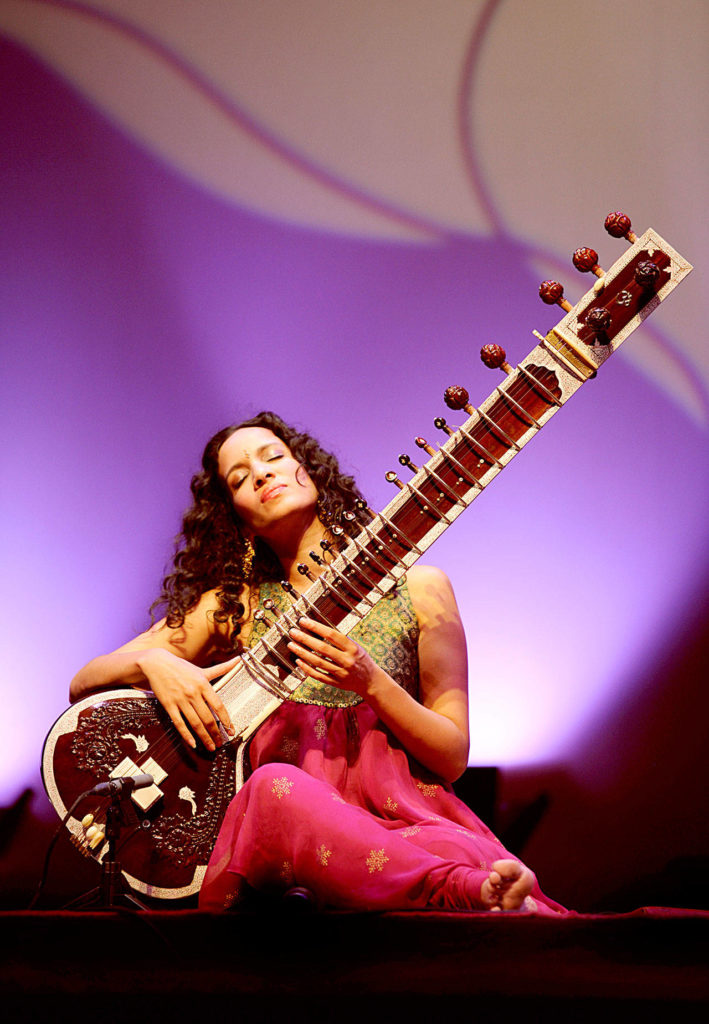
What is it like to experience what can only be described as musical magic?
For Anoushka Shankar, one of those moments occurred in Portugal in 2014 at the Boom Festival.
“There I was, playing at this stage that I had loved as an audience member,” she said. “I felt received and loved. I was newly pregnant with my second child, something I wasn’t sharing yet. I felt completely in love with life. It was very magical.”
Shankar, the internationally renowned player of the sitar, said to be one of the most difficult instruments to master, will perform at a sold-out performance April 24 at Edmonds Center for the Arts. (A few tickets sometimes are turned in on the day of the performance. Call the box office at 425-275-9595 for information.)
The sitar has 19 strings and two bridges. Six of its strings are on the main playing bridge, with 13 strings underneath the main strings and frets. “That gives the cascading sound people recognize and it gives a very unusual, otherworldly resonance,” Shankar said.
Her stop in Edmonds — the first time she has performed at the arts center — is part of a tour of the United States and Canada that began in early March and continues through May 5.
Shankar’s latest album, “Reflections,” released last month, is a compilation of her two decades of recording. It includes collaborations with a number of other artists, including Norah Jones, the jazz singer, pianist and songwriter, who is her half-sister.
The two musicians play in such different styles that Shankar said she was almost fighting off collaboration for years.
“To be honest, it probably occurred to other people before it occurred to us,” she said. In this newest album, the two perform together on “The Sun Won’t Set.”
On her current tour, she performs a mix of both new songs and those released on earlier albums.
Shankar, 37, who lives in London, has been nominated for six Grammy Awards. She began taking lessons when she was 9 years old from her father, the sitar master Ravi Shankar, famous for his performance at the 1967 Monterey Pop Festival.
Although there was “a natural accessibility and curiosity” about the sitar as a child, she said she also was very drawn to the piano.
“In a lot of ways, that was my first love,” she said. It wasn’t until she was about 15 years old, learning both instruments in tandem, that she slowly moved toward solo pursuit of the sitar.
Despite the worldwide acclaim for her music, she said she doesn’t believe one ever truly masters an instrument.
“There’s always something more you can do or move toward or a new form of expression,” she said. “I think it’s about staying open to growth, and being curious and humble and hopefully you keep on growing.”
Her teacher was also her father. “He was exacting,” she said. “He was a real perfectionist. He had a very clear vision he wanted to share. It came from his passion for the music.”
She said she shared his passion and enthusiasm for music when she was very young but also recognized his high expectations and standards. “It could be intimidating,” she said.
But over the years, their relationship grew beyond father and teacher to also include one of collaboration. “I grew very close to him” before his death in 2012, she said.
“Musically I feel like I’m still curious,” she said in a telephone interview. “There are things I haven’t done and want to learn through. But I’m also happy and settled in a way.
“I like the career that I have, how it fits in my life in relation to balancing raising my two boys and living a home life.”
Sharon Salyer: 425-339-3486 or salyer@heraldnet.com.
Talk to us
> Give us your news tips.
> Send us a letter to the editor.
> More Herald contact information.
Gallery