
Friday marks the 38th anniversary of the 1980 Mount St. Helens eruption.
The blast, the most powerful volcanic eruption in U.S. history, swept a superheated flow of pulverized rock, lava and debris over hundreds of square miles and spewed ash over 11 states.
Fifty-seven people died.
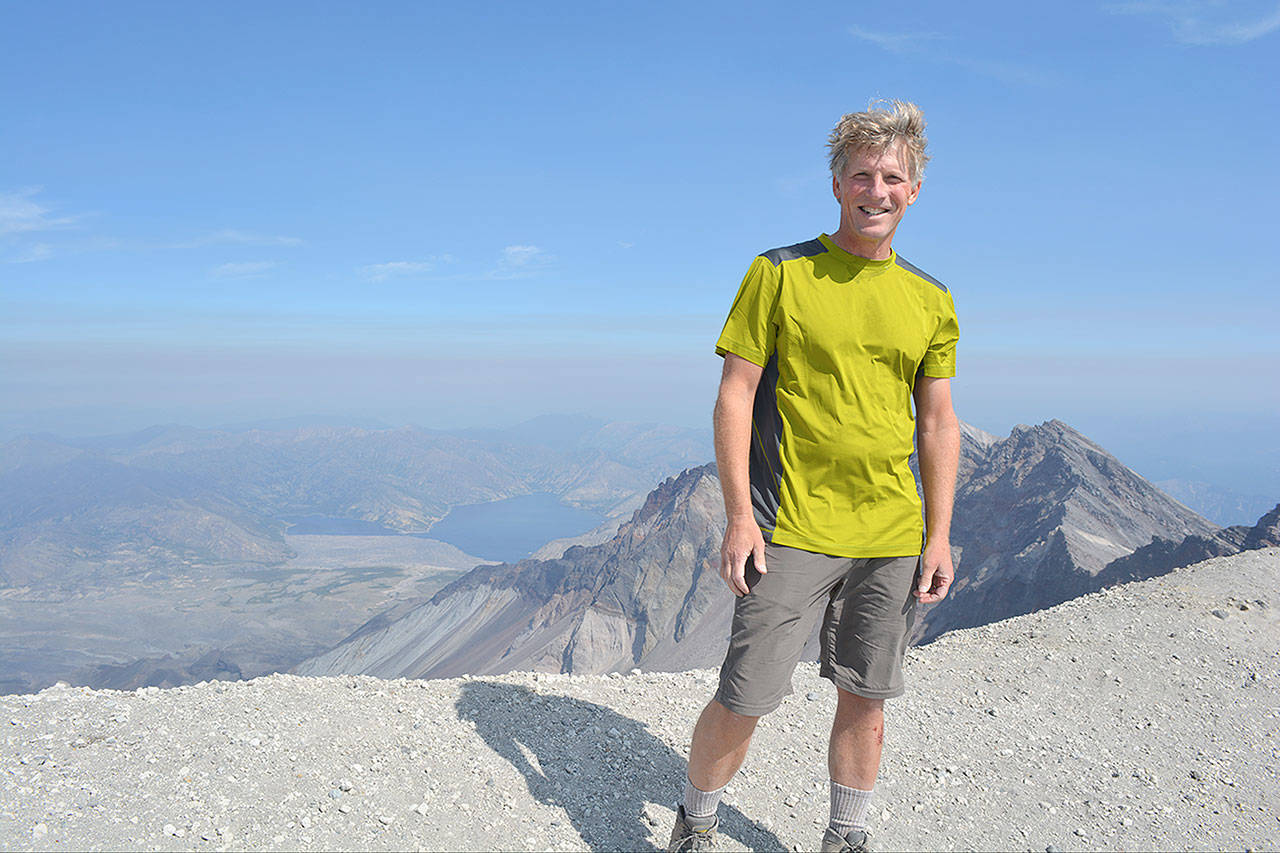
Steve Olson’s 2016 book, “Eruption: The Untold Story of Mount St. Helens,” depicts the buildup to the eruption and personal tales of survival and death. It also addresses whether anything could have reduced the death toll.
The 61-year-old Seattle resident is doing a free book talk at 2 p.m. May 19 at the Everett Public Library Auditorium.
What were your goals for the book?
I wanted to write about more than just the eruption. I wanted to write about why the 57 people killed by the eruption were so close to such an obviously dangerous volcano. Only three of them were in the (government-designated) danger zone. Was the danger zone too small, or was the eruption that much bigger than anticipated? I wanted to answer those questions.

Mount St. Helens sends a plume of ash, smoke and debris skyward in a massive eruption May 18, 1980. (Jack Smith / Associated Press)
What was challenging about writing it?
Nothing — I loved it. It was an excuse to hang out in southwestern Washington for a few years and talk with people, preferably over a couple of beers, about an event they remembered vividly. And it turned out to be an even better story than I thought it would be.
What sources of information did you rely on?
My job was to read everything I possibly could about Mount St. Helens and to talk with as many people as possible. I wanted this to be the complete story, so that people would finish the book and know everything they needed and wanted to know.
How did you piece together the events leading up to the eruption?
Local libraries — especially the wonderful library in Longview — were critical for my research. They contained the written stories I needed to write the book. And they were places where I could meet and talk with people on their turf.
What scientific importance did Mount St. Helens have?
In 1980, geologists knew relatively little about Mount St. Helens and the other volcanoes in the Cascade Range. The last eruption of a Cascades volcano had been way back in 1917 at Lassen Peak in an isolated part of Northern California. The 1980 eruption of Mount St. Helens taught volcanologists a tremendous amount about the Cascades volcanoes and about similar volcanoes around the world, and that knowledge has saved lives many times since then. It’s also helping geologists and emergency planners prepare for the next eruption of a volcano in the Northwest.
Did anyone put themselves at risk to study it?
David Johnston was one of a handful of volcanologists studying Mount St. Helens before the eruption. He was drawing parallels with other lateral explosions of volcanoes. He knew it was dangerous to be at the Coldwater II observation post five miles north of Mount St. Helens. But he decided that monitoring the volcano was part of his job. And he enjoyed getting close to the grandeur of volcanoes — as do many of us. He was killed by a lateral blast, a landslide of hot gas and ash that erupted from the side of the mountain. The observation post was renamed in his honor.
How did you reconstruct personal accounts of those who were killed?
Many of the survivors of the eruption have told their stories, so part of my job was listening to them and figuring out what those stories meant for the people who were killed. Also, a lot was learned from the autopsies, from where the bodies were found, and from people who knew the victims.
Could their deaths have been avoided?
The people who were killed were tremendously unlucky. Many did not know they were in danger, but they were. Yet the eruption occurred at a time — Sunday morning — when fewer people were around the mountain than at almost any time before or after. If the eruption had occurred 24 hours later, hundreds of Weyerhaeuser loggers would have been killed. At its closest, the danger zone was less than 3.5 miles away from the peak of the volcano, which was way too close to such a dangerous volcano. But, the eruption was also much larger than geologists could have anticipated at the time, so not all of the 54 deaths outside the danger zone were avoidable.
Who was Harry R. Truman?
Harry R. Truman was the owner and caretaker of Mount St. Helens Lodge at Spirit Lake, located at the foot of the mountain. He refused to leave despite warnings about the volcano. He said, “If the mountain goes, I’m going with it.” He had lost his wife four years before, he was 83 years old and he had no place else he wanted to go. He was the only person in the danger zone who did not have permission to be there, and that caused great difficulty for law enforcement. But, I figure that he died the way he wanted to die.
Did any of the survivors have amazing stories?
There were so many harrowing rescues and escapes that I couldn’t write about all of them. But, I tried to choose representative stories, so that readers would get a sense of what it was like to be in different places around the mountain that day.
How much damage did the eruption cause to the area?
The devastation has to be seen to be believed. More than 200 square miles of forestland were devastated. That’s more than the largest nuclear weapon in the U.S. arsenal can destroy. I know that from the book I’m writing now (about plutonium production at Hanford).
Were there any important discoveries or lessons learned?
There were many. After the eruption, the federal government established the Cascades Volcano Observatory in Vancouver, and it has produced an unprecedented wealth of scientific information about not only Mount St. Helens, but all of our Cascades volcanoes. We live in a hazardous part of the United States. But it’s so beautiful. It’s worth it.
Evan Thompson: 360-544-2999; ethompson@heraldnet.com.
Talk to us
> Give us your news tips.
> Send us a letter to the editor.
> More Herald contact information.
























